Among the elements, in the abyss of creation. Where we suffer and where we will dwell forever. Hell has neither place nor limits: Where we are, there is hell; where hell is, we must be. At the end of time, following the ruin of the world, Every creature shall be purified—mortal and divine— And hell will be everywhere, save in heaven.
Navigation
1. Concept
2. The Birth of Christ
3. Creation of the World
4. Wonderful World?…
5. The Last Judgment
6. Conclusion
7. Bibliography
Concept
Medieval art remains particularly fascinating even in the contemporary era because the cultural landscape of people from that time was saturated with various religious, mystical, and alchemical symbols. This is due to the profound religiosity of that society and its belief in the supernatural, which governed their entire existence—not only in the human world but also in the afterlife—and determined what was moral and what was not. Concepts of good and evil have always shifted depending on the epoch; what was terrifying in the past can be perceived as completely mundane today.
This paper investigates the creative works of Hieronymus Bosch, specifically examining the symbols he employed, accessible to him in his time, to depict hell, sin, and evil. His works were chosen because they reveal the full diversity of the visual language of that era, as well as the ingrained beliefs of the people—a particularly fascinating aspect given that Bosch belonged to the Brotherhood of the Virgin Mary and was immersed in a worldview of this nature like no other. Even his relatively close descendants noted that: «Bosch could render well… what is concealed in the depths of hell» (Dominic Lampsonie).
The Birth of Christ
I. Bosch — Adoration of the Magi — c. 1485–1500
This subject was depicted by many artists of the time, if not all. However, the uniqueness of this triptych lies in its details.
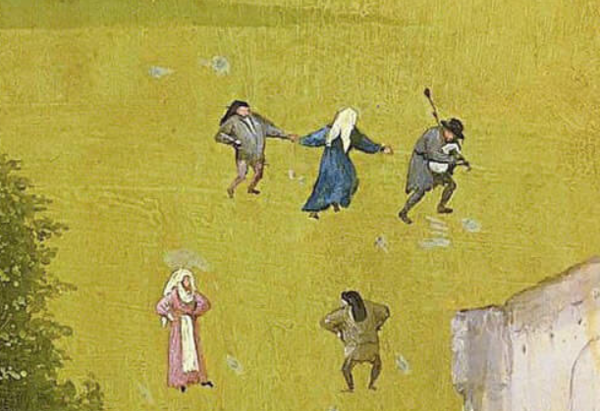
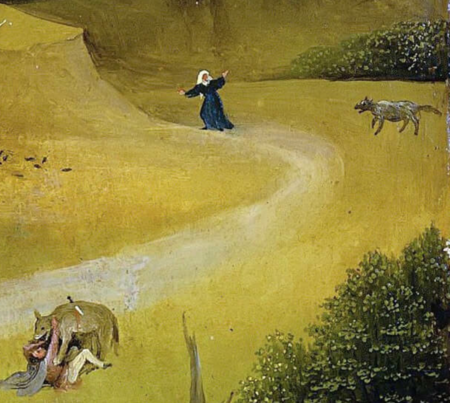
In the background, we can observe quite everyday situations of the peasants of that time—dancing and revelry, wolf attacks. Bosch immediately presents the real world, not something more idealized.
A man is drying sheets near a campfire, and a short distance away is a dark entrance to some space featuring a frog image above it. The frog symbolizes the devil and his repugnance. This indicates that evil already has a source.
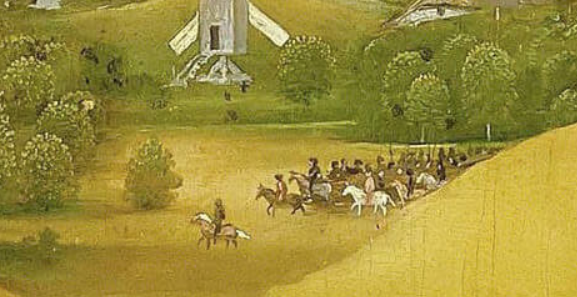
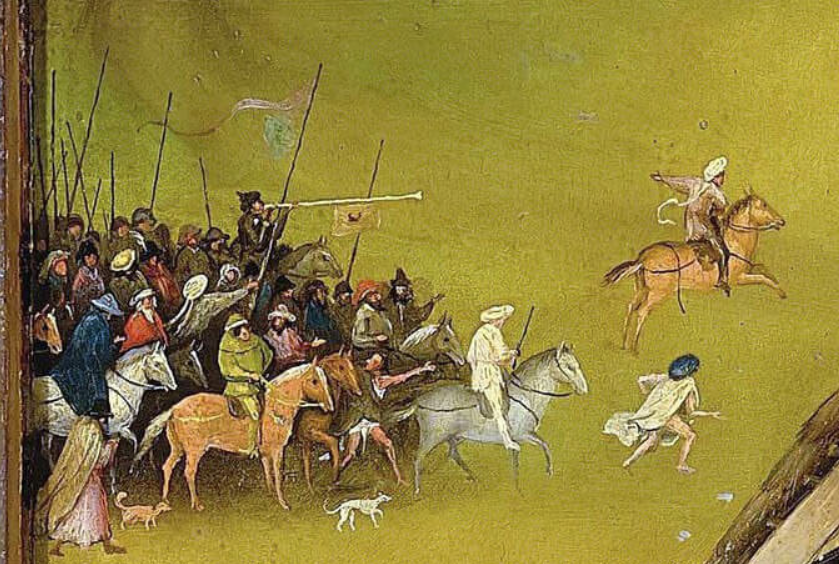
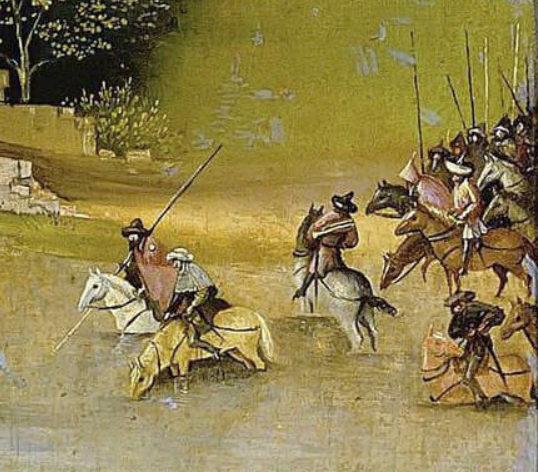
In the middle ground, battles are taking place, and only a limited number of people have noticed that their Savior has been born into the light. This symbolizes humanity’s indifference to all that is righteous—their absorption in worldly passions.
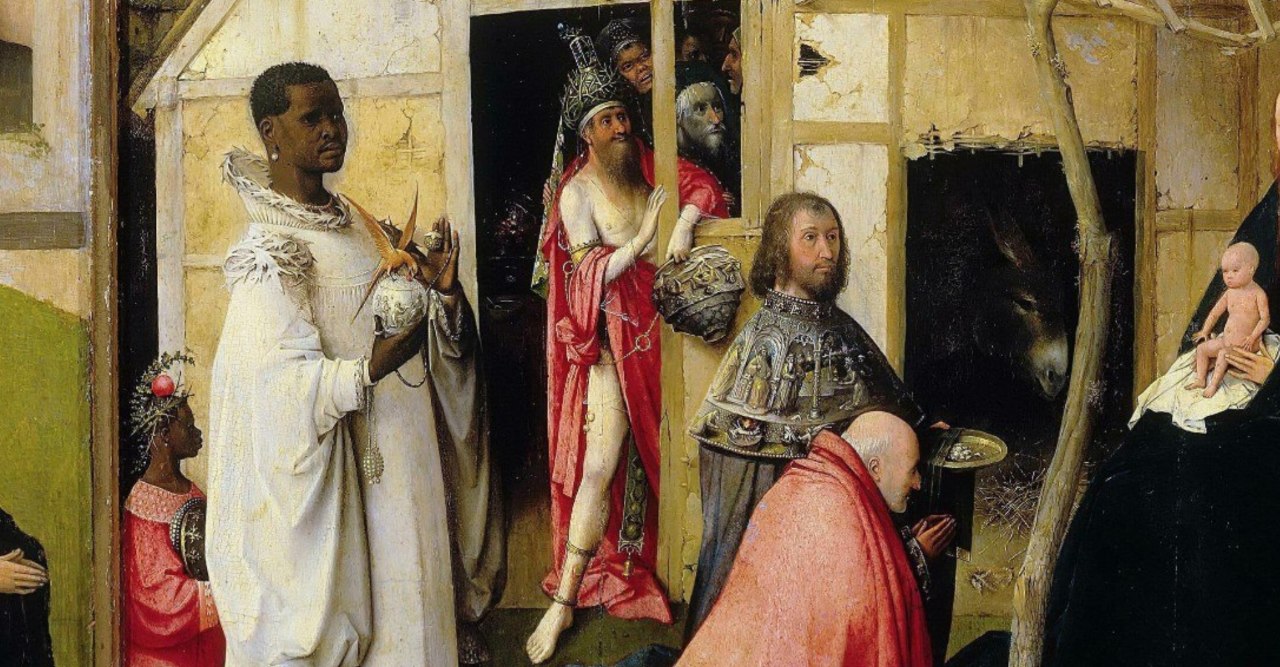
And most importantly—in close proximity to the newborn Jesus stands a strange man in red, emerging from the darkness, looking at everything unfolding with an ambiguous smile, while his «friends» watch with undisguised malice. He is semi-nude, and his crown seems to mock Christ’s future crown of thorns, while a sore on his leg symbolizes sickness.
There are suggestions that he is either Herod, the Antichrist, or an embodiment of the pagan past of the Magi, given that he holds the helmet of one of them. However, his demonic nature is evident—the frog symbol appears on his belt and on the helmet in his hands.
Bosch shows that evil is always near, walking hand-in-hand with light.
Hieronymus Bosch — The Garden of Earthly Delights — c. 1490–1510
Creation of the World
One can see various amphibians and frogs emerging from the water onto the land—evil is infiltrating the world.
Moreover, one can observe how death—animals preying on each other—is already appearing in this new world, which seems poised to be a perfect, pristine place.