Research Structure
1. Concept 2. Early Christian Era: Death as a Symbol 3. Middle Ages: Death as an Event 4. Middle Ages: Death as the Human Body 5. Bibliography
Concept
The theme of the transience and ephemerality of life has run as a central thread through visual art, literature, and philosophy for millennia. As human civilization developed, at specific points in time, death preoccupied people most intensely because their earthly journey was filled with unforeseen circumstances. Its perception varied from one historical and cultural context to another. During the early Christian period and the Middle Ages, the theme of death held a special place. It represented not only a biological process but also served as a reminder of the equality of every person before God, regardless of status, and appeared as punishment for human vices. This idea originated from Christian doctrines, which were particularly prevalent during the Middle Ages. Consequently, over time, the image of death acquired increasingly consolidated characteristics, and artists turned more frequently to the human body.
Key research question
The objective of this research is to trace how the method of depicting death has formed and transformed—gradually shifting from an abstract concept into a recognizable artistic image.
Hypothesis
The depiction of death in European art undergoes a complex visual transformation: from early Christian symbolic representations linked to religious motifs, to its presentation as an autonomous character who actively participates in narratives. Although themes of mortality and associated motifs have been explored throughout human history, they vary significantly depending on the time period.
Structuring Principle
The structure of this research is built upon a chronological-comparative principle. The material is organized according to the degree of personification of death—from religious symbols and conceptions of the afterlife to independent imagery. Each section is dedicated to a different time period and its characteristic mode of representation. This approach allows us to trace the evolution of the visual language in relation to its historical context.
1. Early Christian Era:
death as a symbol
The main feature of this period is that death is reproduced through its opposite concept—life. Instead of depicting a corpse, artists use imagery from nature, animals, plants, biblical narratives, and religious symbols.
In early Christian art, death was not depicted as a standalone phenomenon with its own recognizable form for a long time. Unlike the late Middle Ages, where death assumes the more familiar anthropomorphic shape of a skeleton. The theme of death is perceived primarily through the lens of religion and the Christian concept of salvation—a transition to eternal life. It becomes not the ultimate annihilation of humanity, but an intermediary state between earthly existence and spiritual immortality. Therefore, in early Christian art, death is represented through a system of symbols that point toward rebirth and divine patronage.
Early Christian art developed as Christianity arrived on the territory of the Roman Empire. Its evolution spans the 1st to 6th centuries. The Roman catacombs—underground burial complexes—played a particularly significant role in shaping early Christian visual culture. It is through funerary art that we can most clearly trace how early Christians perceived death and how they expressed their ideas about the afterlife. Painting in the Roman Empire reflected the emergence of a new artistic style. Representations of three-dimensional space give way to flatness, and the real relationship between depicted objects becomes symbolic, taking on a different, more conventional meaning.
1.1. Symbolism of Death and Resurrection
Фреска с павлином и крылатыми гениями (IV века н. э.) в катакомбах на Виа Латина
«Добрый Пастырь» (III век н. э.), находящаяся в Катакомбах Присциллы в Риме
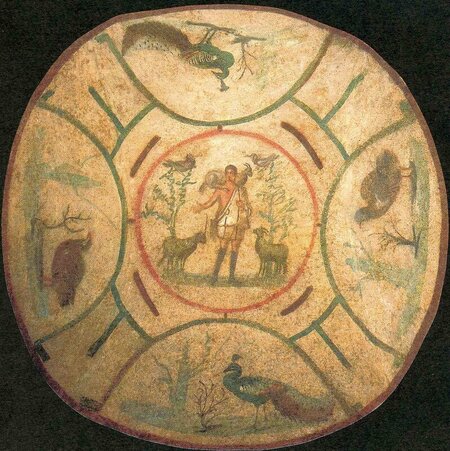
One example is the fresco «The Good Shepherd» (3rd century CE), located on the ceiling of the Priscilla Catacombs in Rome. At the center of the image is a youth carrying a ram on his shoulders, symbolizing Jesus. The figure also alludes to the ancient image of Hermes Psychopompos, who was believed to be a guide of souls to the afterlife. The lamb on the shoulders symbolizes the human soul returning to the Kingdom of Heaven. The peacocks at the top and bottom represented the image of immortality. The composition is an allegory of eternal life, the salvation of the human soul, and God’s care for humanity.
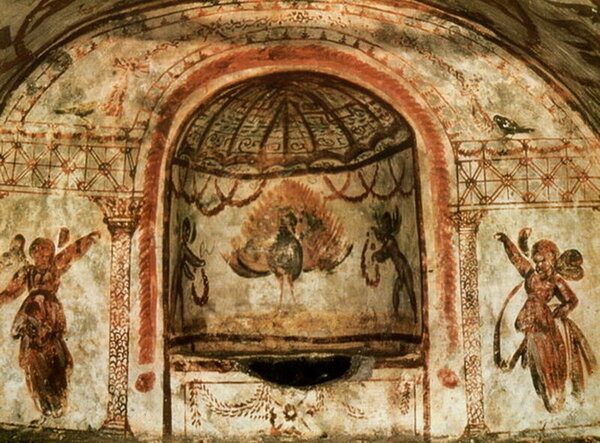
Another example is a 4th-century fresco from the catacombs on the Via Latina. In the center of the composition, within the arch, a peacock appears—the same unchanging symbol of immortality. It is surrounded by winged figures holding wreaths; these wreaths signify victory over death and the triumph of life, which is impervious to decay. The upper section of the fresco is decorated with a latticed parapet entwined with garlands. Tiny birds flit among the flowers and greenery. Together, these details form the image of a paradise garden—a quiet, bright sanctuary toward which the soul of the deceased ascends.
1.2. Depicting Death Through the Idea of Salvation
«Добрый Пастырь, оранты и история Ионы») в катакомбах святых Марцеллина и Петра
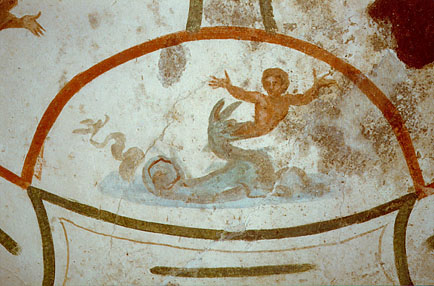
«Иона, извергнутый морским чудовищем» в катакомбах святых Марцеллина и Петра
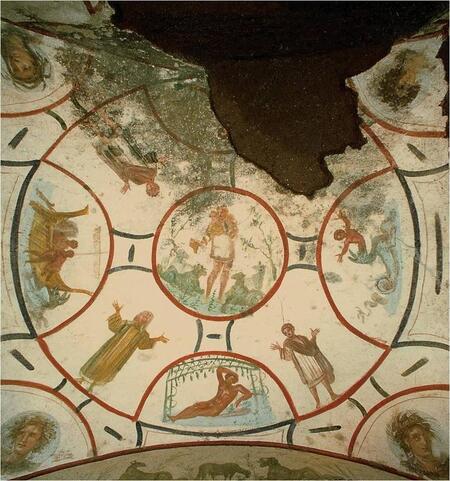
Biblical narratives serve as one of the primary ways to depict mortality—situations where the human confronts impending death and receives salvation. Instead of illustrating the deceased, artists turned to stories where overcoming death became possible through divine intervention.
The story of the prophet Jonah, who spent three days in the belly of a sea monster before being rescued, becomes a particularly important theme. What matters is not the moment of being inside the creature, but its subsequent deliverance. Of special interest is the image of the prophet resting beneath a plant. The composition is built around the idea of returning to life. Humanity is held captive by death, but its existence does not end there. In a funerary context, this motif can be perceived as a metaphor for the deceased’s repose while awaiting resurrection. Death here is presented not as physical decay, but as a temporary disappearance, followed by a return to life.
Thus, during this era, artists barely address the image of bodily decay. Instead, abstracted forms are employed. Early Christian art does not so much depict death as it explains what awaits a person after it.
2. The Middle Ages: Death as an Event
Where early medieval depictions of death emphasized resurrection and the hope of eternal life, starting from the 12th–13th centuries, artists began to favor images that narrated a person’s fate after death as part of a sequence of religious events. Death was no longer viewed merely as a transition from temporary existence to eternal bliss; it also began to denote a point in time where the spiritual value of human life was revealed. Scenes of burial and the Last Judgment frequently appear at the center of compositions. Therefore, in the art of the High Middle Ages, death gradually becomes an independent narrative, connecting physical death with burial, resurrection, and ultimately, judgment.
2.1. Scenes of Death and Burial
Dormition of the Holy Mother of God. Church of Panagia tou Araka, Lagoudera, Cyprus. 1192.
The Dormition of the Theotokos becomes particularly prevalent. The body of the Virgin Mary becomes the compositional center around which the entire space is built. Christ is depicted not as a judge, but as the one who receives the soul of the deceased and ensures its transition into eternity. The presence of the Apostles conveys the collective experience—the grief and reverence for the departed. Jesus holds a swaddled infant in his arms—a symbol of rebirth. The duality of the image allows for the visualization of the invisible process of the soul separating from the physical body. It is especially significant that death here is not depicted as destruction. Instead, it is presented as the completion of earthly existence, followed by spiritual transformation.
The tombs of Alienor of Aquitaine and Henry II at Fontèvre Abbey. 1200.