(1) PROJECT IDEA
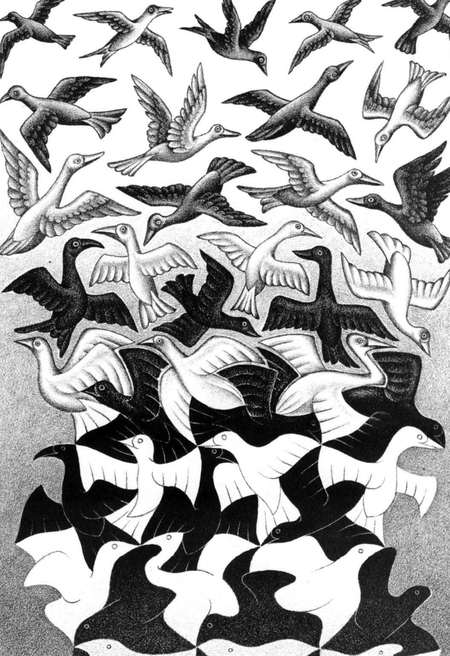
Maurits Cornelis Escher constructed impossible worlds by hand—using rulers, gouges, and months of meticulous labor. Tessellations where birds gradually transform into fish; staircases that fold back into themselves; waterfalls that flow in a circle. His graphics always embody a conflict between a rigorous mathematical system and the apparent impossibility of what it depicts.
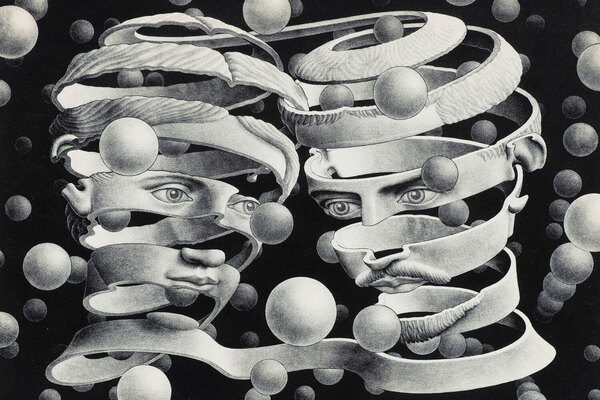
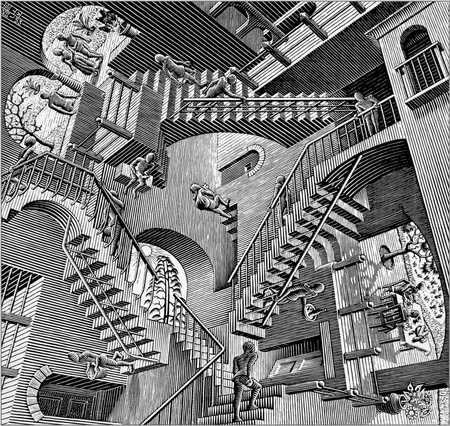
Works by M.C. Escher
A generative neural network is also a machine that builds the impossible—but based on statistics. The project’s idea is to put these two «machines of the impossible» head-to-head: to train the neural network using the master of paradox and see what emerges when Escher’s logic moves from the engraver’s hand into the latent space of a diffusion model.
The series concept is «Order and Paradox.» The network learns order from Escher (strict tessellations, precise tonal graphics, geometric composition) while simultaneously generating paradox: an infinite number of near-possible world variations. Escher could draw one «Metamorphosis”—the model is capable of producing a hundred, none of them repeating another.
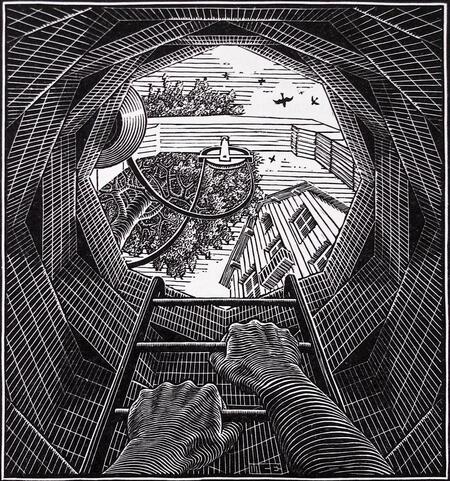
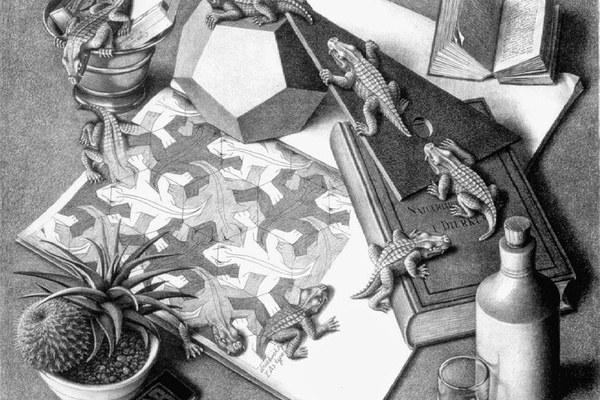
Works by M. C. Escher
Project Goals: Assemble a dataset of M.C. Escher’s graphic works (38 square images, 1:1 aspect ratio) $\rightarrow$ fine-tune Stable Diffusion XL using the LoRA method $\rightarrow$ generate a consistent series of images $\rightarrow$ analyze which stylistic elements were successfully captured.
(2) DATASET: WHAT AND WHY I CHOSE IT
The dataset includes 38 black-and-white works by Escher sourced from WikiArt and Wikimedia: lithographs, woodcuts, and mezzotints. The selection encompasses tessellations, metamorphoses, impossible architecture, and landscapes.
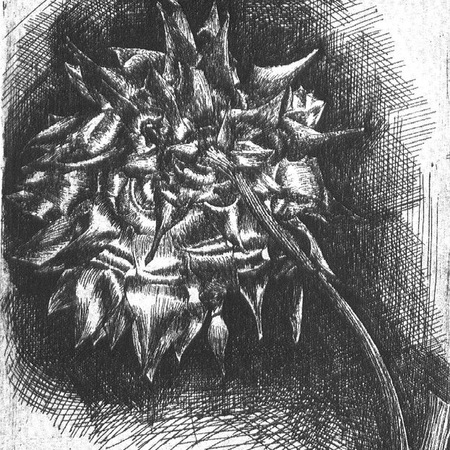
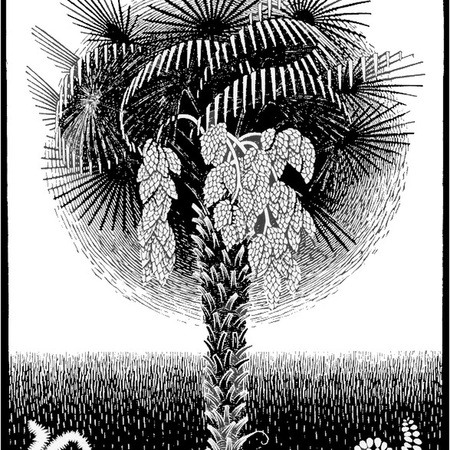
Images from the dataset
Images are cropped to a 1024×1024 square using center cropping. Reproductions smaller than 512 pixels on the shortest side are excluded; borders, captions, and excess margins have been removed.
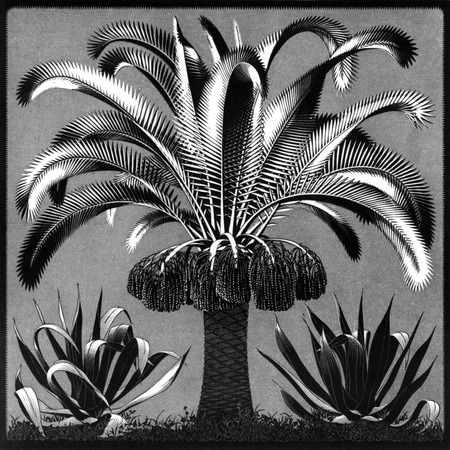
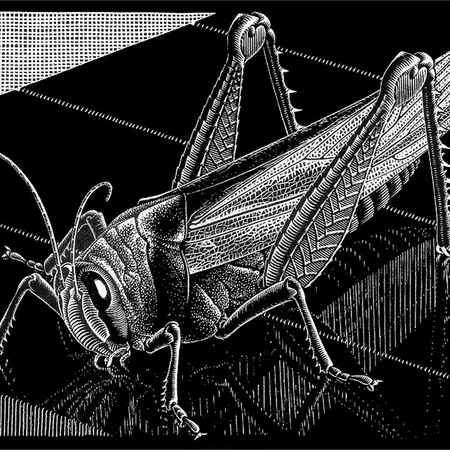
Dataset Images
(3) EDUCATION
For training, LoRA was utilized: the base SDXL weights remained frozen while small trainable matrices adapted the model to the selected style. Each dataset caption contained the trigger «escher style.» Training took place in Google Colab on a Tesla T4 using the official script diffusers train_text_to_image_lora_sdxl.py.
Key Parameters:
Base Model — Stable Diffusion XL 1.0.
Training Resolution — [640 / 768] pixels.
Batch Size — 1, gradient accumulation — 2.
LoRA Rank — 32, learning rate — 1e-4.
Scheduler — cosine, warmup — 100 steps.
Duration — [500 / 800] steps, saving every 300 steps.
Precision — fp16, gradient checkpointing; text encoders were frozen.
(4) FINAL SERIES
The series includes 6 images at 1024×1024. The prompts are unified by the «Escher style» trigger and a description of the graphic technique. Generation parameters: 30 steps, guidance scale 7.0, varied seeds.
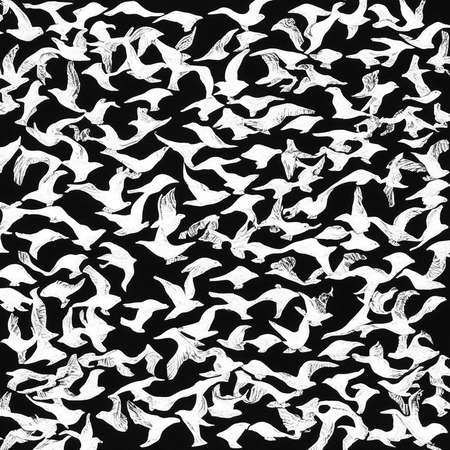
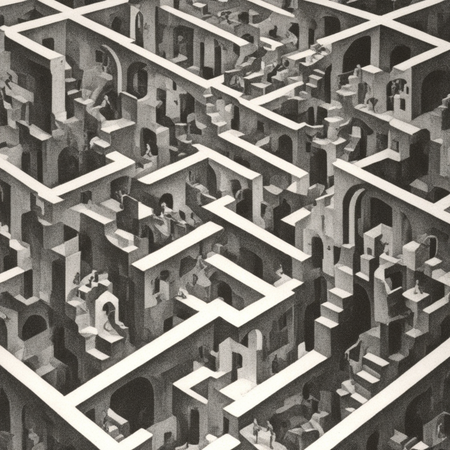
1. «Flock and Shoal» Prompt: escher style, birds turning into fish pattern, black and white woodcut, tessellation 2. «Infinite Staircase» Prompt: escher style, endless staircase with walking figures, impossible architecture, detailed lithograph
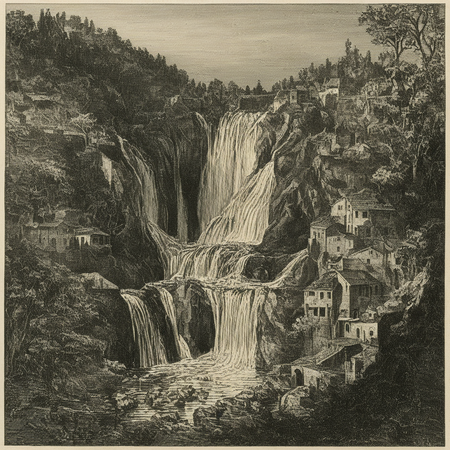
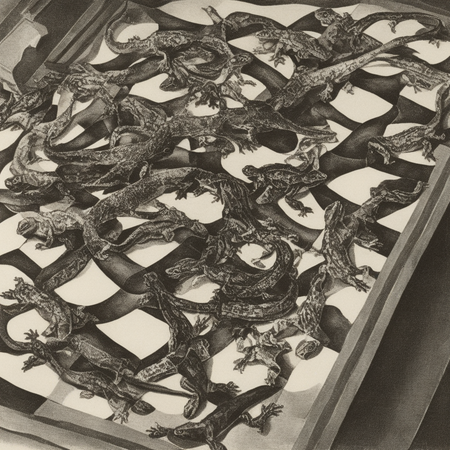
1. «Eternal Waterfall» Prompt: escher style, a waterfall feeding itself in an impossible loop, village below, engraving 2. «Reptiles from Mosaic» Prompt: escher style, reptiles crawling out of a mosaic on a desk, black and white lithograph
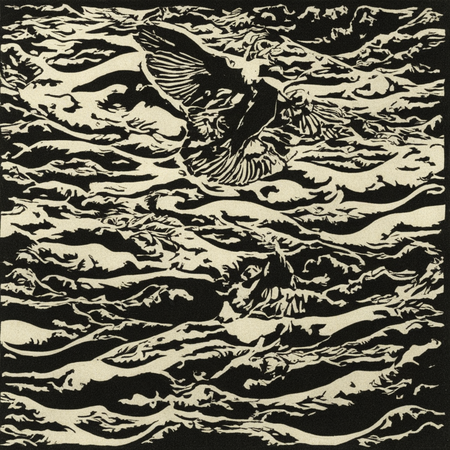
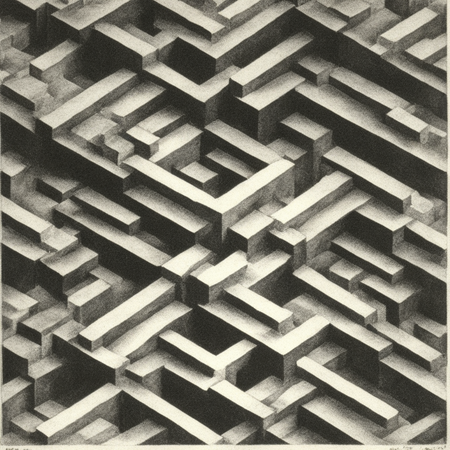
1. «Metamorphosis» Prompt: escher style, sky and water metamorphosis, woodcut, monochrome 2. «Free Variation» escher style, wall metamorphosis, monochrome
(5) RESULTS ANALYSIS
The model captured the characteristic features of Escher’s graphics: monochromaticity, line-hatched texture, rhythmic repetition of forms, and impossible motifs. However, the tessellations do not always align perfectly, and the spatial paradoxes lack the geometric rigor of the originals. The images vary in their subjects, the density of the hatching, and their closeness to the dataset’s motifs. The series demonstrates how a unified visual language evolves from frame to frame.
The main outcome is the transfer of Escher’s recognizable graphical traits into a generative environment. The model reproduces the impression of order and paradox, but the accuracy of this transfer necessitates visual verification.
(6) APPLICATION OF GENERATIVE MODELS
Stable Diffusion XL 1.0 — used to generate the final series after fine-tuning with LoRA on 38 works by Escher. Training and generation were performed in Google Colab on a Tesla T4.
ChatGPT, [GPT-6 Astra] — was utilized for code debugging and prompt preparation.