Categories
1. Introduction
2. Exhibition: How Film Teaches Trusting Intuition
3. The Suitcase: When Repetition Becomes Evidence
4. The Stranger’s Window: The Price of Focused Attention
5. Liza and the Ring: Who Interprets the Image
6. The Counter-Gaze and the Final Frame
7. Conclusion
8. References
Introduction
Concept
In «Rear Window» (1954), the most crucial event for the detective story is never shown: neither the audience nor the protagonist witnesses the murder that photojournalist L.B. Jefferies, confined to a wheelchair due to a broken leg, suspects his neighbor, Lars Thorvald, of committing. Instead, the film meticulously demonstrates how a person who hasn’t seen the crime comes to a firm conviction that it has occurred. The plot is not driven by the event itself, but by its reconstruction—by how a story is pieced together from disparate images viewed through the window across the way, a narrative no one observed in its entirety.
Therefore, the focus of the investigation is not on exposing Jeff, but on the history of the viewer’s trust in him. Why are we willing to take his suspicions seriously, even though we know from the outset how limited his perspective is? The common comparison of Jeff’s apartment to a theater and the windows opposite to small screens is convenient, but insufficient. It explains the observer’s stillness, the rectangular illuminated windows, and the pleasure of observing someone else’s life; it is these qualities of the courtyard that are considered when describing the film as a blend of spectacle and narrative. However, in the theater, the character cannot notice the person sitting in front of the screen. Hitchcock provides this possibility from the very first frame, although for a long time, no one exploits it. The question, therefore, is not only how the window becomes a screen, but also under what conditions it ceases to be one.
The concept of the work is built on the distinction of three positions that coincide in conventional cinematic storytelling: the viewer, the interpreter of what is seen, and the agent capable of action. Initially, it seems all three belong to Jeff. As the plot develops, these roles shift among different people, and the film’s visual narrative can be described as a successive redistribution of the right to determine what actually happened.
Relevance
The relevance of this topic is determined, first, by the film’s place in film history and film studies. «Window to the Yard,» released in 1997, was included in the National Register of Library of Congress Films, and in 1998, it made the list of the top 100 American films by the American Institute of Cinema Arts. The film is used as a foundational example in introductory university courses because it vividly illustrates restricted narrative, gaze-based editing, and the function of the camera, whose movement is unmotivated by character action. Therefore, referencing canonical material requires not merely retelling established observations, but posing a question that would connect them in a new way.
Secondly, the film’s thematic concerns are not limited to its era of creation. Stella’s caregiver’s remark about the «nation of people who love to peep» resonates especially powerfully in the age of social media and the camera in every phone; the film connects with the historical context of the 1950s, when television was spreading and neighborly surveillance was encouraged during the McCarthy era. The academic analysis of the Museum of Screen Culture in Australia also examines the film through themes of observation and surveillance, starting with the introductory camera movement that places the viewer in the position of observing a courtyard. For the modern viewer, who constructs an understanding of another’s life from fragments of images every day, the question of where what is seen ends and speculation begins remains highly relevant.
Third, this topic is significant for those who value visual narrative in their own work. Hitchcock constructs his storytelling almost without reliance on dialogue; the order in which objects are presented, the scale of the shot, and the window framing communicate more to the viewer than conversation does. Analyzing how an image doses information, nudges toward a conclusion, and creates certainty before proof is transferable to any field where the author controls the sequence of vision: storyboarding, comics, presentations, or interfaces.
Level of Comprehension
The literature surrounding the film is extensive and provides a basis for established interpretations. David Bordwell, in his book Narration in the Fiction Film, utilizes Rear Window as a model for spectator activity: Jeff and his companions are likened to viewers who construct a narrative from the plot based on suggested cues. John Beaton discusses the spatial organization of the film—the isolation of Jeff’s apartment from the neighboring apartments and the subsequent transgression of that boundary in the second half of the action. Laura Mulvey’s essay, «Visual Pleasure and Narrative Cinema, ” where the film serves as a prime example of the active male gaze and the passive female figure, became the most cited article in the history of Screen magazine. Tanya Modelecki challenges this reading, demonstrating that the film increasingly asserts a dual perspective for Jeff and Liz, and that Liz herself is active and mobile in areas where Jeff is helpless.
These approaches are usually considered separately: narrative cognitive analysis addresses knowledge, feminist critique addresses the power of the gaze, and spatial analysis addresses the boundaries of the courtyard. This visual study attempts to connect them in a single question: how is the distribution of knowledge between the characters and the viewer expressed through the window frame, and how does this distribution change from episode to episode?
Object, subject of research, and goal
The object of study is the visual narrative of Alfred Hitchcock’s film, Rear Window (1954). The subject of the study is the visual techniques used by the film to distribute knowledge among the protagonist, the other characters, and the audience: the camera placement and the window frame, eye-line editing, the order of detail presentation, repetition and omission of action, the soundscape, and the shift in optical perspective during the climax. The goal of this work is to demonstrate how the film’s visual techniques shape the viewer’s trust in Jeff’s conclusions and how those same techniques gradually reveal the limits of that trust.
Hypothesis
The working hypothesis is that trust in the protagonist emerges from the temporary confluence of three positions—the beholder, the interpreter, and the actor—and that the film’s visual narrative sequentially separates them. Lisa makes the crucial discoveries in the investigation; the viewer reaches some conclusions without Jeff, but Torvald is the one who most accurately interprets the observed gesture at the decisive moment. If the hypothesis is correct, the film’s climax is not the confirmation of Jeff’s correctness, but the realization that his mode of reasoning is accessible to the person he was observing.
Exhibition: How Film Teaches the Art of Guesswork
Storyboard of initial shots from Alfred Hitchcock’s film «Rear Window» (1954)
During the opening credits, three bamboo screens rise sequentially on the window; behind them, a courtyard is revealed, and Jeff is asleep during the initial meeting. If the view of the neighbors genuinely belonged to the protagonist from beginning to end, Hitchcock could have simply shown him waking up and looking out the window first. The order is fundamentally different. We get a chance to become interested in the courtyard before the person who will later be held responsible for the eavesdropping appears. When Jeff begins looking, the viewer will not follow him onto unfamiliar territory but will return to the activity already underway.
A frame from Alfred Hitchcock’s «Rear Window» (1954)
The camera’s reverse sequence is particularly important—moving from the occupants' apartments to Jeff’s own belongings. The cast on his leg, the damaged camera, and the photograph of the race accident allow the viewer to reconstruct the injury’s backstory before the protagonist even tells it. No single image provides the necessary explanation. The cast speaks to a fracture, the broken camera points to equipment damage, and the photo depicts a perilous incident. Only the sequence of presentation links these three facts: the photographer was near the crash and was injured while working. The viewer performs a small intellectual exercise and is rewarded—a still body and its surrounding objects coalesce into a biography.
A still from Alfred Hitchcock’s film, «Rear Window» (1954)
Here, a trap is set that will spring later. In Jeff’s room, the narrative camera presents us with his belongings: it guides us from one detail to the next, making their causal connection seem secure. In the courtyard, Jeff will begin to pick apart the details, who already has a suspicion. Formally, the viewer will be offered the same task: place the images side-by-side and reconstruct the missing event. However, the grounds for such a conclusion will become weaker. Trust in Jeff’s nighttime observations is fostered not so much by the authority of his profession as by the viewer’s own recent success: in the first scene, reading the items as clues has already proven productive.
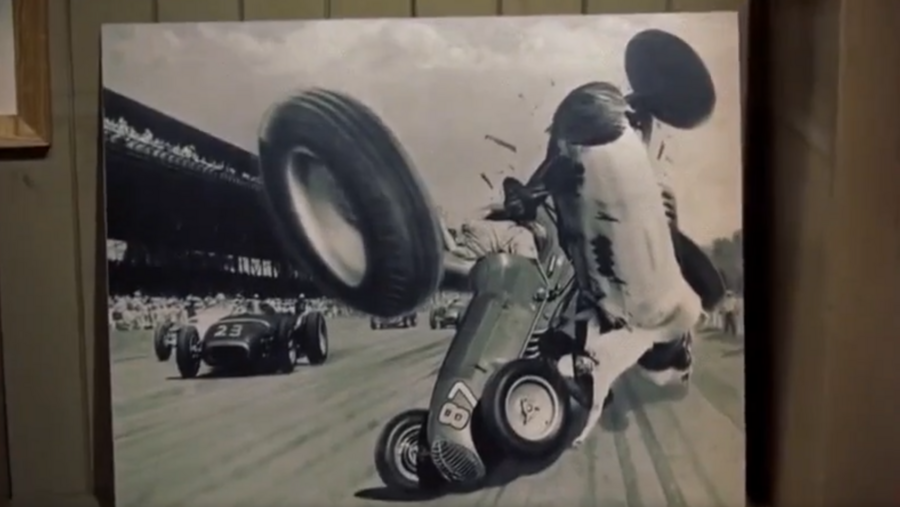
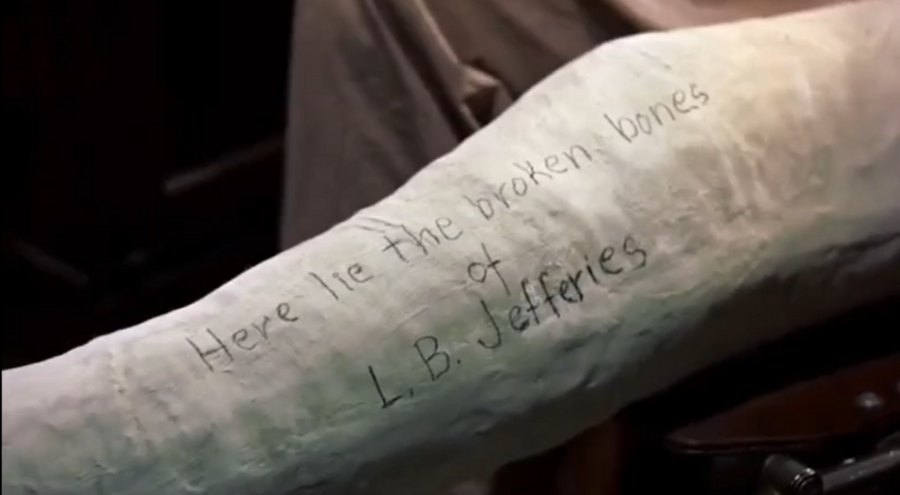
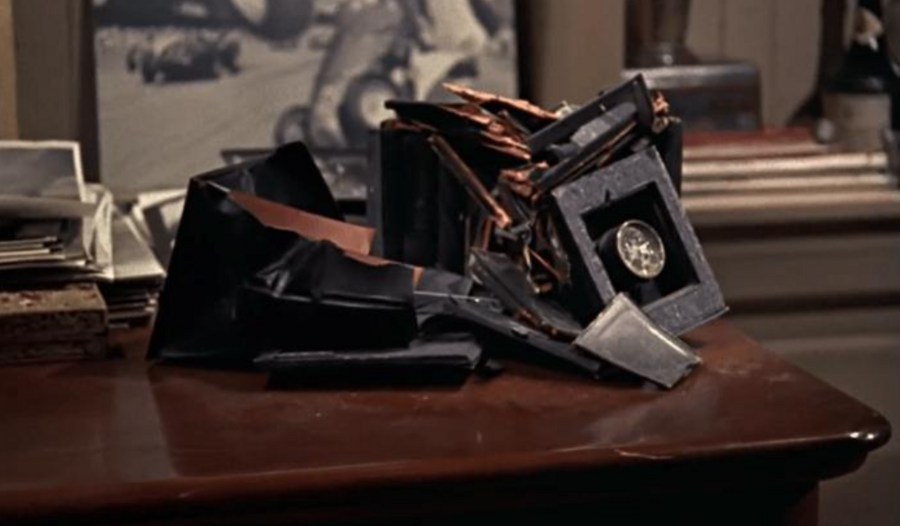
Stills from Alfred Hitchcock’s «Rear Window» (1954)
The Suitcase: When Repetition Becomes Evidence
A scene from Alfred Hitchcock’s film, «Rear Window» (1954)
At night, Jeff notices several times Torvald leaves the house with a suitcase; it’s impossible to know where he is going or what he’s carrying from the window. The suitcase in its first appearance holds nothing that would make it a clue. This significance develops retrospectively: the second outing makes the viewer recall the first, and the subsequent trip transforms a similarity into a pattern. The more frequently the viewer sees a repeated action, the stronger the need becomes to invent a single cause for it. At this point, the contents of the suitcase are known no better after several observations than they are after one. Repetition increases certainty before any new information about the crime itself emerges.
Still from Alfred Hitchcock’s film «Rear Window» (1954)