Research Concept
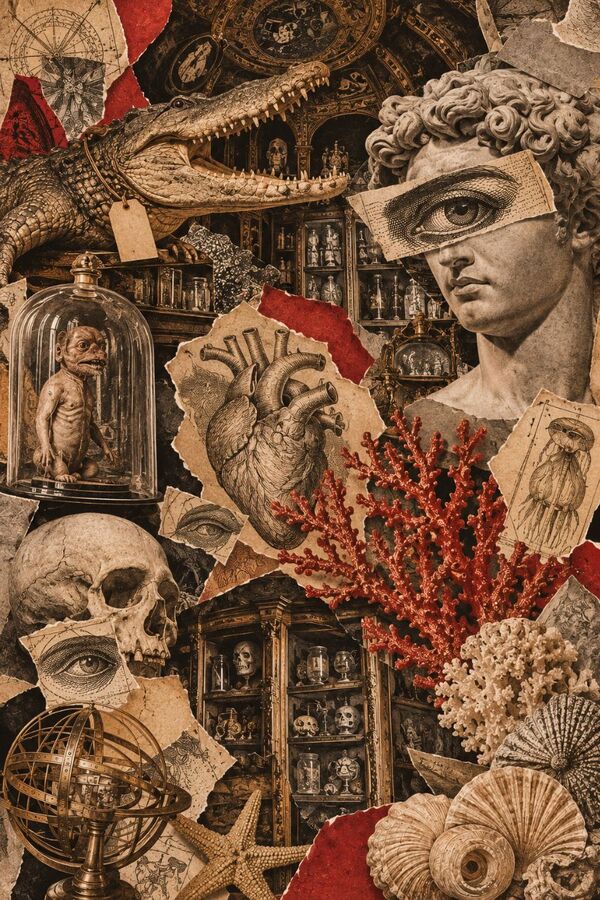
In the era of the Renaissance and early Baroque in Europe, a unique phenomenon and direct precursor to the modern museum—the cabinet of curiosities, or Wunderkammer—emerged. For the contemporary viewer, accustomed as they are to strict scientific classification, the spaces of these cabinets can seem like a chaotic and absurd jumble of objects. Here, a stuffed Nile crocodile is placed next to an ancient gem, coral branches intertwine with clockwork mechanisms, and portraits of individuals with anomalies hang beside masterpieces of painting. However, this so-called «chaos» was not the random product of unsystematic collecting.
Material Selection Principle
To substantiate the hypothesis and construct a documentary visual sequence, the material was selected based on the principles of genre diversity and the reliability of 16th–17th-century sources:
Engravings and frontispieces from the printed catalogs of renowned collectors (such as the cabinets of Ferrante Imperato, Olaus Worm, and Francesco Calcolari). These images serve as the primary spatial blueprints, documenting the actual topography of objects within interior spaces.
Flemish «gallery paintings» from the genre of painting (works by Frans Francken the Younger, Jan Brueghel the Elder, and Hieronymus Francken), which allow for a detailed reconstruction of color palette, object texture, and the nature of their arrangement within private aristocratic collections.
High-quality macro photographs of surviving decorative and applied arts objects from leading European treasuries (Grünes Gewölbe in Dresden, the Kunsthistorisches Museum in Vienna, and Schloss Ambras in Innsbruck) for detailed visual analysis of the structure of hybrid artifacts.
Principles of Selecting and Analyzing Textual Sources
For the theoretical foundation of the research, works on the history of museology and the intellectual history of Europe were selected. The analysis of the texts is based on comparing Early Modern manifestos (Francis Bacon on the design of the ideal cabinet) with contemporary studies of curatorial practices (J. Bazant’s «History of Art History, ” O. Impey’s „Cabinets of Curiosities in Europe“). The textual sources are used to decipher the symbolic meanings that the Renaissance viewer perceived while looking at certain visual juxtapositions within room spaces.
Navigator
- Concept
- The «Celestial» Tier of the Cabinet of Curiosities: Mastering the Expository Vertical
- The Boundaries of Nature and Human Artifice: A Symbiosis of Naturalia and Artificialia
- Architecture Within Architecture: Cabinets as Archives of the Universe
- Visualizing Anomalies: A Theater of Wonders and «Nature Games»
- Conclusion
The key question of visual research
What was the logic of visual direction in the spaces of Renaissance cabinets of curiosity, and how was a cohesive image of the knowable world formed through the spatial juxtaposition of heterogeneous objects?
Visual Research Hypothesis
The visual «chaos» of the Kunstkamera is a meticulously staged spatial metaphor for the Universe, where the exhibition was organized not according to scientific classification, but according to visual and semantic resonances between three categories: those created by nature, those altered by humans, and anomalous objects.
Part 1. The «Celestial» Tier of the Cabinet of Curiosities: Mastering the Exhibition Vertical
In contemporary museology, the ceiling and the upper portions of the walls traditionally remain a «sterile, ” neutral zone, intended not to distract the visitor from the exhibits at eye level. However, in Renaissance and Baroque cabinets of curiosity from the 16th and 17th centuries, the exhibition vertical played the role of the main semantic and artistic dominant. Populating the upper tier of the interior with large, exotic objects—such as crocodile effigies, giant fish, rays, sharks, and turtle shells—constituted the first curatorial technique in history aimed at managing the viewer experience through the creation of a „sense of wonder.“
Representation of Chthonic Chaos: The Crocodile Under the Ceiling
The first thing a visitor encountered when stepping over the threshold of the curiosity cabinet was the necessity of physically tilting their head back. This bodily gesture instantly alters the optics of our perception. A taxidermied Nile crocodile or another large reptile almost always served as the central element of the «heavenly» tier.
Kunstkammer of the Franke Institutions in Halle (Germany, 1698) What is in the photo: A massive Nile crocodile, stuffed with straw, hovers directly above the heads of visitors and wooden display cabinets.
In the medieval consciousness, the crocodile was invariably associated with the biblical Leviathan, the forces of hell, and primal chthonic chaos. Placing its taxidermied specimen beneath the ceiling of a study carried a dual visual code. On one hand, it was a display of conquered exoticism. On the other—it was the collector’s political and intellectual manifesto. It proclaimed: the wild monster has been captured, dissected, and literally shackled by iron chains to the ceiling of a human dwelling. The intellect of the Modern Age vividly demonstrated its triumph over the forces of nature, transforming a frightening monster into an ordered and familiar object of aesthetic contemplation.
Unknown Artist. Interior of the Ferrante Imperato Museum in Naples. Engraving from Dell’Historia Naturale. 1599.
This image is considered the oldest documented interior of the Kunstkamera. The engraving clearly shows the rigid curatorial direction of the vertical space: the entire ceiling of the room is draped with taxidermied specimens of fish, birds, and crocodiles. Here, the ceiling functions not as a structural overlay, but as a metaphorical «ocean upside down, ” suspended above the visitors’ heads (noblemen in hats, depicted below), which created a Baroque sensation of optical illusion and total spatial saturation.
Mapping the «Hanging Macrocosm»
The Wunderkammer sought to replicate the structure of the universe in miniature (the microcosm principle). In this cosmological model, the lower cabinets represented the earthly and solid world, while the ceiling metaphorically symbolized the «vault of heaven» or «heavenly waters.»
Hanging objects allowed collectors to efficiently address the problem of limited space in cramped Renaissance rooms while simultaneously establishing a complex visual hierarchy. Birds, flying fish, seals' flippers, and whale whiskers hovered in the air, demarcating the upper boundaries of the knowable world. This technique transformed the room into a volumetric, three-dimensional map of Earth, wherein the viewer found themselves inside the space we were exploring, surrounded on all sides by artifacts.
Unknown engraver. The Cabinet of Curiosities of Ole Worm in Copenhagen. Frontispiece of the Museum Wormianum edition. 1655.
The engraving depicts one of the most famous curiosity cabinets in Northern Europe. The tool for visual analysis here is the comparison of scales. A large crocodile taxidermy specimen suspended from the ceiling organizes the room’s axial symmetry.
Hieronymus Viscardi (engraver). Museo Francesco Calzolari in Verona. Engraving from the Musaeum Francisi Calceolari catalog. 1622.
The visual chaos of the upper gallery of the curiosity cabinet was a strictly structured décor. The ceiling acted as a curatorial tool that, through scale, the hanging of monsters, and the activation of spatial surprise, engaged the viewer in an intellectual game, preparing them for a more detailed examination of the smaller exhibits on the lower levels.
Part 2. The Boundaries of the Natural and the Manmade: A Symbiosis of Naturalia and Artificialia
The visual chaos of the wonder gallery on this level was overcome by creating unique hybrid objects. Jewelers of the Mannerist and Baroque eras did not seek to isolate natural objects, as modern natural history museums do. On the contrary, they took a wild, raw organic form—a branch of rare coral, an elaborate pearl, a ostrich eggshell, or a tropical mollusk shell—and «completed» it using gold, silver, and precious stones. For the Renaissance viewer, this symbiosis was a vivid visualization of the co-creation between God (as the chief artist of nature) and humankind (as his earthly student).
Ocean in a Golden Frame: Metamorphoses of the Nautilus Shell