Concept
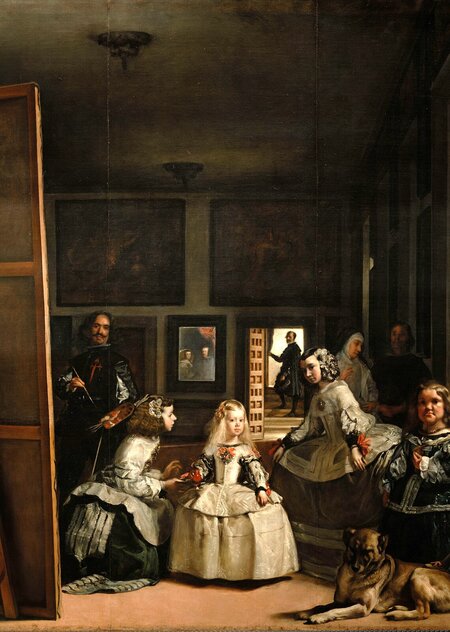
This research examines how the mirror functions within pictorial space: what it depicts, from where the reflection is organized, and to whom it is addressed. Through the analysis of four works—Jan van Eyck’s «Arnolfini Portrait» (1434), Petrus Christus’s «Portrait of a Master in His Workshop» (1449), Quentin Matsys’s «The Menses and His Wife» (1514), and Diego Velázquez’s «Las Meninas» (1656)—we trace the transition from the mirror as a means of expanding depicted space to the mirror as a device that renders visible the spectator’s own position.
The goal of my visual research is to determine how the mirror alters the relationship between the depicted space, the external world, and the viewer in painting from 1434 to 1656.
Why the mirror becomes a problem
In painting, the mirror appears to be an object that should merely replicate the existing world. However, a reflection is never a neutral copy. It alters the scale, curvature, and lighting of the space, and most importantly—it reveals what is omitted from the main scene. Therefore, a mirror can expand a room, introduce an absent figure, connect the interior to the street, or prompt the viewer to contemplate their own position.
In 15th-century Dutch painting, the convex mirror becomes an expressive tool for demonstrating pictorial observation. In Van Eyck’s work, it gathers the room and the figures at the entrance within a small circle; in Christus’s, the reflection leads the gaze beyond the stall. In Massej’s work, the mirror in the foreground becomes an independent part of the semantic structure. In Velázquez’s, a small mirror on the far wall is integrated into a system of views where the depicted characters cannot be separated from the implied viewer.
Jan van Eyck. «The Arnolfini Portrait»
The painting is rendered in oil on oak board. A man and a woman stand in an interior illuminated by a window on the left. Behind them are a bed, a chandelier, furnishings, and the central part of the back wall, which features a mirror. At first glance, the space appears to be an exact depiction of a room. However, the National Gallery’s catalog notes discrepancies: the chandelier does not quite fit the implied volume, there is no fireplace, and the mirror seems unusually large. The interior cannot be considered a literal documentation of a room.The mirror plays a crucial role in constructing the space. It reveals a part of the room that the viewer cannot see directly: a door and two figures situated behind the depicted couple. Thanks to the reflection, the interior stops being a closed scene—it becomes evident that there is another space and people present beyond the main image.
1 — Jan van Eyck. «The Arnolfini Portrait, ” 1434
A round convex mirror is positioned almost along the center axis of the back wall. It is framed by ten small medallions depicting scenes from the Passion of Christ. The frame transforms an everyday object into a complex miniature composition: the reflective surface abuts a sequence of religious images.
The mirror shows the backs of a man and a woman, part of the room, a door, and two small figures entering the space. The reflection compresses and distorts the space: the straight lines of the interior become curved, and objects are arranged at an unfamiliar scale. The convexity of the surface allows for a wide field of view to be captured in one frame. The mirror does not replicate the main scene, but rather shows it from the opposite side—from an area that remains outside the direct depiction in the painting.
Artist within the image?
2 — Jan van Eyck. «The Arnolfini Portrait, ” 1434. Fragment
The inscription above the mirror is especially significant: «Johannes de Eyck fuit hic. 1434”—“Jan van Eyck was here. 1434.» It is placed not at the bottom of the painting, but directly on the wall of the depicted room. Consequently, the signature is perceived as part of the space, rather than merely an attribution.
The combination of the inscription and the reflection has led to the suggestion that one of the figures in the mirror is Van Eyck himself. While this interpretation is possible, it remains unproven. The inscription may indicate the artist’s presence in a broader sense—as the creator who conceived and documented the scene depicted. Therefore, it is more accurate to speak of the connection between the signature, the reflection, and the theme of presence, rather than asserting a definitive self-portrait.
The Mirror as a Witness to Presence
The mirror was also connected to marriage rites, the presence of witnesses, and religious symbolism. However, these interpretations should not be taken as definitive explanations of the scene. The National Gallery views the painting as a portrait of a couple, likely Giovanni di Nicolo Arnolfini and his wife; the theory of a specific marriage ceremony is not considered established.
Technical analysis shows that the composition evolved during the creation process. In the preparatory sketch, the mirror was a larger octagonal shape, which was later modified. Campbell also points out its unusual size in the final version [2]. This confirms that the mirror was not merely an interior detail but an element the artist intentionally integrated into the painting’s structure.
«Arnolfini Portrait.» Exit
Thus, in Van Eyck’s work, the mirror serves two interconnected functions: it expands the depicted space and testifies to the presence of people outside the main scene. It reveals what cannot be seen directly, and the artist’s signature reinforces the themes of presence and authorship. At this point, the viewer has not yet become the primary subject of the image; the mirror primarily informs them of the existence of space beyond the painting.
Petrus Christus. «Master of Goldwork in His Workshop»
3 — Petrus Christus. «Master of Goldwork in His Studio, ” 1449
The painting by Petrus Christus is dated 1449 and is signed by the artist. At the center of the composition is a master working with jewelry. In front of him stands a couple examining a ring; nearby are scales, precious stones, and craft tools. For a long time, the painting was called the depiction of Saint Eligius because of the halo above the master’s head. However, research has shown that the halo was added later and removed during restoration. Therefore, the Metropolitan Museum uses the neutral title: «Goldsmith in His Workshop.»A small, convex mirror is placed on the front part of the counter, almost on the border between the depicted space and the viewer. It reflects the buildings of the street and two young people, one of whom is holding a falcon. Thus, the mirror shows not the interior of the workshop, but what lies beyond it. It connects the scene of labor with the urban environment, allowing the viewer to simultaneously see what is happening inside the shop and the people outside.
The Mirror as a Connection to the City
The main scene revolves around professional life. The craftsman examines a ring and works with weights, while the items on the counter demonstrate the value of the materials and the precision of the craft. The museum suggests that the depicted figure is a specific jeweler, possibly connected to the court of the Duke of Burgundy, but this identification remains a hypothesis. Therefore, the painting can be viewed not only as a moralizing depiction but also as a professional portrait or a scene from the workshop’s life.
The characters do not pay attention to the mirror: the craftsman is busy working, and the couple is examining the piece. The reflection is intended primarily for the external viewer. It informs the viewer about the space that the main characters seem oblivious to. In this, Christ continues a technique used by Van Eyck, but changes its direction: the mirror reveals not the room behind the viewer, but the street outside the workshop.
4 — Petrus Christus. «Master of Goldsmithing in His Workshop, ” 1449. Fragment
A possible moral reading of this contrast suggests the falcon is associated with arrogance and greed, contrasting with the focused work of the artisan and the careless stance of the passersby. Nevertheless, the scales tip in favor of the virtuous pair.
«The Master of the Goldsmith in His Workshop.» Conclusion
The mirror functions simultaneously as an interior design element and an optical device. Its small surface allows the artist to depict architecture and human figures in a distorted reflection. The mirror connects the studio with the city and introduces the outside world into the interior space. It continues the spatial function noticeable in Van Eyck’s work, but it shifts the social focus: the reflection shows passersby on the street rather than visitors entering a private room. The moral interpretation featuring the falcon reinforces the contrast between the two worlds, though it remains an interpretation.
Quentin Masseis. «Changing Her and Her Husband»
In Quentin Massais’s painting, «Changing and His Wife, ” the mirror is positioned in the foreground and depicts a scene that does not repeat the main action. It reflects a person in red clothing reading a book by the window. The Louvre emphasizes that this fragment is primarily intended for the viewer of the painting. The mirror becomes an autonomous image within an image.
5 — Quentin Masseis. «She Changed and His Wife, ” 1514
In the center of the composition, a man weighs coins, while the woman beside him holds an open book and turns toward his activity. On the table, money, scales, and jewelry are spread out; shelving and a slightly ajar door are visible behind the figures. Three spatial planes can be distinguished: the table with objects, the figures, and the back wall. Despite the presence of the door and reflections, the space in the painting remains shallow and densely organized.
A reflection as an image within an image