Navigator
- Concept
- The Closed Space as a Trap
- The Space Constructed by the Protagonist
- Open Space and Its Boundaries
- Conclusion
Concept
The space in Garry Bardin’s films is an active visual element that organizes the narrative and defines the character’s relationship to their environment. From 1979 to 1990, Bardin created a series of works in which the frame’s boundaries, the figure’s scale, the direction of movement, and the physical properties of the material form both closed spaces that constrain the character and open spaces that dissolve the frame.
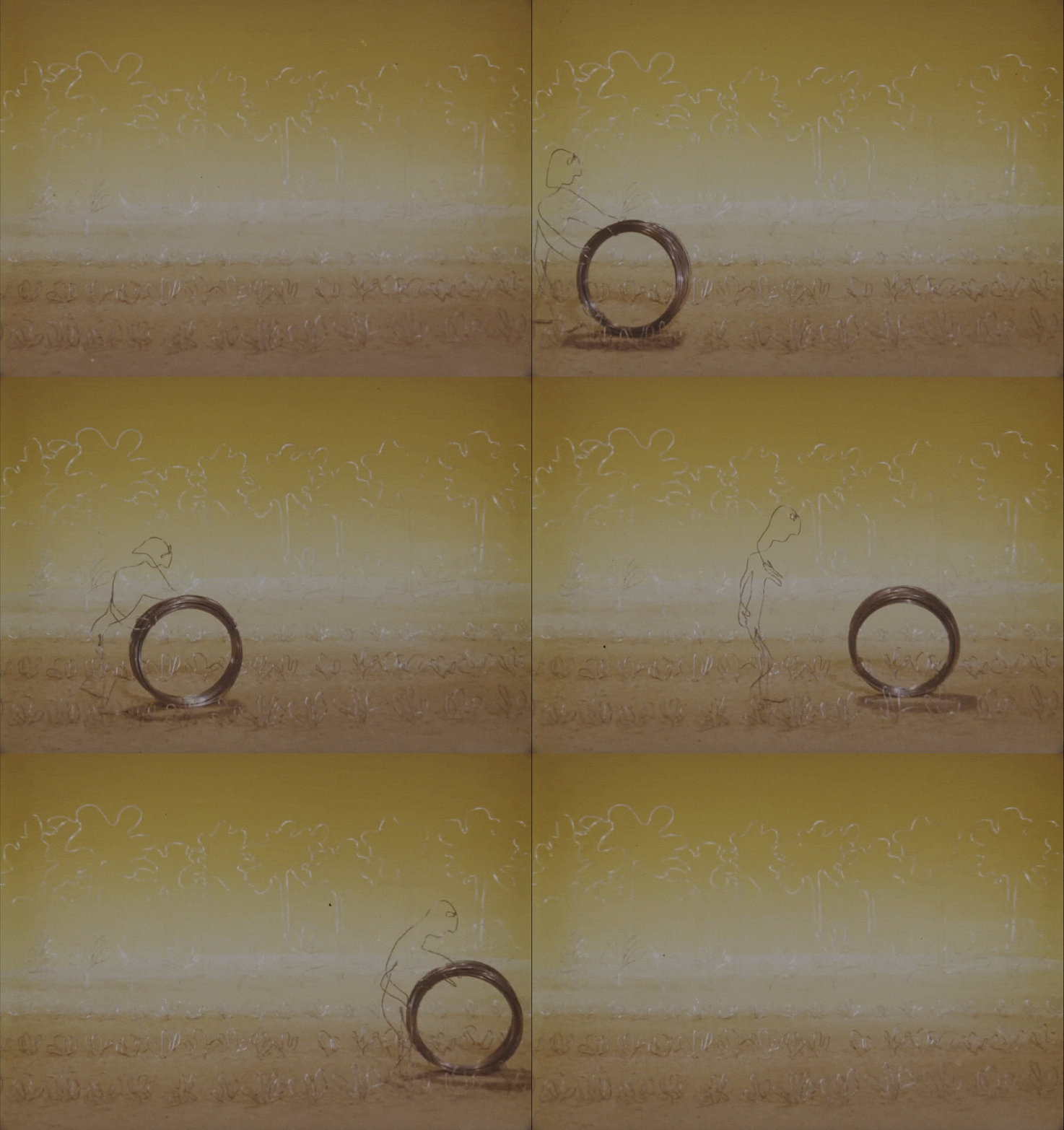
«Exaggerations, ” directed by Harry Bardin, 1987.
The technological and artistic characteristics of this period in his films can be attributed to the use of various techniques: drawn animation, where the boundary is defined by a line and the plane of the sheet; object animation, and clay animation, where the boundary depends on the weight, fragility, and deformability or resistance of the object. Using these works as an example, one can examine how the material dictates the nature of the boundaries and the type of movement within them, and how space is materialized in the frame through a system of physical constraints—constraints the character either discovers as externally imposed, creates themselves, or overcomes on the path to their goal.
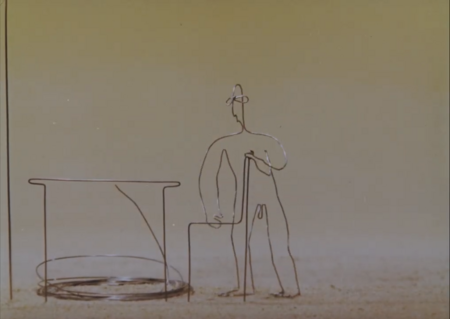
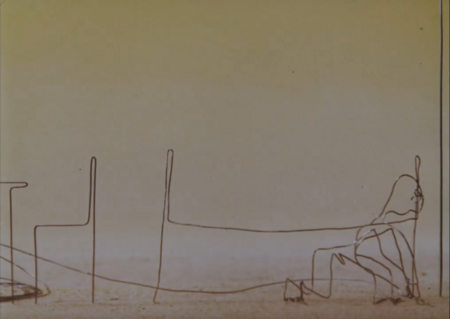
«Twists,» directed by Garry Bardin, 1987.
The visual study examines six films by Harry Bardin: «The Flying Ship, ” „Conflict, ” „Banquet, ” „Shenanigans, ” „Marriage, ” and „The Grey Wolf and Little Red Riding Hood.“ The selection of these materials is based on the fact that each film presents one of the types of spatial organization, and together they allow us to trace the characteristics of Bardin’s approach to representing open and closed spaces.
«The Grey Wolf and Little Red Riding Hood,» directed by Garry Bardin, 1990.
The first part of the study focuses on enclosed space as a trap, imposed by the object or a domestic situation. In «Conflict» and «Banquet, ” the character is confined within defined boundaries—whether it is a matchbox or the invisible perimeter of a feast. The second part examines space that the protagonist builds through their own actions. In „Follies, ” the boundary emerges from a desire for seclusion and gradually grows into an obsessive idea that leads to destruction; in „Marriage, ” it is caused by a desire for unity and the resulting limitations. The third part addresses space as a destination. For instance, in „The Flying Ship“ and „The Grey Wolf and Little Red Riding Hood, ” the external environment makes the boundaries surmountable.
The goal of this visual study is to describe and systematize the techniques of spatial organization, demonstrating that space in Bardin’s films functions as an independent visual element.
The visual investigation is structured around three key aspects that explore the theme: enclosed space as a trap, space that the protagonist constructs, and open space and its boundaries. The work’s organization follows this three-part structure. When selecting visual materials, preference was given to scenes where the spatial organization is most evident. During the selection of theoretical sources, particular attention was paid to works that explore the relationship between material and space in Bardin’s animation, as well as studies that examine space as an active element of animated discourse.
Confined space as a trap
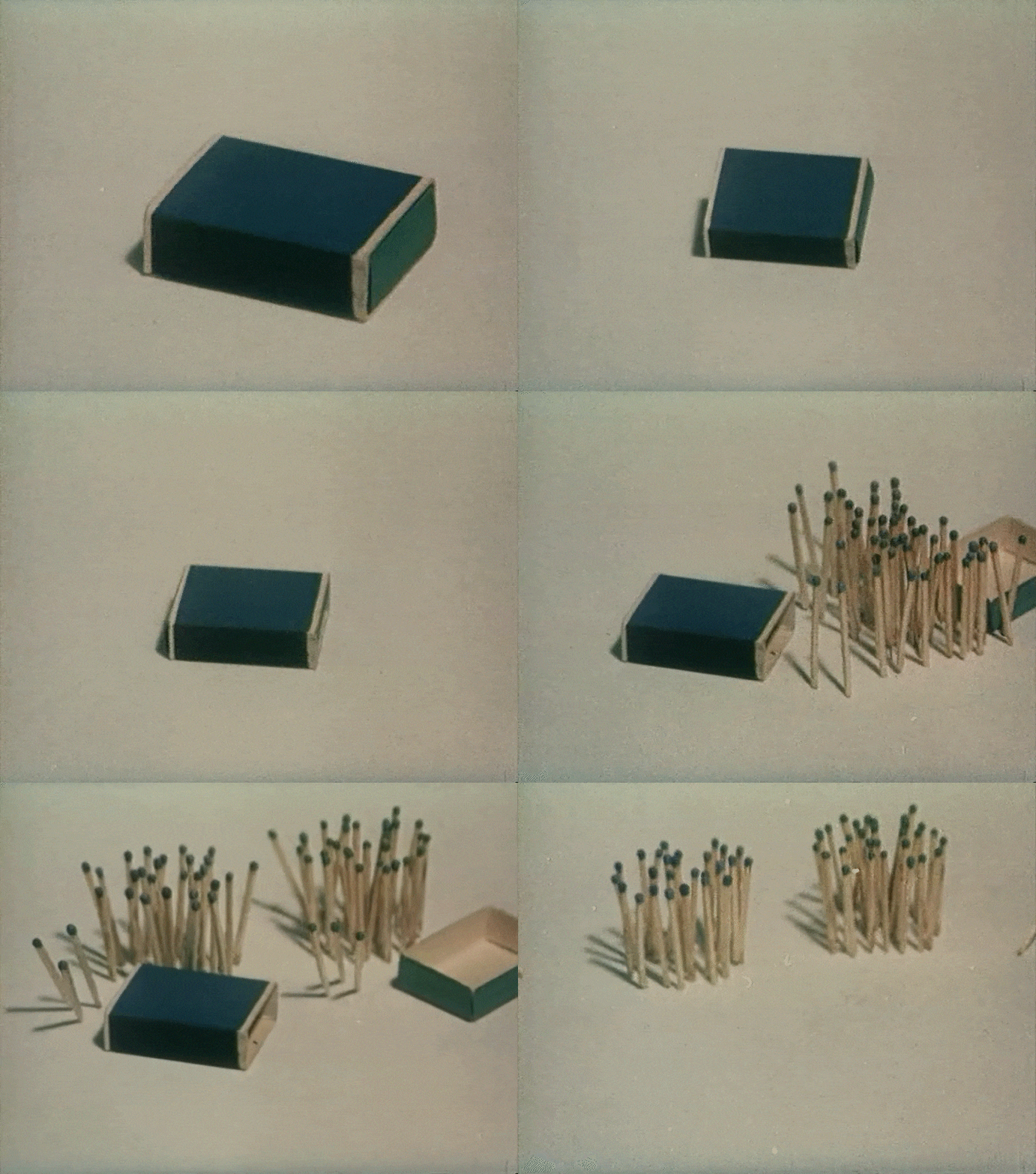
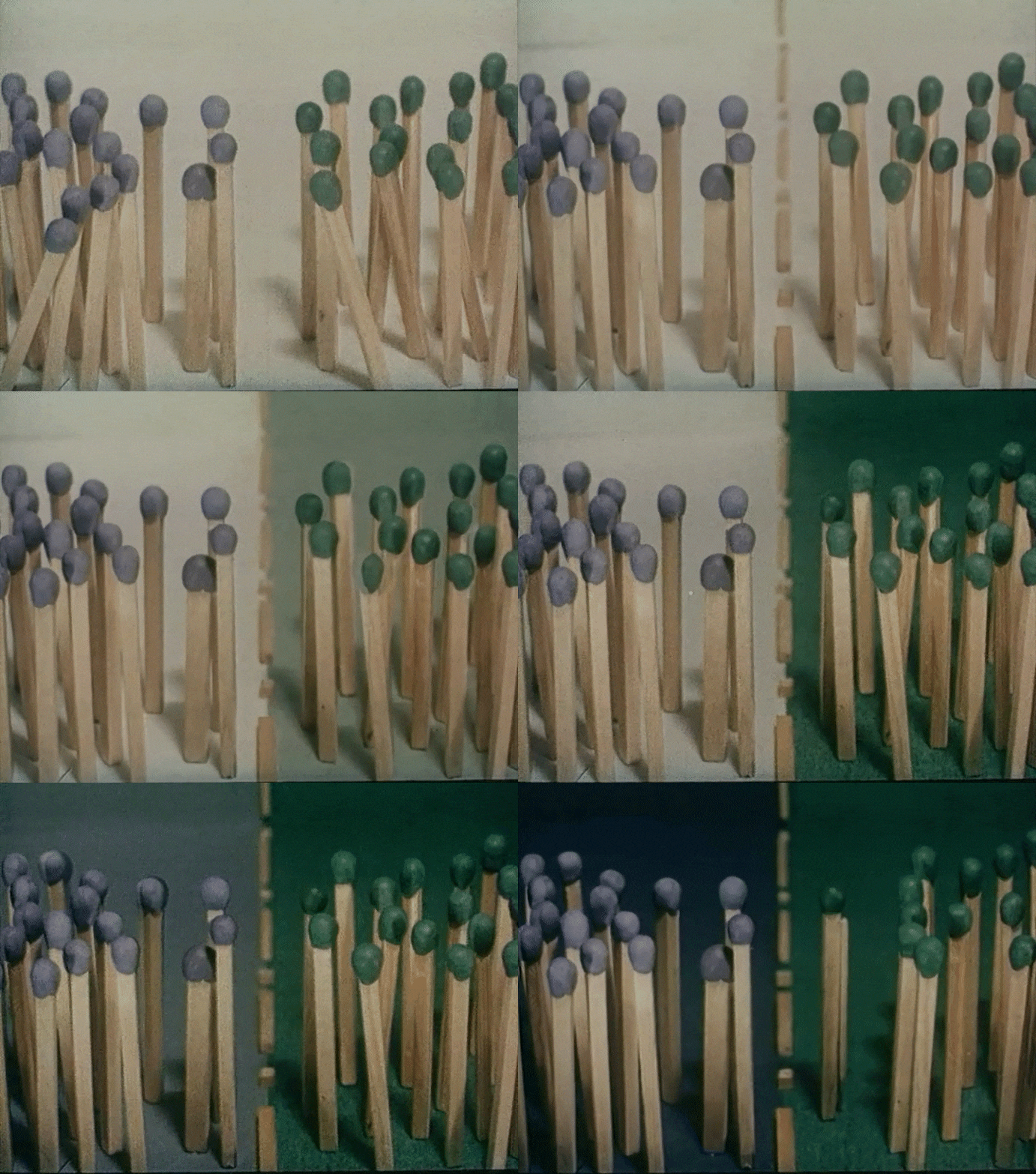
«Conflict, ” directed by Garry Bardin, 1983.
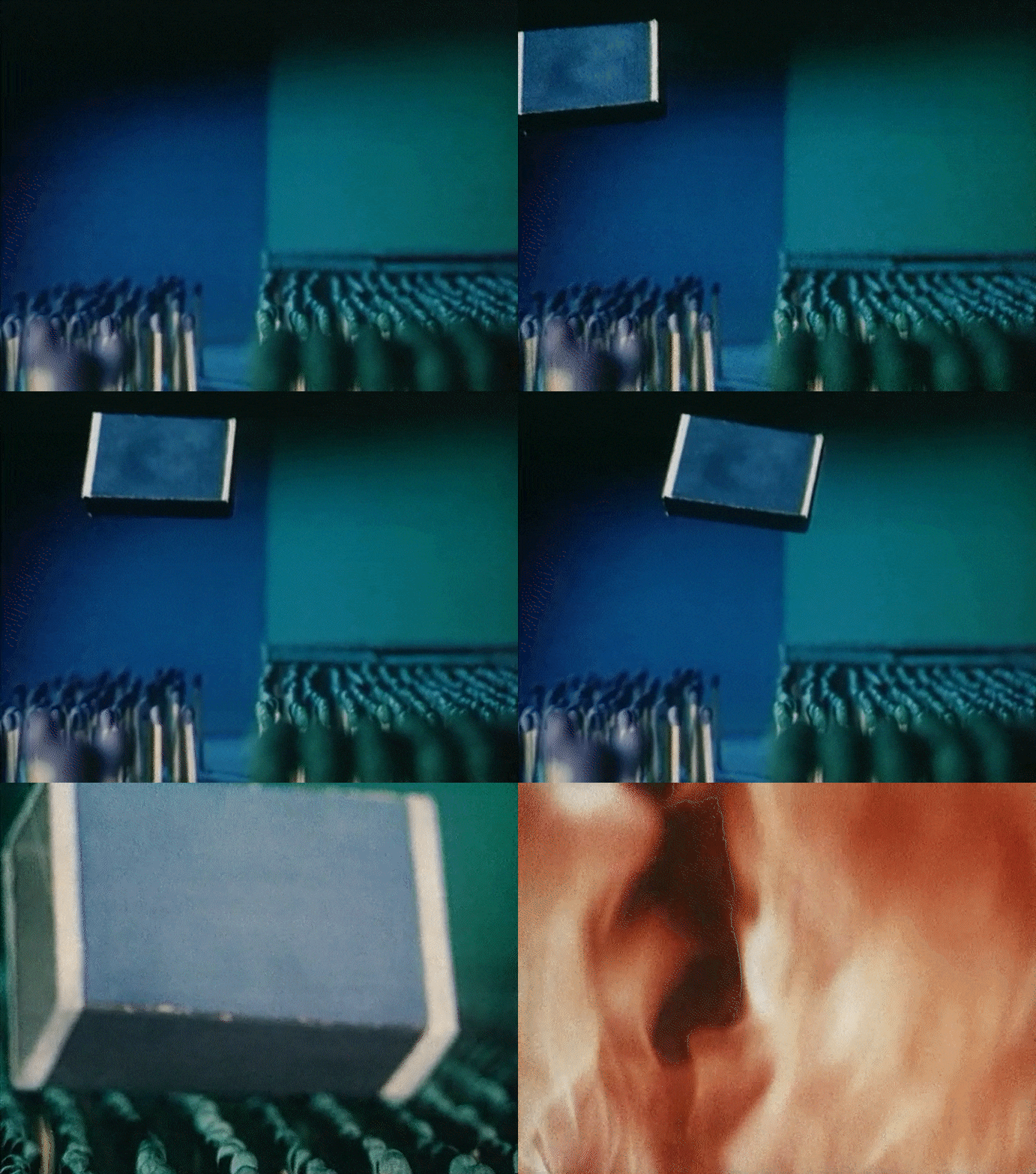
In the opening scenes of Bardin’s film «Conflict, ” the space is defined by the limits of a box. The division of matches into blue and green signifies a symbolic boundary between two groups. As the conflict escalates, this boundary materializes into a physical barrier made of matchstick fragments.
«Conflict, ” directed by Garry Bardin, 1983.
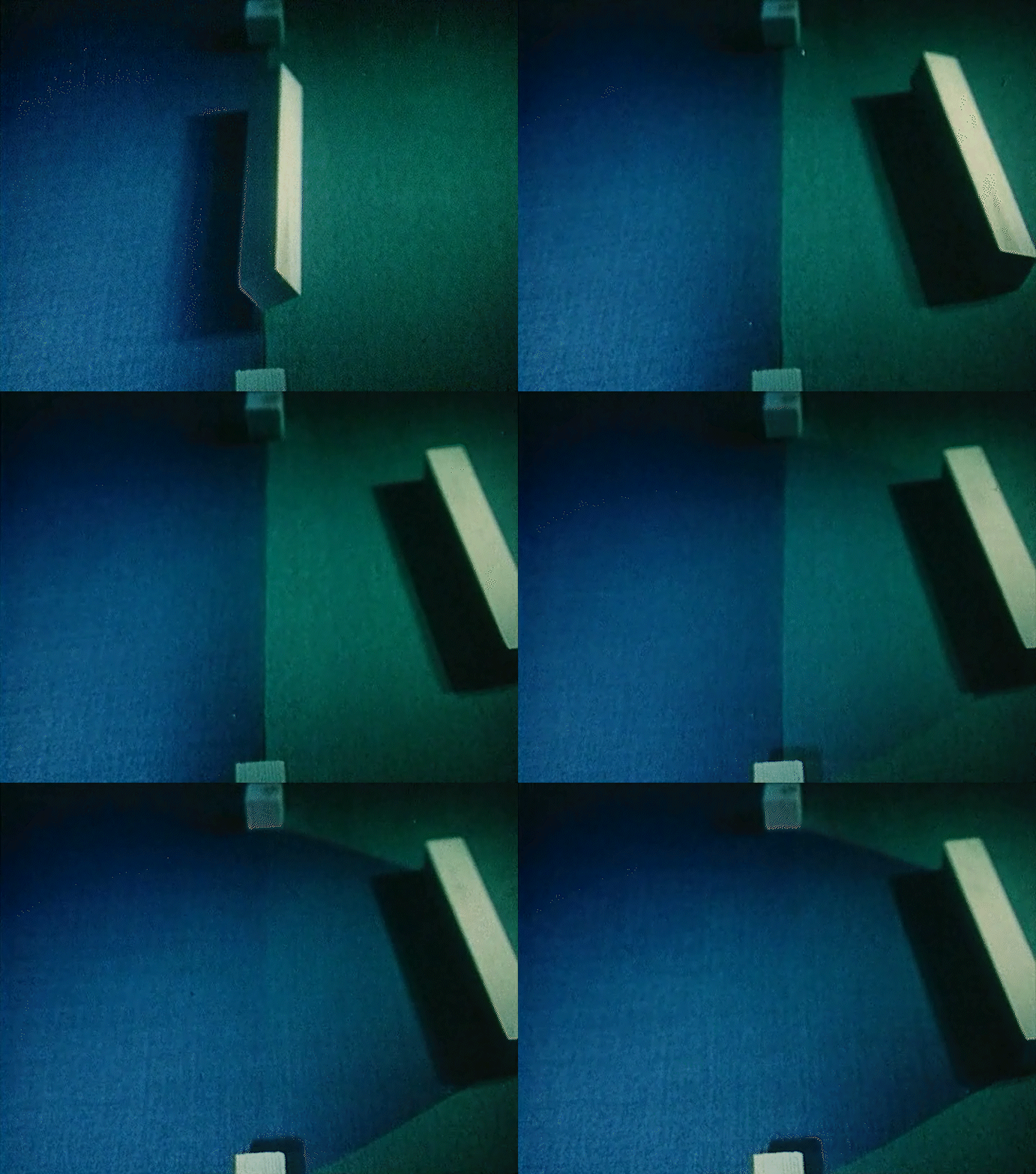
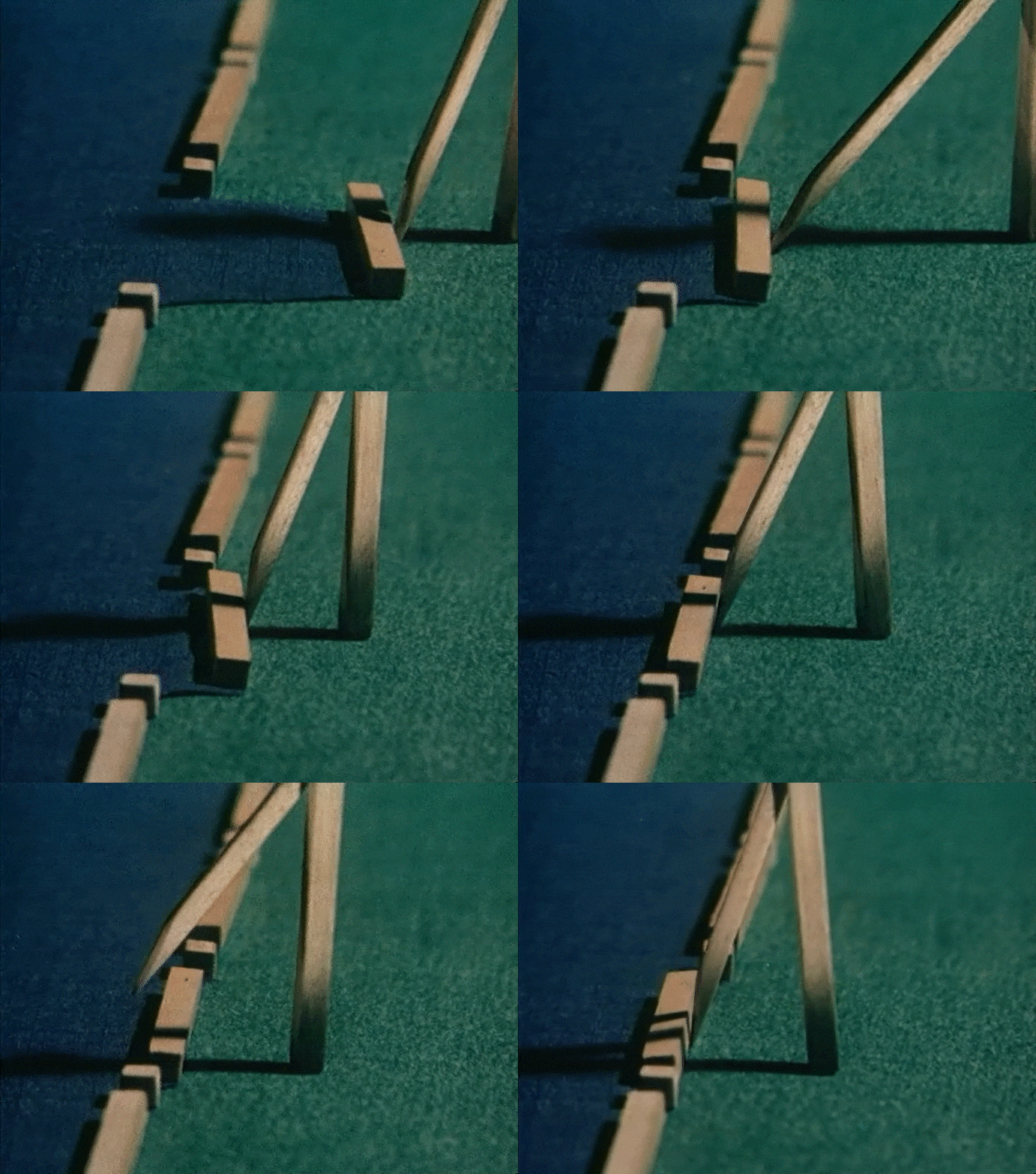
«Conflict, ” dir. Harry Bardin, 1983.
«Conflict,» directed by Garry Bardin, 1983.
The development of conflict is shown progressively. In many scenes, the mise-en-scène is organized as a confrontation between two camps, symmetrically distributed on either side of the frame. The border between them seems unstable because it is composed of numerous segments that can be shifted or destroyed. The mobility of the material allows the adversaries to be held within a single space of conflict.
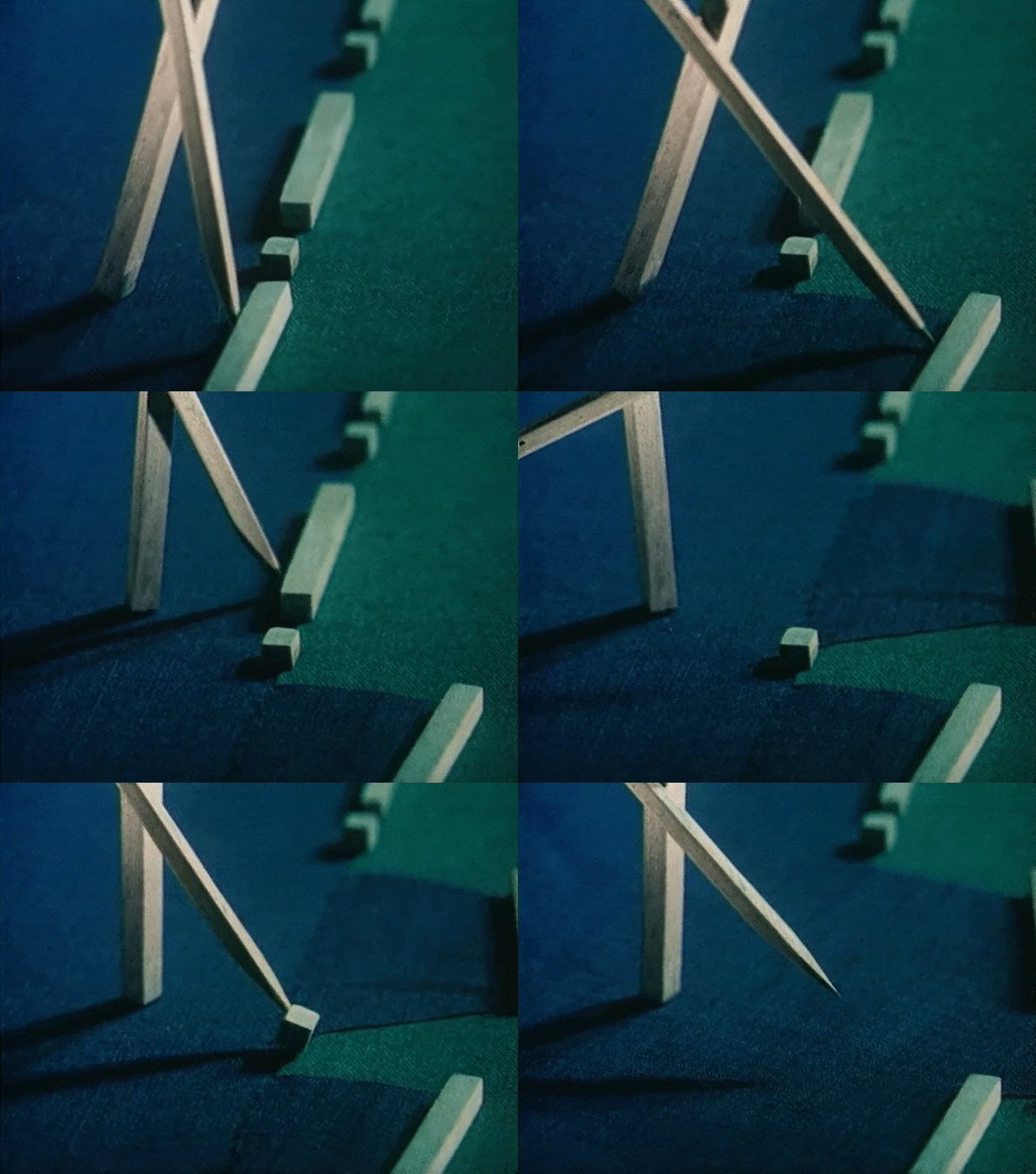
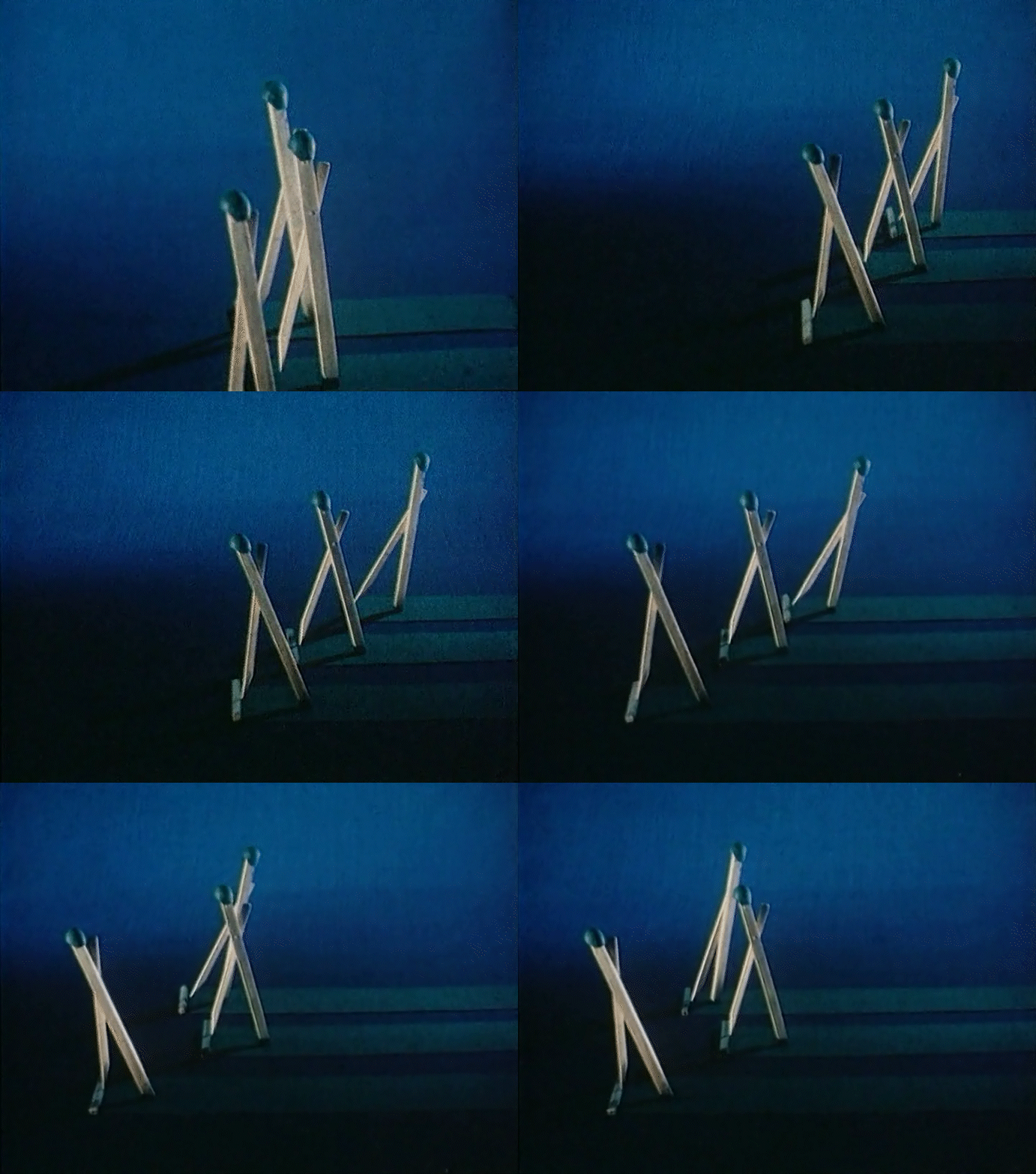
«Conflict, ” dir. Harry Bardin, 1983.
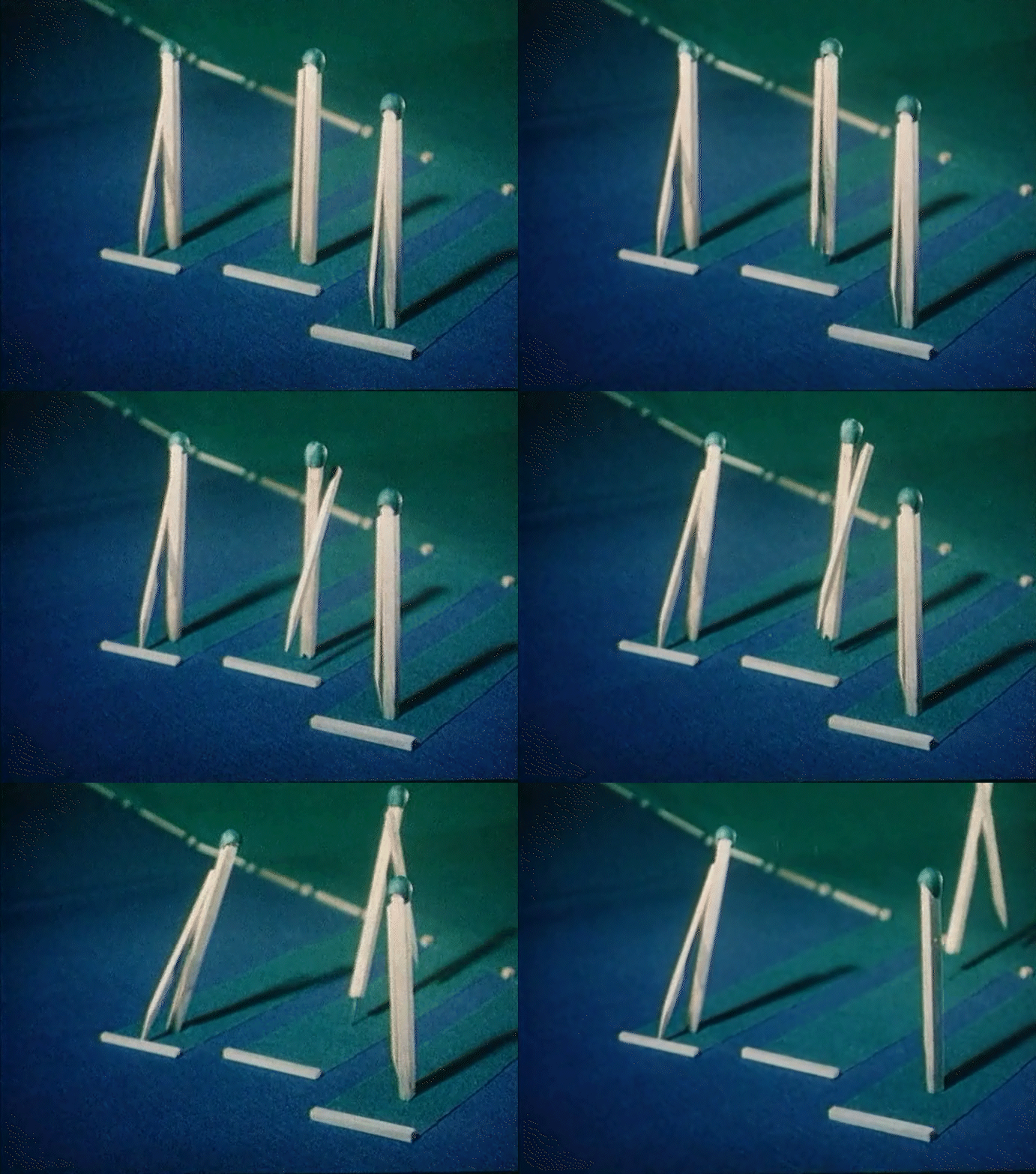
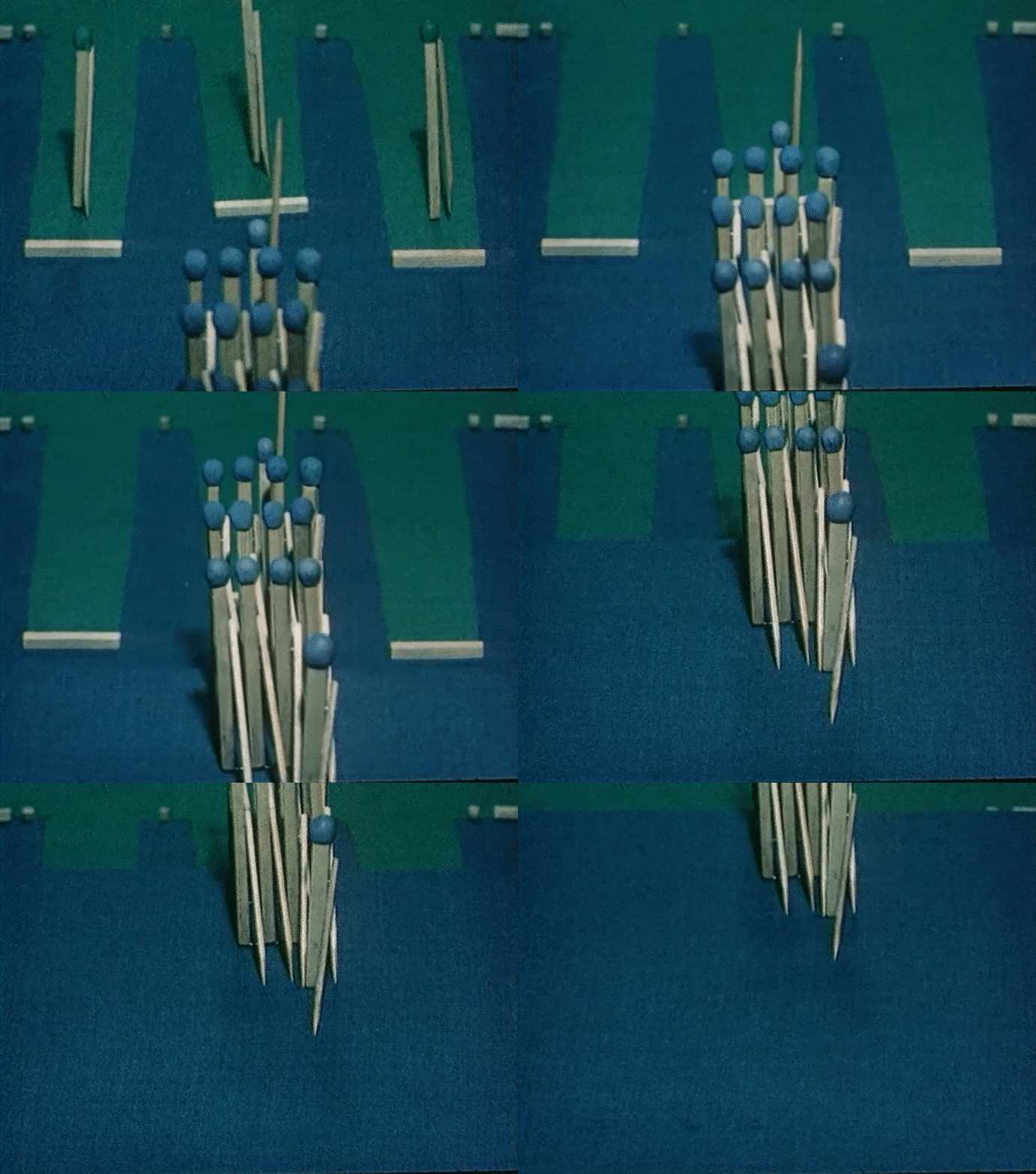
«Conflict, ” directed by Garry Bardin, 1983.
The breakthrough across the boundary happens suddenly, after which the conflict moves into a phase where a return to the original division is no longer possible.
«Conflict,» directed by Garry Bardin, 1983
During the battle scene, the space also maintains a color division of blue and green, but the boundaries between them are destabilized and are constructed diagonally. This makes the battlefield feel more dynamic.
«Conflict, ” directed by Harry Bardin, 1983.
The final shots of the film return the viewer to the box as the original enclosed space. The matches are back in the box, but their unity arises after the destruction and does not negate the conflict that occurred.
«Banquet, ” directed by Harry Bardin, 1986.
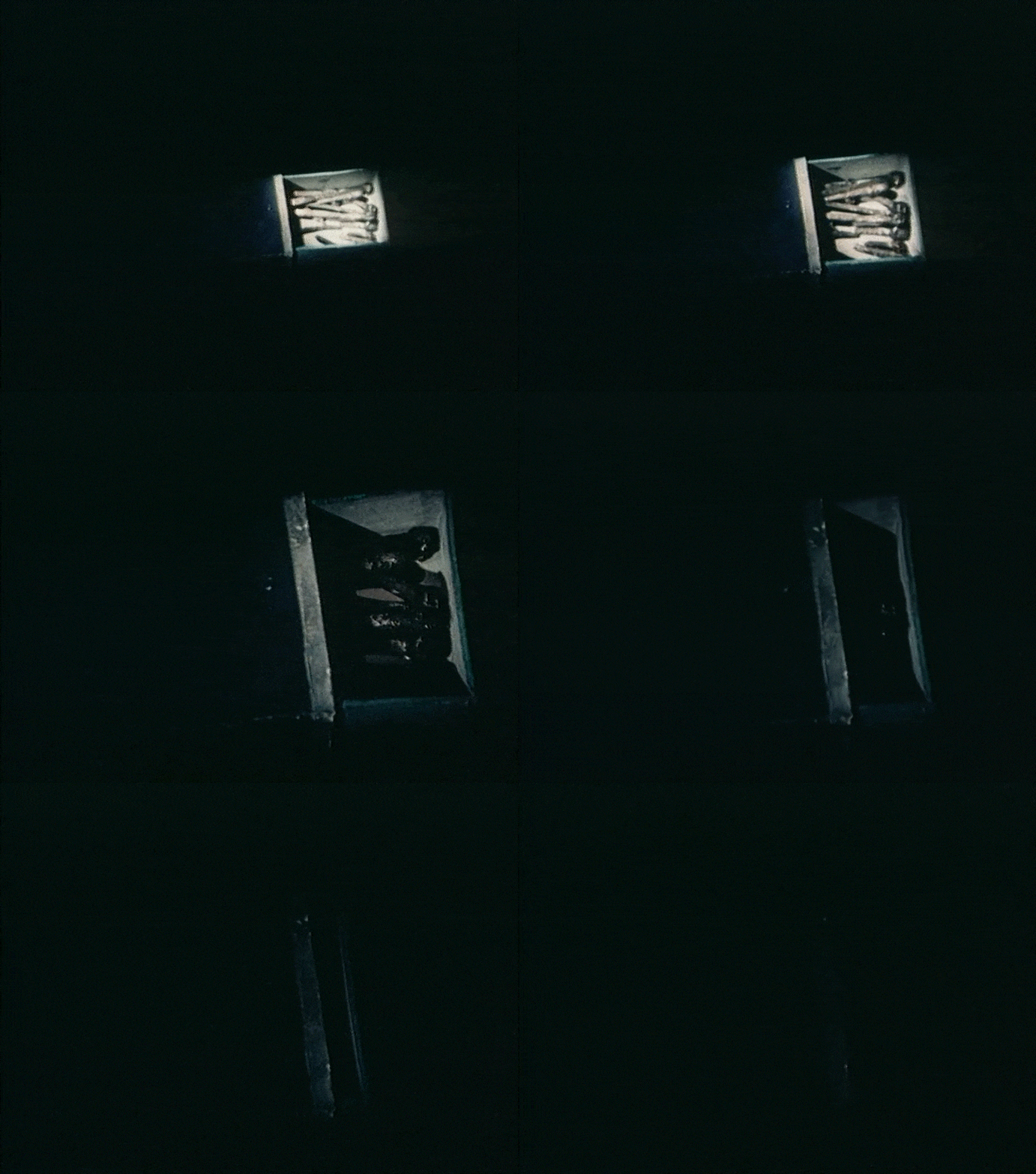
In «The Banquet, ” the space is shaped around the table and the situation of a celebratory feast. The only visible boundary is the tablecloth, illuminating the contours of a table that almost merges with the general darkness of the room.
«Banquet,» directed by Gary Bardin, 1986.
Everything outside the illuminated tablecloth is barely discernible. Guests are hidden in the darkness, recognizable only by specific visible details, characteristic actions, and voices. Thanks to this fragmentation, attention is focused on the collective event of the feast.