INDEX
| 00. Concept| 01. Funny Power| 02. Real People| 03. The Environment That Speaks| 04. Conclusion
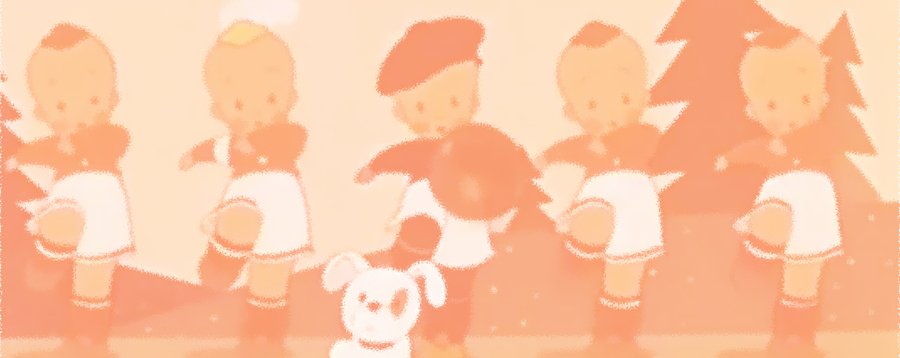
Extraordinary Match / 1955
00.
CONCEPTBy the late 1950s, Soyuzmultfilm had established a clearly defined production model, which was gradually beginning to evolve in the context of history. From the studio’s founding in 1936 until the late 1950s, Soviet animation was almost exclusively geared toward children: fairy tales, fables, epics, and stories about animals. The exception was during the Great Patriotic War, when political posters briefly returned to the screen. Technically, the studio was aligned with the Disney model—utilizing cel animation, rotoscoping, assembly-line production, vibrant plasticity, and musical rhythm. The films grew longer; production designers began working on the visuals, and full musical compositions were written for the scenes.
In the 1960s, Soviet animation underwent a stylistic turning point: the goal shifted to expanding the audience base, reintroducing «adult» genres, and exploring new artistic forms. Animations ceased being solely children’s entertainment; they were now expected to participate in the ideological education of the «new person,» serve as anti-capitalist propaganda, and critique social issues.
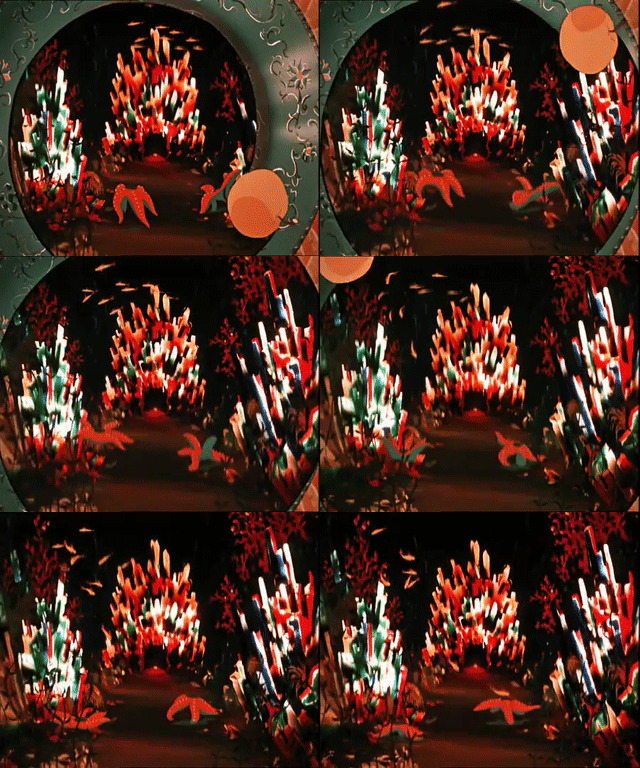
The Scarlet Flower / 1952
The early 1960s are often called the «golden age» of Soviet animation: this is when directors initiated a period of experimentation that spawned a flood of styles, genres, and artistic techniques, and later, a series of auteur animations that brought international recognition to the studio. At the turn of the 1940s and 1960s, a clear transformation in artistic methods emerged: moving from the experimental work of individual animation artists toward more complex, genre-blending forms. The international context also played a role: starting in 1960, the animation section of the Cannes Festival began independent operations in Annecy, evolving into the world’s largest showcase for animation, and Soviet animators increasingly diverged from Disney-style animation, becoming more self-sufficient.
Dyozhkin at work
It was at this moment that Boris Dyozhkin developed into a director. He studied American animation frame by frame, copying Disney cartoons, yet managed to forge his own unique style. His «Extraordinary Match» (1955) and sports films from the late 1950s demonstrate a brilliant command of the «Disney» movement—dynamic and grotesque, stretching to accompany the musical compositions. For him, it was crucial that the characters' movements were more convincing than the drawings; every body part had to be in action, not treated as separate elements. Music was also a vital component of his cartoons; the movement was shaped by rhythm, or emotions were amplified by musical accompaniment. The caricature of his drawings reinforced the characters' affiliation with their roles, positive or negative, prompting laughter at foolish heroes or eliciting sympathy for them in specific scenes.
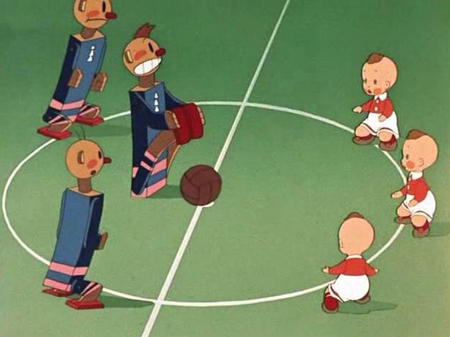
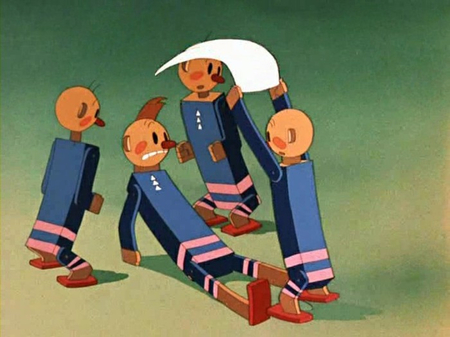
Unusual Match / 1955
At the intersection of the Disney school, the fairy tales of Soyuzmultfilm, and the new demand for «adult» satire emerges «Chipolino» (1961). Culturally, this was a moment when Soviet animation still knew how to be vibrant and «cartoony,» but it had already received permission for social critique.Deyozhkin seemed the ideal figure for such a transitional work: he mastered the tools of «cheerful» animation perfectly and could use them for opposing purposes. His characters move with a bright, dancing energy, but this energy is directed toward making power ridiculous and the oppressed sympathetic. The visual language of «Chipolino» continues the development of Soyuzmultfilm, moving away from realistic stories and fairy tale adaptations to transform its experience of vibrant plasticity and rhythm not only into a children’s story but also into an adult satire on tyranny and revolution.
Deyozhkin’s key insight is that a character’s personality is understandable even before they speak—it is evident in how they move and how they are drawn.
Dyozhkin employs a clear system: those in power are depicted as absurd and frantic. The Prince of Lemon has a hysterical, scurrying gait; Signor Tomato swells with anger, which makes him comical; and Countess Cherry has merged into one absurd entity. In contrast, the ordinary characters—Squash, Maestro Grape Inverse—are drawn warmly and simply, moving with calm confidence. This dynamic works like this: the closer a character is to power, the more jittery and comical they appear, whereas the closer they are to the earth and manual labor, the more human they seem. This is precisely why analyzing the visual language of this film allows us to see how Soviet animation, on the cusp of the 1960s, was redefining its relationship with authority—not through direct propaganda, but through irony embedded within the very plasticity of the characters.In this paper, we will analyze the visual language of «Chipolino» (1961): what techniques make those in power funny and the common people appealing. We will examine three groups of elements: characters of authority, working-class characters, and the environment—the backgrounds, homes, and how space is organized within the frame. For this research, I utilized various sources, including materials on Dyozhkin’s working methods and his study of Disney animation, studies on 1960s Soviet animation, as well as archival footage and concept art from Soyuzmultfilm.
Cipollino / 1961
01.
FUNNY POWERThe plot of «Chipolino» is built around a conflict that is read with absolute clarity within the Soviet tradition: the rulers—Prince Lemon, Signor Tomato, and the Cherry Countesses—oppress the simple inhabitants of the fruit and vegetable country, while the little onion boy and his friends stand up for justice. Even in the opening, this conflict takes on grotesque forms: Chipolino’s father is imprisoned because his son accidentally stepped on the Prince’s foot. Signor Tomato seizes Pumpkin’s home, and the Lemon soldiers arrest anyone who has displeased the authorities in any way. This is not just a fairy tale about the struggle between good and evil, but a story about how tyranny operates.This is precisely why it is important how Dezhkin depicts the negative characters in the cartoon. If he had made them visually terrifying—dark, enormous, oppressive—the film would have turned into a story about overcoming fear, but the director chooses the opposite strategy. His rulers do not frighten; they make people laugh. Prince Lemon is corpulent and bustling; Signor Tomato swells with rage; and the Cherry Countesses have fused into one comic entity. This is not a softening of the theme, but its visual resolution: the power in the film lacks an aura of seriousness, and that alone makes it vulnerable.
| Prince Lemon
Chiocolino / 1961
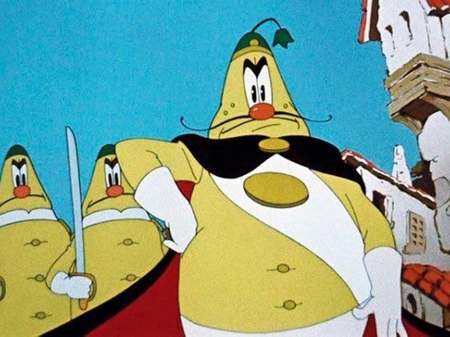
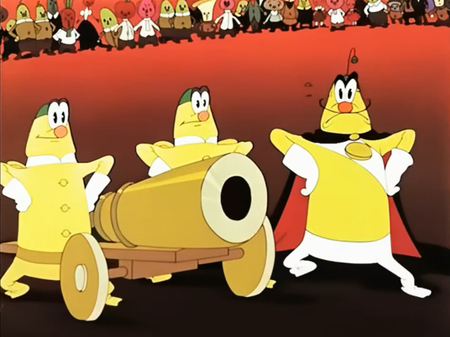
Prince Lemon is the supreme ruler of the fruit country, yet Dyozhkin depicts him with thick, hysterical lines, fragmented, and agitated movements. His body does not occupy space; rather, it is compressed within it. This figure directly contradicts the visual weight a monarch should possess: the crown seems small and constricting around his head, while the mantle hangs upon him like a vast piece of fabric. Lemon is extremely volatile and unbalanced. He is constantly accompanied by hysterical shrieks and cries—he is a ruthless, malicious, greedy, and cruel ruler who shows no regard for his people, a fact evident in how he is drawn and animated.
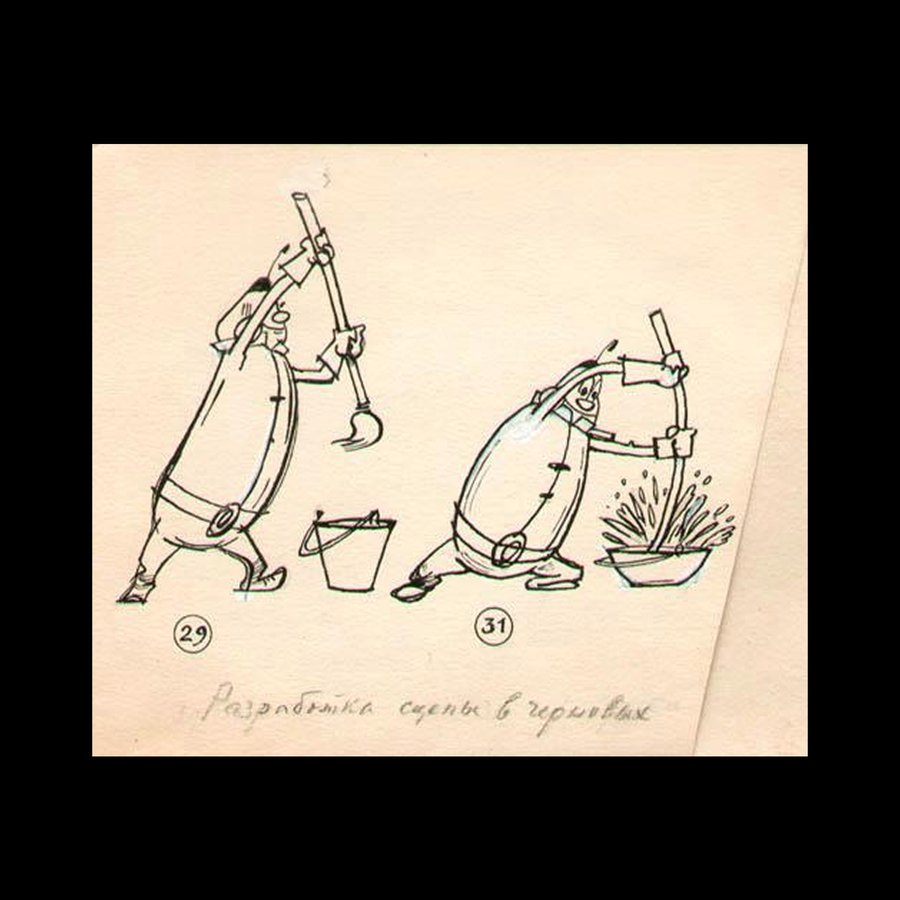
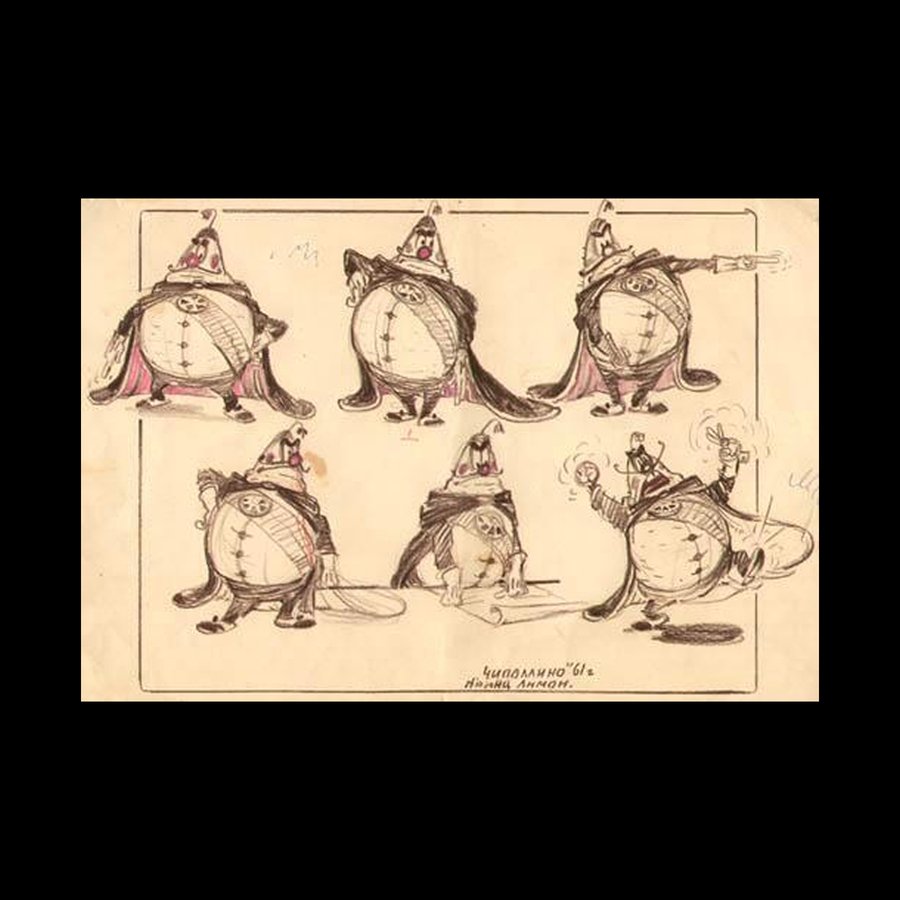
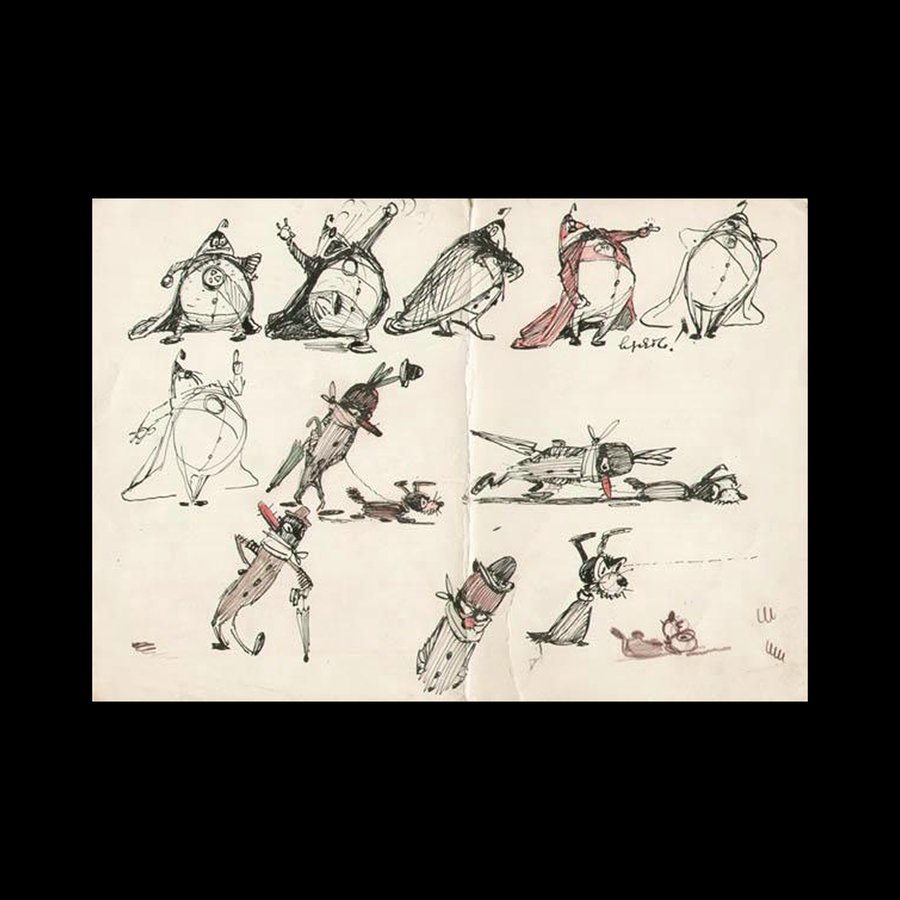
Prince Lemon/Detective Carrot and Prince Lemon/Guard / Sketches for Chippolino / Boris Dyozhkin / 1961
At first glance, the viewer sees a person who should not possess power. Moreover, the Prince of Lemon’s behavior when angry—how he is ready to execute a child simply because his leg was crushed—is combined with his histrionic movements. A person who is so easily provoked and reacts to it in such a disproportionate manner reveals the fragility of his authority. Actor Sergey Martinson, who voiced the character, infused him with nervousness and petulance, which further amplifies the effect of the «offended, chubby monarch.»
Cipollino / 1961
| Señor Tomato
Chipolino / 1961
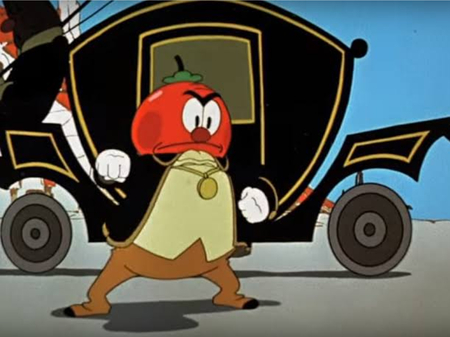
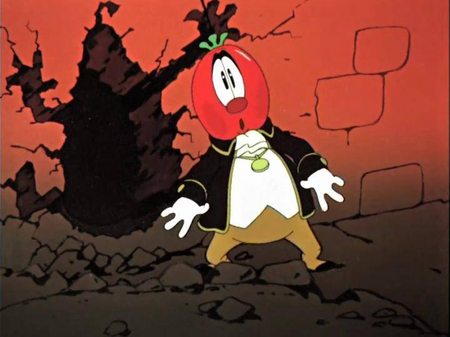
Senior Tomato—the most complex figure of authority in the film and the central subject of Dyozhkin’s visual satire. He is like a vast, red body, ready to burst at any moment. In the original source material, Tomato is a cold manager, someone «unaware of tears»; he takes Pumpkin’s house and evicts the village residents. In the plot, he is the direct agent of oppression, but Dyozhkin transforms this oppressor’s body into the object of ridicule itself. When Tomato gets angry, he swells up, his face shifts from red to a darker red, his cheeks puff out, and his eyes stretch across his entire face. His clownish transformations during moments when he should inspire fear only make the character comical.
Mr. Tomato / Sketches for Chippolino / Boris Dyozhkin / 1961
In Signore Pomodoro, Dezhkin’s stylistic power is most evident; he comically exaggerates the characters' movements, stylizing them and moving away from rotoscope smoothness. Pomodoro’s anger is not a static grimace, but a chain of spiraling bodily reactions: puffing, stomping, swelling up like a balloon. His authority is demonstrated by his ability to command and threaten, yet his body betrays him; every time he tries to look menacing, his physical form reveals the spectacle. This is Dezhkin’s method: allowing the exercise of power to become the punchline itself.
Chipolino / 1961
| Graphic Design by Vishnya
The Duchesses in the film are not villains, but they serve as an example of visual sarcasm. They are two bodies with one single, tall, fused hairstyle. They move together, wear the same expressions, speak, and panic in unison.The political implication of this choice is profoundly direct: aristocracy here is not a collection of individuals, but a fused construct. Individuality has vanished; only the repeatability of class membership remains. When they panic simultaneously, it is not felt as the emotion of two distinct characters, but as a collective reaction of the class. Dyozhkin does not force them to commit anything particularly cruel, but their entire manner of being—how they move, how they occupy space, how they synchronize—already speaks volumes about these characters.