Parsuna: Face and Position
How to identify a person when their image simultaneously represents royal power, court rank, or a role within court society?
The aim of the study is that in a persona, the face and social signs work together, but their relationship changes from portrait to portrait.
Table of Contents
Research Concept
I. The Royal Formula
II. Figure and Rank
III. Costume and Gesture
IV. Face and Role
V. Name and Attribution
Conclusions
Bibliography
Image Sources
Question and Hypothesis
The parsun is interesting not only as an early form of Russian portraiture but also as an image in which one must distinguish between the person and their social standing. In one work, the gaze captures attention; in another, it is the crown, the jeweled collar, the weapon, or the inscription. Moreover, identification is not solely dependent on physical resemblance: the viewer can understand that they are looking at a sovereign even before reading their name. This study is dedicated to how these different modes of identification interact within the image.
The key question is: through what means does the late 17th-century parsun portray a specific individual while simultaneously cementing their status? The working hypothesis is that the face, costume, gesture, and inscription form a joint system of identification. Individual features do not necessarily displace conventional composition. On the contrary, an expressive face can remain part of a stable schema, and the detailed rendering of fabric can intensify the significance of the social role. This hypothesis must be tested on portraits where the relationship between the face and its attributes varies.
Material and Method
The core of this study comprises a curated selection of works from the collection of the State Russian Museum. We have chosen royal double portraits of Mikhail Fedorovich and Alexei Mikhailovich, a portrait by Anikita Repnin, female portraits by Martha Matveevna and Natalia Kirillovna, as well as several pieces from the Transfiguration series. This selection allows for a comparison not of random masterpieces, but of diverse solutions to a single problem within a closely related historical period. The primary material dates to the latter half of the 17th century, predominantly from 1680–1690. Works dated into the 18th century have been excluded from this corpus.
The unit of analysis is not the biography of the subject, but the visible relationship between details. Initially, the portrait is presented in its entirety; subsequently, an individual fragment is compared with a similar section from another work. Factors considered include the angle of the head, the positioning of the hands, the density of the ornamentation, the contours of the silhouette, and the placement of inscriptions. The fragments are not presented as independent works. The scale of the reproductions may vary during comparison—the objective is to reveal compositional relationships, not to replicate the museum display in life-size.
Material and Method
The core of this research consists of a curated selection of works from the State Russian Museum collection. The chosen pieces include royal paired portraits of Mikhail Fyodorovich and Alexey Mikhailovich, a portrait by Anikita Repnin, female portraits by Martha Matveevna and Natalia Kirillovna, as well as several works from the Transformation series. This selection allows for a comparison not of arbitrary masterpieces, but of diverse solutions to a single problem within a closely related historical period. The main material dates from the latter half of the 17th century, primarily from the 1680s–1690s. Works dated into the 18th century have been excluded from this corpus.The unit of analysis is not the biography of the sitter, but the visible relationship between details. Initially, the portrait is presented in its entirety; subsequently, an isolated fragment is compared with a similar section from another work. Factors considered include the tilt of the head, the position of the hands, the density of the ornamentation, the boundaries of the silhouette, and the placement of inscriptions. Fragments are never presented as standalone works. The scale of the reproductions used for comparison may vary—the objective of the comparison is to reveal compositional relationships, not to replicate the museum display at life size.
Structure and Sources
The categorization is structured around different ways of representing the human figure. The first section examines the imperial image and its recurring system of regalia. The second focuses on the full-length figure of a courtier. The third is dedicated to women’s costume and gesture. The fourth tests the initial hypothesis using the Preobrazhenskaya series, where facial expressiveness merges with a courtly role. The final section investigates inscriptions, the limitations of visual recognition, and shifts in museum attributions. This sequence allows a progression from the most stable forms to cases that cannot be reduced to a simple dichotomy between convention and individuality.
The primary source for attributions is the current subject catalog of the Russian Museum: it enables the verification of title, date, material, and inventory number. A reference article on the «parsune» is used to define the term. B. Ivanova’s study helps account for the memorial function of the early portrait without automatically equating it to the funerary purpose of each work. Museum interpretations are accompanied by citations; observations on composition are articulated separately and are not attributed to other authors.
Important limitation of the method: reproduction allows for the analysis of visible forms, but it does not prove the accuracy of similarity to the human, the artist’s character, or intentions. Therefore, the study does not reconstruct the psychology of the models based on facial expression. Its result should be a model verifiable through a visual sequence: which elements convey status, which distinguish characters, and in what cases a single image is insufficient to establish identity.
Two entities—one structure
-
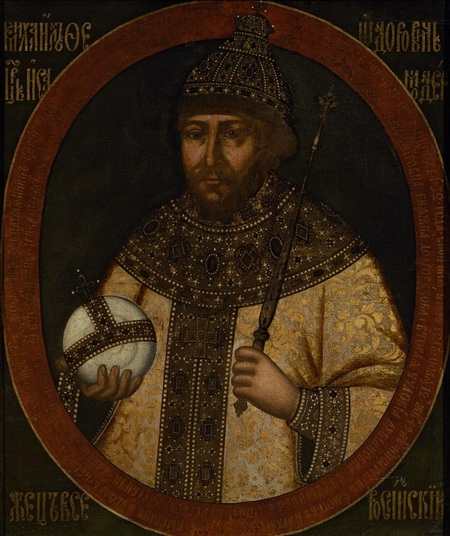
Unknown artist. Portrait of Tsar Michael Fyodorovich. Second half of the 17th century. 1680s. Canvas, oil. 33,0 × 28.2 inches. State Russian Museum, J-3978.
-
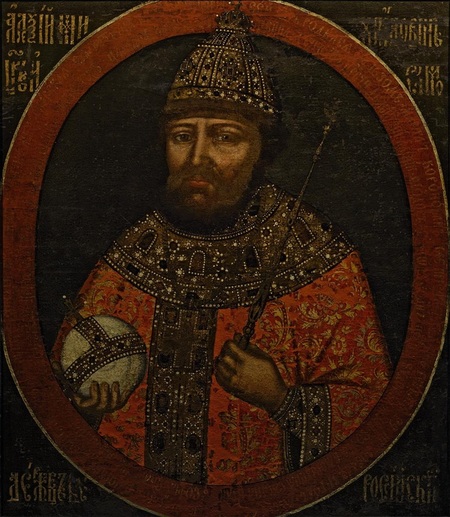
Unknown artist. Portrait of Tsar Alexey Mikhailovich. Second half of the 17th century. 1680s. Canvas, oil. 33,0 × 30.7 inches. State Russian Museum, J-3979.
The paired portraits of Mikhail Fyodorovich and Alexei Mikhailovich are built around the oval, the crown, and the regalia. The repeated composition makes the royal status recognizable even before the name is read. Differences in the faces are maintained within the overall scheme: individuality does not negate the visual unity of power.
Regalia binds hands
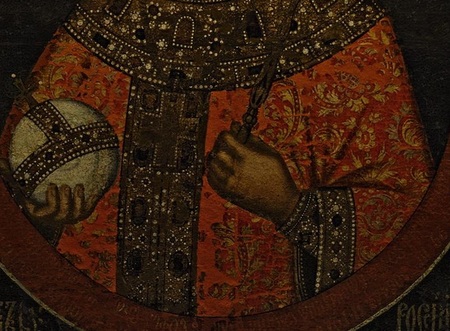
-
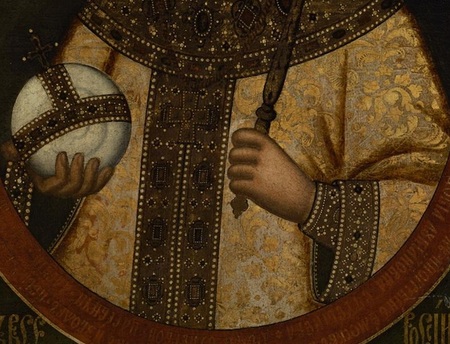
Unknown artist. Portrait of Tsar Mikhail Fyodorovich. Second half of the 17th century. 1680s. Canvas, oil. 83,5 × 71.5 cm. State Russian Museum, J-3978. Hands and regalia.
-
Unknown artist. Portrait of Tsar Alexey Mikhailovich. Second half of the 17th century. 1680s. Canvas, oil. 83,5 × 78 cm. State Russian Museum, J-3979. Hands and regalia.
The hands are included in the demonstration of power and the scepter. They are not performing a mundane action, but are holding objects necessary to represent authority. The similarity in the placement of the objects outweighs the differences in the brushwork.
The face inside the ornament
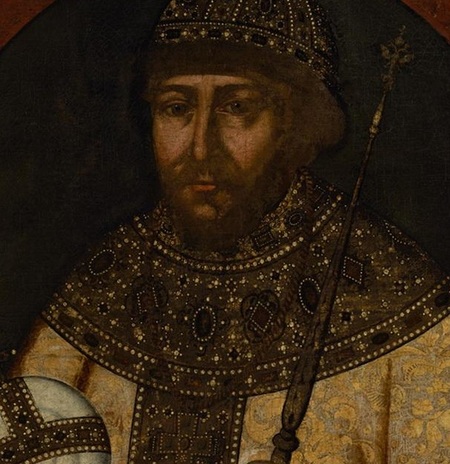
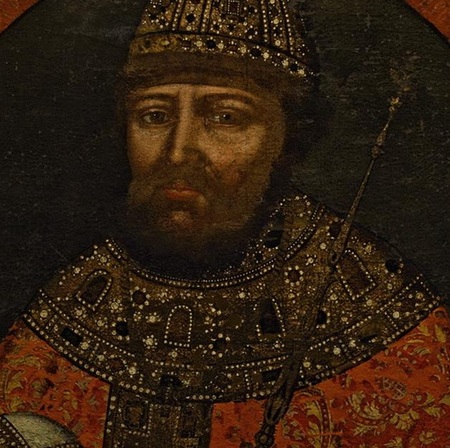
-
Unknown Artist. Portrait of Tsar Mikhail Fyodorovich. Second half of the 17th century. 1680s. Canvas, oil. 83,5 × 71.5 cm. State Russian Museum, Z-3978. Face and collar.
-
Unknown Artist. Portrait of Tsar Alexei Mikhailovich. Second half of the 17th century. 1680s. Canvas, oil. 83,5 × 78 cm. State Russian Museum, Z-3979. Face and collar.
The face does not disappear among the details. On the contrary, the relatively calm surface of the skin stands out against the fragmented pattern. Individuality is noticeable precisely because of the contrast between the face and the repeating decorative surroundings.
Repnin: Figure, Costume, and Weaponry
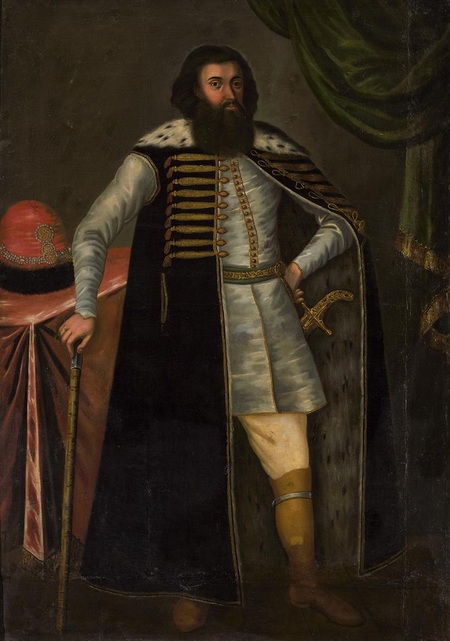
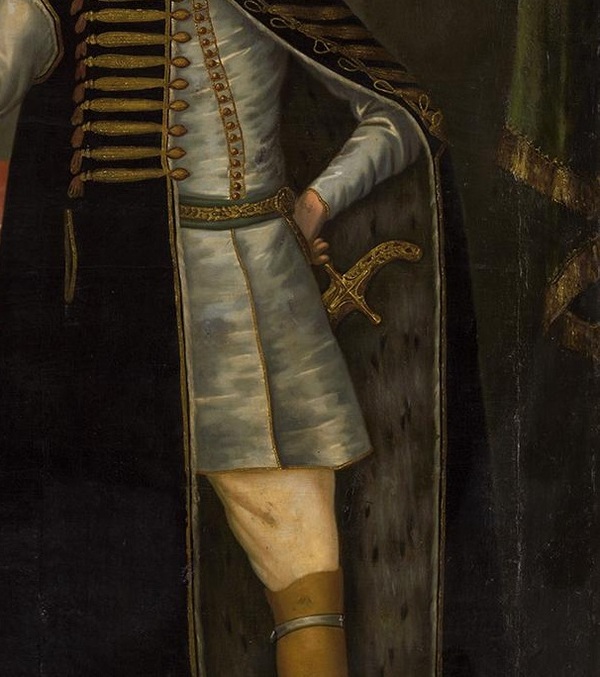
-
Unknown artist. Portrait of Prince Anikiy Ivanovich Repnin. Late 1694 — early 1695. Canvas, oil. 181 × 128 cm. State Russian Museum, J-3947.
-
Unknown artist. Portrait of Prince Anikiy Ivanovich Repnin. Late 1694 — early 1695. Canvas, oil. 181 × 128 cm. State Russian Museum, J-3947. Costume, arm, and weapon.
The full-length format connects the face, elongated silhouette, costume, and sabre. The hand holds the weapon, and the drapery sets the figure apart against the background. Social status is conveyed through the entire body pose. The sabre participates in the museum discussion of the model’s identity—the compositional detail becomes a historical testament.
Two ways to highlight a face
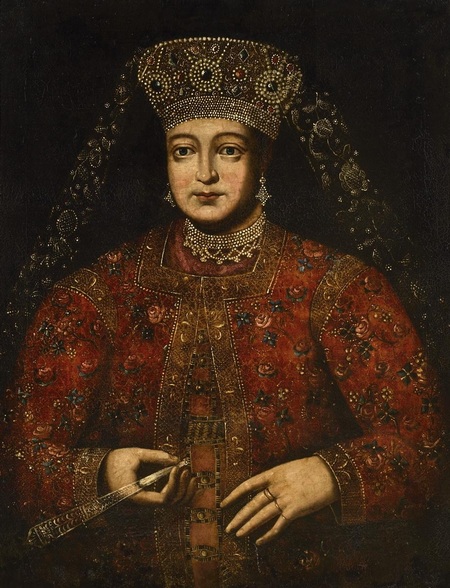
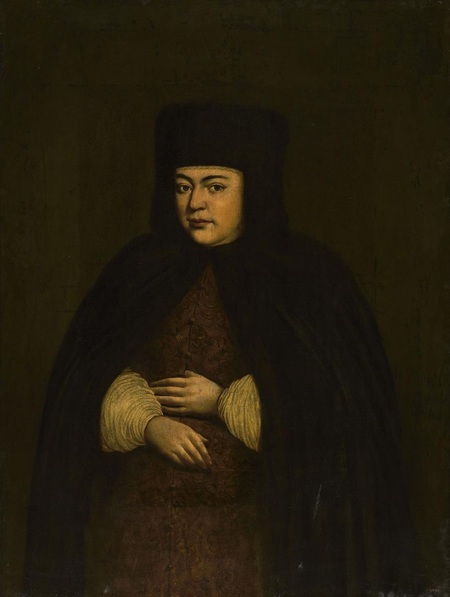
-
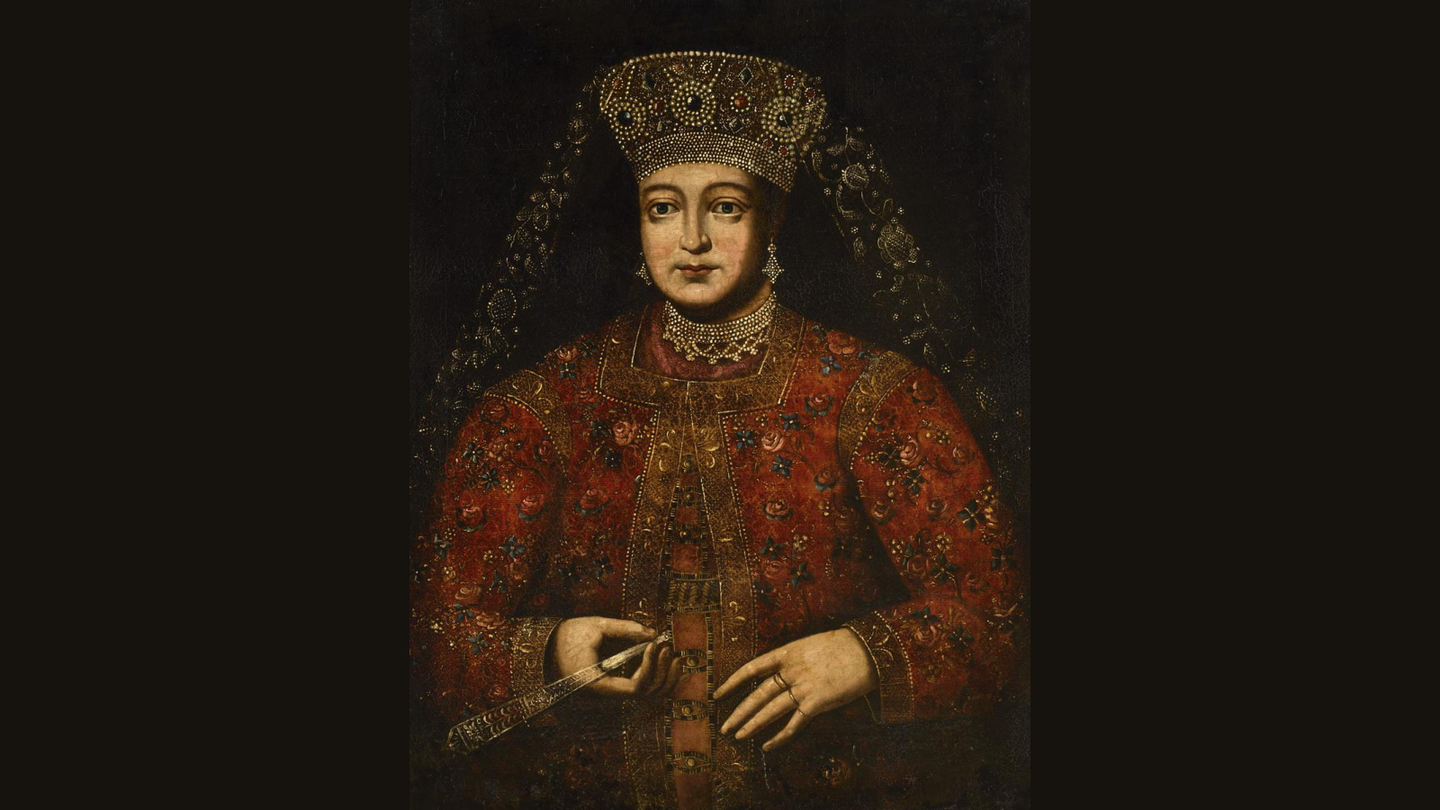
Unknown artist. Portrait of Tsarina Martha Matveevna. Not later than April 27, 1682. Canvas, oil. 89 × 70 cm. State Russian Museum, Zh-3970.
-
M. I. Choglokov. Portrait of Tsarina Natalia Kirillovna. Late January — early February 1694. Canvas, oil. 126,5 × 95.5 cm. State Russian Museum, Zh-3943.
Marpha Matveevna’s face is framed by dense ornamentation, while Natalya Kirillovna’s face is highlighted by dark clothing. The varied saturation of the surfaces shifts the distribution of attention. Moreover, Natalya’s portrait canvas was later extended—the current boundaries of the work cannot be automatically considered the artist’s original design.
Hands disrupt stillness