Navigation
- Research Concept
- Grain of Sand
- Protagonist
- Crowd
- Conclusion
Concept
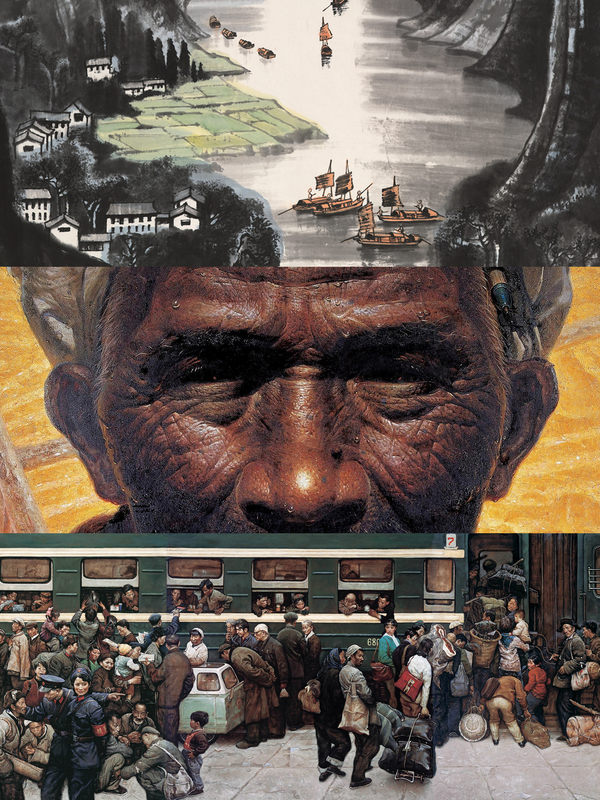
In Fan Kuang’s scroll at the foot of the mountain, tiny figures appear: a caravan of donkeys and two travelers. They are smaller than any tree, and this is not an act of diminishment, but a way of stating that the mountain is older. The 1970 poster reverses this proportion: the figure takes up half the sheet, and the landscape, if present, adapts to it. In the 1981 painting, there are many people, and none of them is the central focus.
In these cases, the size changes for reasons that have nothing to do with fashion.
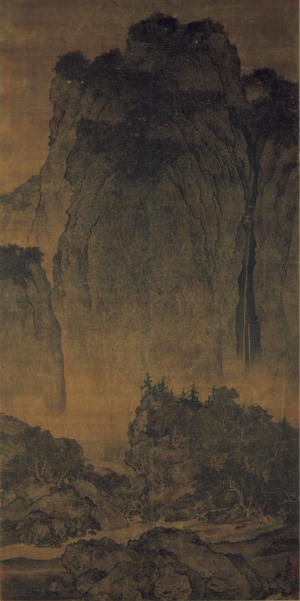
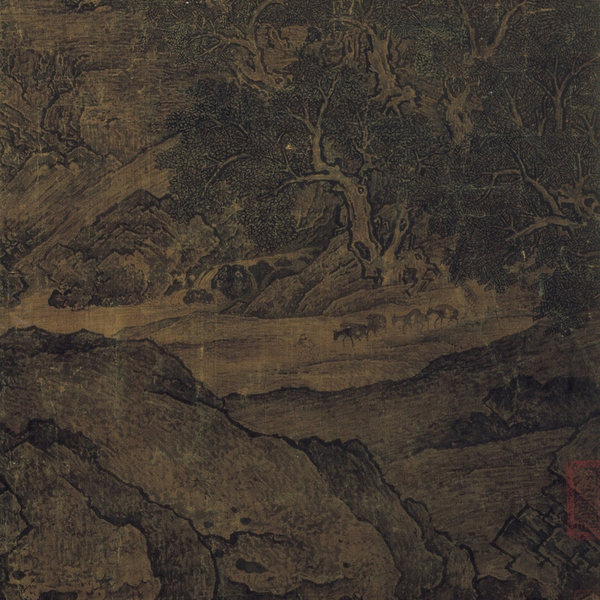
Fan Quan. Travelers Among Mountains and Currents. Circa 1000–1020
The scale was chosen as the subject of study because it is present in every image—whether a scroll, a poster, or a photograph—and is independent of the technique. This allows for the comparison of otherwise incomparable things and reveals that what is changing is not the style, but the measure of the human being.
Key Question: What explains the sudden shift in the scale of the human figure in Chinese imagery—from an almost indiscernible point to a figure dominating the frame—and what changes along with it?
Apparently, the scale of the figure indicates to whom in the image the authority belongs. The 20th century in China changed this answer several times, and this was noticeable before the slogans did. The poster and the painting use the same medium, only with different signs.
This is usually explained by changes in eras: traditional painting, socialist realism, modern art. But in the same years, there also appear posters with dozens of small figures distributed across the sheet, much like an illustration, and posters where a single figure grows almost to the top edge.
The difference between them was the nature of the relationship that needed to be established with the person.
Central Academy of Arts and Crafts, Beijing. For the honor of the great leader Chairman Mao, for the honor of the great socialist motherland. July 1970
If that is the case, the figure size is a working tool.
One might say that the world is larger than the individual; that a person is equal to history; and that there are many people, and they are not considered as a whole. The method used is economical: neither symbols nor captions are necessary—it is sufficient to alter the relationship between the figure and the frame. Furthermore, its application is not always dictated by politics; sometimes it precedes political discourse, and sometimes it lags behind it.The sections are organized based on the scale of the person within the frame: first, diminished, then enlarged, and finally, one among many. Each section features works from various techniques and years so that the scale does not appear to be a relic of a specific time. The selection principle is simple: included works demonstrate the relationship between the figure’s height and the frame’s height without requiring explanation. Fans and miniatures are excluded, as the carrier dictates the scale, rendering the artist’s solution irrelevant. The timeframe covered is the 20th century and the beginning of the 21st; a classical landscape is included as a point of reference.
Gao Xiaohua. Rushing to catch the train. 1981
The work draws on various texts: art history provides dating and context, image theory offers a language to describe the background and point of view, and the poster archive allows for working with print run as a material.Yet, everything is tested against Lu Junli’s «Father»: the canvas is nearly two meters high, and the face fills it entirely. The piece was created in the 1980s, when heroic scale was still dominant—and yet it is a monument to a man who was never a hero. The scale remains, but the pathos fades. If this is the case, then the figure’s size is a tool wielded by the artist.
Grain of sand
In 1974, during the height of poster heroism, sheets appeared where the human figure is almost indiscernible. The same commission, the same theme—collective labor—but the scale is different. And it speaks more than the narrative.
Liu Qizhi. Battle on the Quyu River. 1974
The slope dominates nearly the entire page; the people on it are rendered as short strokes: carrying stretchers, baskets filled with stone, bent backs. No faces are defined; the work is done by hand, and a wooden winch raises the stone upward. The artist demonstrates the scale of the labor—how much earth needs to be dug and how many hands are required for it. The individual here is a unit of labor, and the scale captures this more precisely than any slogan. On the next page, the focus shifts from the labor to its outcome—the cultivated earth.
Ma Jianya. The village has changed its appearance. 1974
Panorama: terraces, skirts, cars, canal. Figures are scattered across the entire width of the page, and the gaze sweeps over the harvest rather than the people. The subject of the page is the cultivated earth; the person is part of the landscape, equal to the tractor and the bridge. The third page reduces the pathos to a mundane scene, and the scale is maintained.
Lü Zhigui. Harvest in Shanxi. 1974
The harvester on the cart seems dominant: he is in the foreground, his arm is raised, and his face is turned toward the viewer. Yet, the horizon is high, the field stretches out to it, and there are dozens of similar harvesters in that field—the large foreground element doesn’t isolate anyone; it only brings them closer.
Li Kejian. River Landscape of Li. 1977
The mountains occupy almost the entire sheet; the boats with people on the light water are small spots, and no single figure stands out. There is no labor, no feat, no slogan here—it is a landscape in which the human being is integrated into the world and does not claim anything more. Scale functions as it does in a poster, but it is set by painting—and because of this, it is more evident that the technique does not belong to a specific era.
Yao Lu. Boats by Mount Yu. 2008
The mountain here is a landfill of construction debris covered in netting, and the water is a mist layered on top. The composition borrows from a classic scroll, and the human figure within it is once again tiny: a boat, a figure on the shore. Yao Lu continues this tradition, substituting a different content underneath it, and the scale remains the same.
Works from 1974, painting from 1977, and photography from 2008 are structured similarly: a vast world, a small human figure. Thirty-four years and a shift in medium separate them, yet the relationship between the figure and the frame remains unchanged.
Scale, in this context, is a way to convey that the world exists prior to humanity and is not measured by us.