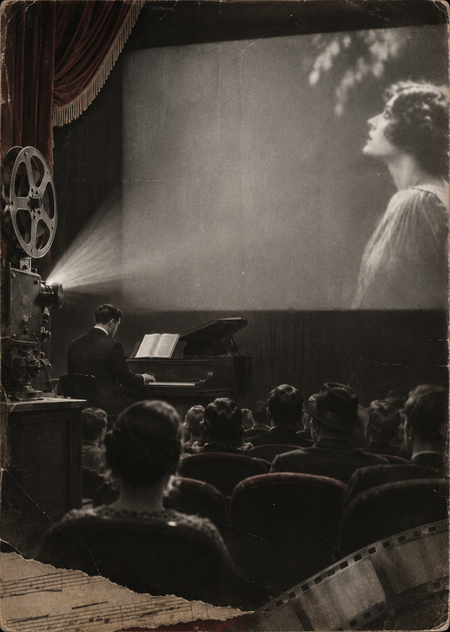
Navigation Menu
- Visual Research Concepts
- The Birth of Silent Film: Image Without Recorded Sound
- The Cinema Viewing Space: From Early Screenings to Movie Theaters
- The Taper: Music Born Alongside the Image
- Musical Compilations: How Film Moods Were Curated
- Musical Cues: Early Methods of Sound and Image Synchronization
- The Orchestra in the Cinema Hall: Transforming a Screening into a Performance
- The Kinetophone: An Entire Orchestra in One Instrument
- Sound Effects: How the Audible World of Film Was Created
- The Voice of Silent Cinema: Narrators and Japanese Benshi
- From Live Performance to Recorded Sound
- Conclusion: Why Silent Film Was Not Silent
- Bibliography
- Image Sources
Concept
Visual research is dedicated to examining the sonic component of late 19th-century cinema. Silent film is often perceived as the art of moving images without sound, but in practice, cinematic presentations were significantly more diverse. While there were no recorded dialogues and audiences were not in complete silence, because showings in many movie houses were accompanied by music, vocal commentary, and specially created sound effects.
The selection of the theme stems from the tension between the contemporary perception of silent film and how it was received by audiences of its era. Today, films can be viewed anywhere—from digital platforms to archival recordings. In the early 20th century, watching a film was often a collective event involving not only the actors on screen but also the musicians, performers, and audience members present in the theater. Sound altered the mood of a scene, intensified dramatic tension, and created comedic effects; all these elements were perceived as a single, cohesive experience.
The visual investigation spans the period from the advent of public film screenings in the 1890s to the widespread adoption of sound cinema around the turn of the 1920s and 1930s. The primary focus is on the musical and sound accompaniment within Western cinema practices, as well as the Japanese tradition of live film commentary. This selection illustrates that silent cinema did not possess a singular sonic form; everything depended on the country, the historical period, available technology, and the performers' skills.
The structure is built around the sequential unfolding of the main forms of support. Initially, the stages of film screening and the reasons for the emergence of sound accompaniment are examined. Following this, individual methods of sound creation are analyzed. The concluding section is devoted to the transition from live performance to technically synchronized sound.
The central question of this research is: how does sound become a component of silent film screenings, and what role did it play in the audience’s perception of the film? The hypothesis posits that silent cinema should be viewed not merely as recorded imagery, but as a distinct form of audiovisual presentation whose ultimate character was shaped directly during the screening. Sound effect performers could influence the viewers as much as the image itself. The sonic presentation constituted a vital artistic element.
Edison’s Greatest Marvel — The Vitascope, advertising lithograph, Metropolitan Print Company, 1896.
The Birth of Silent Film: Imagery Without Recorded Sound
The birth of cinema in the late 19th century was tied to technological advancements. One of the most famous events was the Lumière brothers' commercial film screening on December 28, 1895, in Paris. The films consisted of short scenes depicting everyday life. The main novelty was the ability to witness movement, something previously accessible only in real life.
The technology of that era did not allow for the conventional recording and playback of synchronized sound alongside images. Film existed as a sequence of frames. However, sound was not entirely absent from the cinematic experience. Conductors, musicians, and audiences could create their own sonic environment around the moving images.
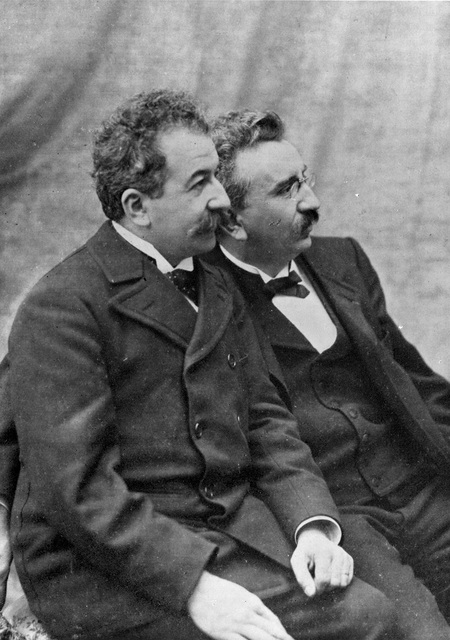
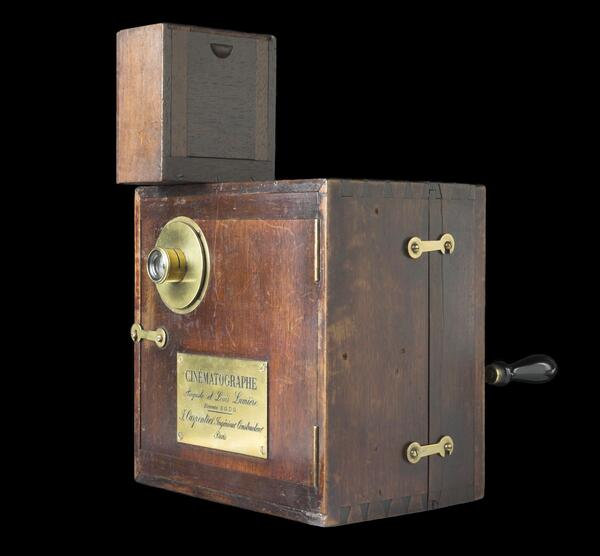
The Lumière brothers' cinema and historical materials on the first film screenings, 1895.
It should be noted that musical accompaniment was not immediately mandatory after the invention of cinema. In the early days of filmmaking, some films were shown without synchronized sound. In other cases, music might play independently of what was happening on screen. Eventually, the development of longer narrative films and movie theaters led to the establishment of a consistent practice of musical scoring.
Edison’s Greatest Marvel — The Vitascope, archival print of a promotional lithograph, 1896.
Screening space: from first screenings to cinemas
Early films were often shown in venues not originally intended for cinema. These could include variety theaters, music halls, and others. Film screenings became one element within a broader program alongside musical and stage performances. This origin largely explains the presence of live sound in early cinema.
As cinema grew in popularity, specialized venues emerged. Small movie theaters might have featured a single pianist for musical accompaniment, whereas larger venues employed their own ensembles and orchestras. Thus, the sound environment depended not only on the film itself but also on the capabilities of the theater.
Normal Theater, Chicago, interior photograph, 1909. Photographer unknown.
In the 1910s and 1920s, movie theaters gradually transformed into spaces for mass entertainment. Their architecture incorporated decorative halls, stages, orchestra pits, and dedicated spaces for musical instruments. The audience bought a ticket not just for a film, but for an entire performance—a unified experience created by the music, interior design, and lighting.
Interior of the first building to house a Nickelodeon in Pittsburgh, 1907
Taper: music born alongside image
The most popular form of accompanying silent film was live piano performance. The musician who played during the movie screening was called a taper. During the film, the taper would be positioned near the screen or in a designated spot and perform music throughout the feature. This form of accompaniment was relatively accessible and did not require a large ensemble of performers.
The tap dancer’s role was not limited to performing pre-choreographed pieces; they could also improvise and vary the tempo. Fast passages could accompany a chase sequence, soft melodies a romantic scene, and tense chords convey danger or anxiety. Consequently, the film could be perceived entirely differently in various cinemas.
Musical scores used by pianist Ines Garrison while accompanying silent films at the Garden Theater in Kansas, 1920s.
The taper’s contribution was immensely important. Unlike modern soundtracks, its performance was not entirely pre-recorded. It depended on the skill, attentiveness, and musical experience of the individual performer. The taper became a unique intermediary between the screen and the audience, transforming the act of watching a film into an unreproducible live performance.
Ben Modell accompanies a silent film on piano during the Mostly Lost event at the Library of Congress, photographer Sean Miller, 2015.
Music Compilations: How the Mood of a Film Was Selected
With the rise of cinema, there arose a need to systematize music. Musicians utilized not only their own improvisations but also popular melodies, classical works, and specialized music collections. These publications contained short compositions that could be used in various narrative scenes.
Some of the most renowned compilations were «photoplay music.» These recordings were classified by emotional character and action type. This allowed the musician to quickly select accompaniment for what was happening on screen. Music gradually evolved into a kind of library of emotional states.