Navigation
CONCEPTCHAPTER 1. Object as an Image of Soviet Reality. 1.1 «Communal Kitchen» 1.2 «Toilet» 1.3 «Trash Can»CHAPTER 2. Object as an Archive of Memories 2.1 «16 Ropes» 2.2 «Labyrinth. My Mother’s Album» 2.3 «The Person Who Never Threw Anything Away» from «10 Characters»CHAPTER 3. Untidiness as a State of the World 3.1 «The Person Who Flew into Space from Their Room»CONCLUSION
CONCEPT
Ilya Kabakov is one of the most significant figures of Moscow Conceptualism. For nearly thirty years, he worked as an illustrator for children’s books, but it was his total installations that brought him worldwide fame. In these works, the artist creates a fictional space filled with ordinary objects of Soviet daily life: dishes, photographs, notes, old items, and trash. Through these objects, Kabakov speaks about people who often remain unseen themselves. The viewer does not see the main character directly, but can reconstruct their image by carefully observing the surrounding environment.
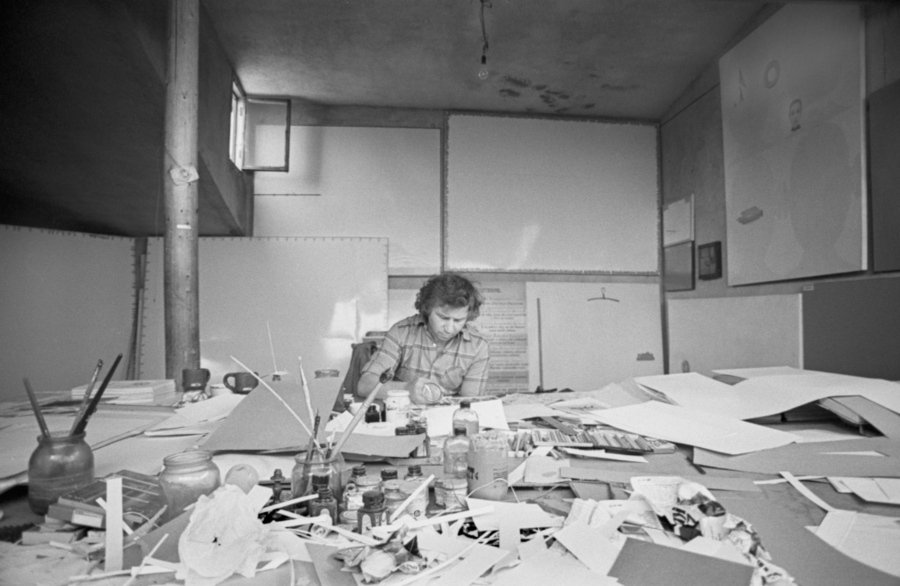
Ilya Kobyakov in his studio, Sretensky Boulevard, 1985
The central research question is how the placement of everyday objects within Ilya Kabakov’s installations shapes the image of the absent person, and what details of the setting allow the viewer to infer his habits, past, and potential actions.
In Ilya Kabakov’s installations, everyday objects serve as a means to narrate about a person who is absent from the space. Each object—its placement and condition—can hint at specific events or traits of the character’s life. Left-behind possessions, clutter, accumulated items, and traces of daily routines gradually assemble into a kind of portrait. Through these private stories, a broader picture of Soviet daily life is revealed.
The study pays particular attention to the relationship between a person and the material world. The objects in Kabakov’s installations do more than just set a scene; they become a necessity, a means of preserving memory, and simultaneously a source of domestic burden. The inability to part with accumulated belongings, dependence on limited space, and the constant presence of unnecessary objects reflect specific aspects of Soviet life. Through these mundane details, the artist portrays not only the personal histories of his characters but also the contradictions of 20th-century culture and society.
The structure of the research is built on the principle of examining different ways in which the image of an absent person is revealed through their surrounding objects.
The first chapter is dedicated to Soviet communal life and human dependence on objects. It examines how shared spaces, cramped conditions, and everyday items reflect the habits and lifestyles of the characters.
The second chapter will discuss object accumulation and the inability to let go of the past. The items are analyzed as carriers of personal memory, allowing for the reconstruction of a person’s history and their relationship to their lived experience.
The third chapter focuses on trash and residual traces. Here, how clutter, discarded items, and the remnants of daily activity become peculiar clues that allow the viewer to hypothesize what occurred in the space and what happened to its inhabitant.
For this study, we have selected well-known total installations by Ilya Kabakov, those featured in the exhibition at the Tretyakov Gallery, as well as installation sketches that allow us to examine the features of space organization and object placement.
The textual sources include Boris Groys’s «Dialogues, ” Ilya Kabakov’s article „Not Everyone Will Be Taken Into the Future, ” as well as scholarly articles and materials dedicated to his work.
CHAPTER 1 The Object as an Image of Soviet Reality
The central question is: why is a person surrounded by objects, and what role do those objects play in their daily life?
The main question: Why is a person surrounded by objects, and what role do those objects play in their daily life?
— «A moment in the hallway near the kitchen» — «The restroom» — «The trash bin»
Here, we explore communal living, hoarding, scarcity, domestic habits, and human dependence on objects.
To understand Ilya Kabakov’s work, it is crucial to consider the historical context. In the post-war Soviet Union, the state sought to establish a new lifestyle and domestic standard, yet daily reality often diverged significantly from this ideal. Scarcity and shortages led to hoarding—people kept items long after they had lost practical value. The significance of an object was determined not so much by its monetary worth as by the personal history attached to it.During this period, Western artists also began to incorporate everyday objects into their work: for instance, Robert Rauschenberg created pieces from old furniture, clothing, and found objects, while Donald Judd utilized simple geometric forms and industrial materials in his art. Kabakov, however, focused on objects of Soviet daily life that were inherently part of his own existence and the reality surrounding him.
1.1 «Case in the hallway by the kitchen, ” 1989
«Incident in the hallway near the kitchen, ” Ilya Kabakov, 1989 Photo from the exhibition „Ilya and Emilia Kabakov. Not everyone will make it to the future, ” in the Tretyakov Gallery, 2019
«Incident in the hallway near the kitchen, ” 1989. Video for the Tretyakov Gallery exhibition, „Ilya and Emilia Kabakov. Not Everyone Will Be Taken to the Future, ” 2019.
1.2 «Toilet, ” 1992
Total Installation «Toilet, ” Ilya and Emilia Kabakov, 1992
«The Toilet» is not something negative; it is a metaphor for life. The entire world lives in a very comfortable toilet. People from different countries run away from reality, searching for an escape in their own fantasies.
CHAPTER 2
The Object as a Memory Archive
Why can something of no inherent value retain value?
The central question: why can even a seemingly unnecessary object retain value, and what happens to a person’s personal history when it transforms into a collection of things?— «The Junk Drawer» — «The Labyrinth. My Mother’s Album» — «The Person Who Never Threw Anything Away» from «10 Characters»Here, we explore memory, family history, accumulation, and the impossibility of letting go of the past.
2.1 «Trash Can, ” 1986
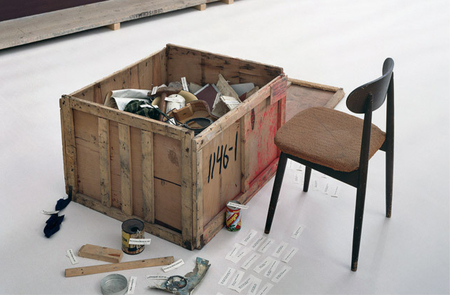
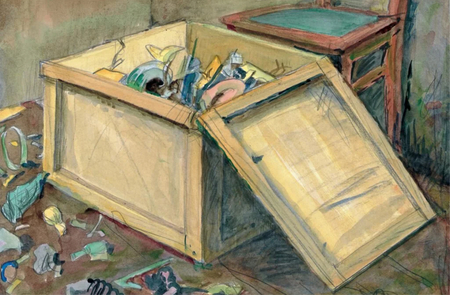
Total Installation «The Trash Box,» Ilya Kabakov, 1981
2.2 «The Person Who Never Threw Anything Away, ” 1988
Installation «The Person Who Never Threw Anything Away, ” 1988 Video for the Tretyakov Gallery exhibition „Ilya and Emilia Kabakov. Not Everyone Will Make It to the Future, ” 2019
2.3 «Labyrinth (My Mother’s Album), ” 1990
«Labyrinth (My Mother’s Album), ” Ilya and Emilia Kabakov, 1990 Video for the exhibition at the Tretyakov Gallery, „Ilya and Emilia Kabakov. Not Everyone Will Be Taken into the Future, ” 2019
CHAPTER 3
Untidiness as a State of the World
Why does Kabakov’s space appear unfinished, disrupted, and cluttered with objects?
— «The Human Who Flew to Space From His Room»Here we explore the absence of the human figure, disrupted order, traces of action, and the impossibility of finally structuring surrounding reality.
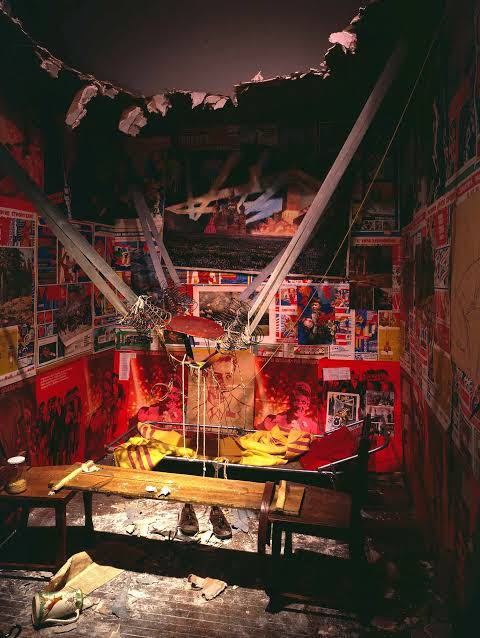
3.1 «Man Who Flew into Space from His Room, ” 1985