
Area of Study
Iconography and visual culture of 17th–18th-century Chinese porcelain, linked to the culture of the affluent class during the Qing Dynasty.

Object of Study
17th–13th-century Chinese porcelain from the Qing Dynasty, featuring motifs of animals, plants, colors, numbers, and hieroglyphs.

Research Focus
The ways in which decorative elements of Chinese porcelain acquire additional meaning and can convey wishes through symbolism, language, sonic resonance, and composition.

Key Question
How do images and other decorative elements in Chinese porcelain convey hidden meanings and wishes?

Hypothesis
I hypothesize that Chinese porcelain can be perceived not only as decorative art but also as a unique system of signs. The same element can carry multiple meanings depending on its title, sound, quantity, color, and adjacent imagery.

Research Objective
To understand how various decorative elements of Qing Dynasty Chinese porcelain create additional meanings (its own language), and to demonstrate how individual symbols coalesce into a complete message.

Objectives
1 Identify the main types of codes used in the decoration of Chinese porcelain: image, color, number, ideogram, and phonetics.
2 Examine the meanings of animals, plants, and other objects in Chinese symbolism.
3 Consider phonetic rebus—cases where an image was used because its name sounded similar to another word.
4 Investigate how numbers and their sound could influence the meaning of an image or object.
5 Analyze the significance of color in porcelain decoration and its connection to social status, good fortune, wealth, and other concepts.
6 Analyze several real porcelain objects where different types of codes are combined in a single composition.
Research Material
The research material consists of Chinese porcelain items from the 17th–13th centuries, housed in the collections of major museums, including 1. The Metropolitan Museum of Art, 2. The British Museum, 3. The Shanghai Museum, and 4. The Palace Museum. (Museum locations: 1. New York, USA; 2. London, UK; 3. Shanghai, China; 4. Beijing, China)
For analysis, I have selected objects that feature:
• Animals—bats, fish, deer, cranes, dragons, and others
• Plants and fruits—peach, peony, pomegranate, lotus
• Hieroglyphs associated with wishes
• Various color combinations
• Compositions with a specific number of elements
• Combinations of multiple symbols
Courses that integrate multiple «codes» are particularly important. For example, an image might possess its own symbolic meaning, additionally allude to another word through phonetic similarity, and its quantity or color could amplify the overall meaning of the composition.
Rationale for Material Selection
I chose Chinese porcelain because I have always been fascinated by the connection between imagery and the sound of words in the Chinese language. In their culture, a single sound can link together diverse concepts, so the picture sometimes transforms into a unique visual pun.
Furthermore, porcelain is ideal for this type of exploration because a single, small object can simultaneously incorporate many different elements: animals, plants, ornamentation, color, inscriptions, and a specific arrangement of images.
For example, the deer, through phonetic association, can connect to abundance and prosperity, while the dragon relates to power and high status. Furthermore, their meaning can be augmented by color, quantity, or other compositional elements. Therefore, I am interested in viewing the porcelain not just as a piece of art, but as a message that can be progressively deciphered.
Analysis of Photographic Material
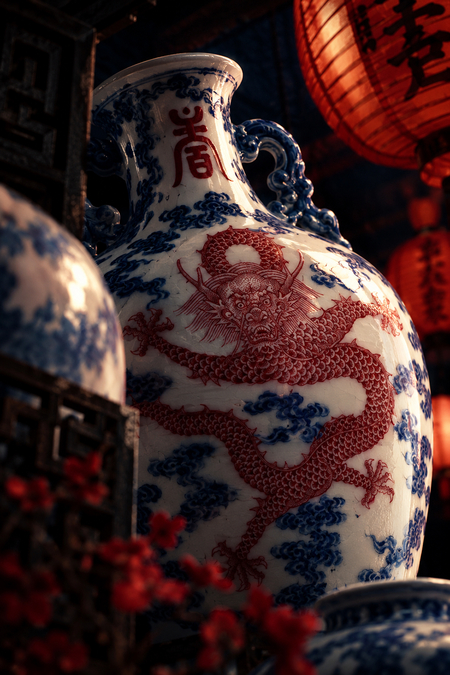
The selection of research photographs demonstrates the diverse ways Chinese masters utilized symbolism in porcelain decoration. Animals, plants, mythical creatures, hieroglyphs, and repeating motifs consistently appear on the pieces.
Moreover, the same motif can appear in various combinations, acquiring a new nuance of meaning or a new «language.» For instance, fish is linked to the concept of prosperity because of the phonetic similarity between the Chinese words for «fish» and «abundance.»
When viewing the photographs, it is important to pay attention not only to what is depicted but also to the quantity of elements, their arrangement, color, and how they combine with one another.
IMAGERY — MEANING
• Bat 蝙蝠 biānfú — Happiness 福 fú;
• Peach 桃 táo — Longevity 壽 shòu;
• Deer 禄 lù — Abundance / Prosperity 福利 fúlì;
• Fish 魚 yú — Wealth/Abundance 富裕 fùyù;
• Crane 起重機 qǐzhòngjī — Longevity 長壽 shángshòu;
• Peony 牡丹 mǔdān — Wealth 財富 sáifù;
• Mandarin 國語 guóyǔ — Luck / Well-being 運氣 yùnqì;
• Lion 獅子 shīzǐ — Protection 保護 bǎohù;
• Dragon 龍 lóng — Power, Imperial Symbolism 力量 lìliàng;
• Phoenix 鳳凰 fènghuáng — Harmony, Auspiciousness 和諧 héxié.
SOUND — MEANING
For my research, the phonetic rebus in Chinese symbolism proved particularly fascinating. In these examples, an object or animal is not chosen randomly—its name sounds the same as, or similar to, another word with the desired meaning.
For instance:
蝠 fú — 福 fú
bat — happiness
魚 yú — 餘 yú
fish — abundance
鹿 lù — 禄 lù
deer — prosperity / well-being
As a result, the image begins to perform a function akin to a word. A person sees a fish, but they also decode the idea of abundance. This is one of the most compelling aspects of the study because the visual image connects directly to language.
NUMBER — MEANING
The quantity of elements can also be part of the composition.
In Chinese culture, numbers carry specific associations often linked to their sound and tradition. Therefore, the number of details in a piece can be more than just a way to count—it can be part of the visual message.
1 — One (yī) — unity, beginning, completeness.
2 — Two (èr) — pairing, harmony, and balance.
3 — Three (sān) — development, stability, and auspiciousness.
4 — Four (sì) — is considered unlucky because it sounds like the word 死 (sǐ) — «death.»
5 — Five (wǔ) — is associated with the five elements: wood, fire, earth, metal, and water.
6 — Six (liù) — is associated with good fortune and smooth, successful affairs.
7 — Seven (qī) — holds varied meanings depending on the context and is connected to traditions and the calendar.
8 — Eight (bā) — signifies wealth, success, and prosperity; it is one of the most favorable numbers.
9 — Nine (jiǔ) — represents longevity and duration, sounding similar to 久 (jiǔ)—“long.»
10 — Ten (shí) — signifies fullness and completion.
For my research, this is important because the number stops being just a way to count objects; it can become part of the visual message.