Introduction
What makes a botanical ornament beautiful: its resemblance to nature or the organization of lines, color, and rhythm? This question allows us to examine decorative art through the philosophy of Immanuel Kant. In his Critique of Judgment (1790), Kant distinguishes between free and subordinate beauty. The former does not presuppose knowledge of the object’s purpose or ideal; pleasure arises from contemplating its form. Among examples of free beauty, the philosopher cites ornaments and floral patterns on wallpaper. However, wallpaper is a functional object intended for interior decoration. Can such an object be perceived independently of its practical purpose?The subject of study is the botanical ornaments of William Morris (1834–1896), a British artist and designer associated with the Arts and Crafts movement. His wallpapers feature leaves, flowers, stems, and fruits, but their forms adhere to the principles of repetition, symmetry, and color balance. Morris’s choice is driven precisely by this contradiction: the viewer sees representations of plants while simultaneously perceiving the composition as an autonomous system of forms. The ornament thus proves to be an ideal material for testing Kant’s distinction between free and subordinate beauty.
Research Question: Can a plant ornament that retains recognizable natural motifs and serves a decorative function be perceived as free beauty in the Kantian sense? The hypothesis is that the aesthetic pleasure derived from Morris’s ornaments is determined primarily by formal relationships—rhythm, line, repetition, and the interplay between figure and ground—rather than by botanical knowledge. However, when evaluating wallpaper as part of a specific interior setting, the perception of its function is included in the judgment, which limits the freedom of aesthetic perception.
For the analysis, 25 images of wallpaper and preparatory sketches by Morris, created predominantly in the second half of the 19th century, were selected. The main selection criteria were the degree of plant stylization, the organization of the repeating pattern, the complexity of the composition, the handling of color, and the relationship between artistic form and function. The visual sequence is constructed not as an exhibition catalog, but as a progressive demonstration of the hypothesis.
The research is divided into five chapters. The first chapter traces the transition from a recognizable plant to a decorative form. The second chapter focuses on rhythm and repetition. The third examines the blurring of the boundary between figure and ground. The fourth chapter compares scale, saturation, and color variations in patterns. The fifth chapter addresses sketches and ornaments for specific interiors to determine the limits of free beauty.
The theoretical foundation is Kant’s «Critique of Judgment, ” particularly its principles regarding disinterested pleasure, formal purposiveness, and the two types of beauty. The historical context and attribution of the works are clarified using museum catalogs and studies of Morris’s oeuvre. Through a sequential comparison of images, the study aims to demonstrate under what conditions a botanical ornament is perceived as an independent beautiful form, and when it is perceived as an object whose beauty is tied to its function.
From Nature to Ornament: Transforming Flora into Decorative Form
At what point does an image of a natural object cease to be mere representation and begin to be perceived as an independent artistic form?
In Morris’s early works, natural motifs remain closely tied to recognizable reality, but they gradually yield to decorative composition. Comparing early and late ornaments allows us to discern how this transformation takes place.
William Morris, Philip Webb. «Trellis.» 1862
William Morris. «Daisy.» 1862
William Morris. «Fruit» (also Pomegranate). 1865–1866
William Morris. «Wild Tulip.» 1884
William Morris. «Lily and Pomegranate.» 1886
Botanical ornamentation does not erase the depicted object, but it alters its role. The plant ceases to be the central subject of the image and becomes an element of the surface’s formal organization. This creates an opportunity for aesthetic perception that does not depend on knowledge of the specific plant.
Rhythm and Repetition as Foundations of Free Beauty
Can rhythm itself be a source of aesthetic pleasure?
In this chapter, the focus shifts from the illustrated plants to the patterns of their arrangement. Important aspects include recurring line movements, the alternation of forms, and the organization of the decorative surface.
William Morris. «Branch.» 1871
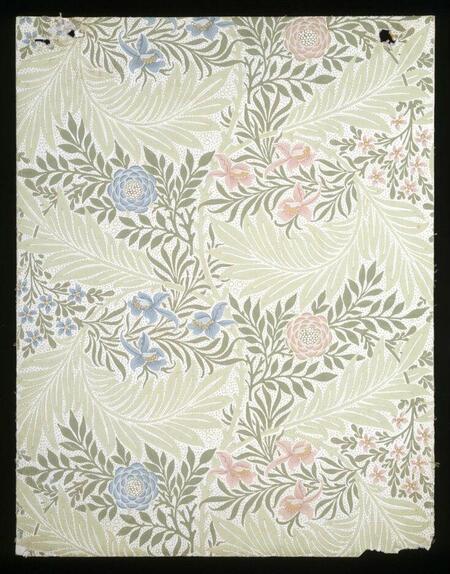
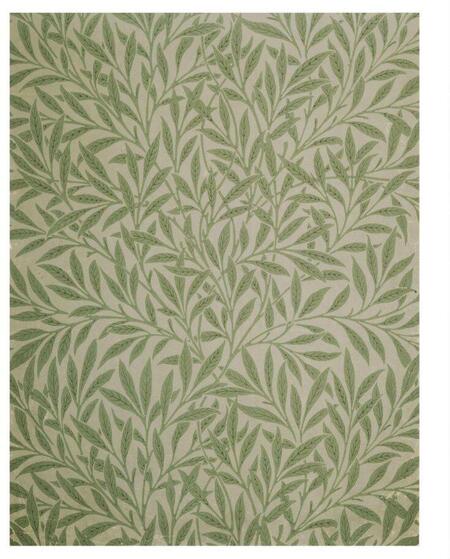
William Morris. «Larkspur.» 1872 / William Morris. «Willow.» 1874
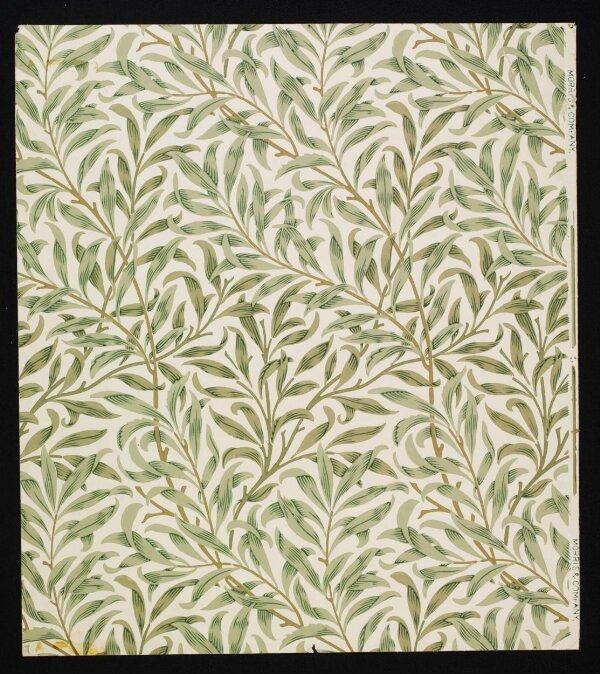
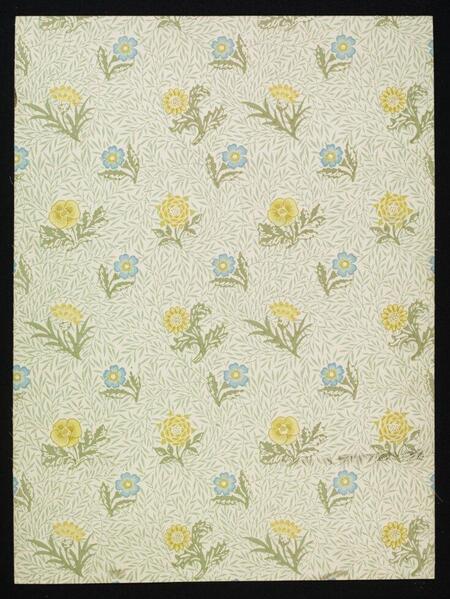
William Morris. «Willow Bough.» 1887 / William Morris. Wallpaper sketch «Powdered.» 1874
Rhythm becomes an independent source of aesthetic expression. The viewer derives pleasure from the repetition and variation of forms, regardless of their subject matter. In this regard, Morris’s ornaments resemble Kant’s concept of free beauty as pleasure derived from form.
The dissolution of the boundary between figure and ground
What happens to aesthetic perception when it is impossible to clearly separate the main object from secondary elements?
In Morris’s complex ornaments, the space gradually ceases to be neutral. It becomes filled with small leaves, flowers, and curving lines, which become equal components of the composition.
William Morris. «Jasmine.» 1872
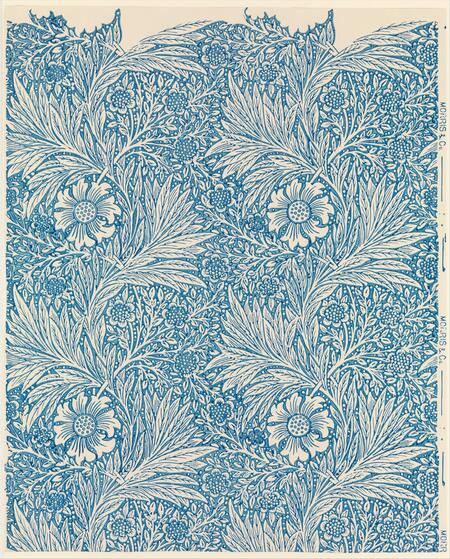
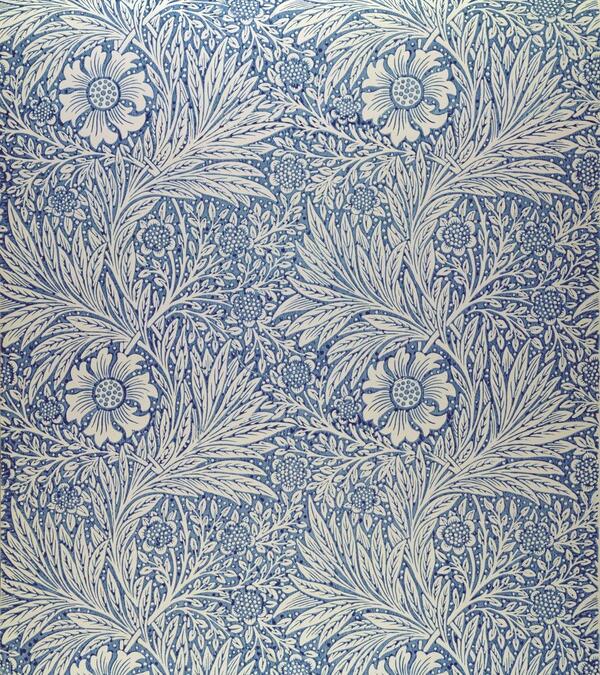
William Morris. «Marigold.» 1875 / William Morris. «Marigold.» 1875
William Morris. «Ochre Color» (Pimpernel). 1876
William Morris. «Carnation and Rose» (Pink and Rose). 1891
William Morris. «Christchurch.» 1882–1883
As the ornament becomes more complex, the distinction between the main image and the background loses its defining significance. Beauty begins to be perceived as a property of the entire composition rather than of individual elements. This principle is particularly vital for understanding free beauty—aesthetic pleasure can arise without highlighting a specific depicted object.
Color, scale, and visual complexity