Navigation
- Concept
- Origins: The Rubber Body
- Disney Sets the Rules
- Speed as a Graphic Sign
- Bob Clampett’s Rubber World
- Chuck Jones’s «The Dover Boys»
- The Body That Explodes with Emotion
- Counterpoint: Speed Without Distortion
- Conclusion
- Bibliography
- Image Sources
Concept
Why do we instantly understand that a character is scared when their eyes pop out by half a meter? And why does a body stretched into a long ribbon look like frantic speed rather than an artist’s mistake?The cartoon body has never been required to obey the laws of physics. But it was in the 1930s and 1940s that American animators realized that these laws could be intentionally broken, transforming deformation into a distinct visual language. The viewer requires no prior knowledge—the joke lands in a split second.
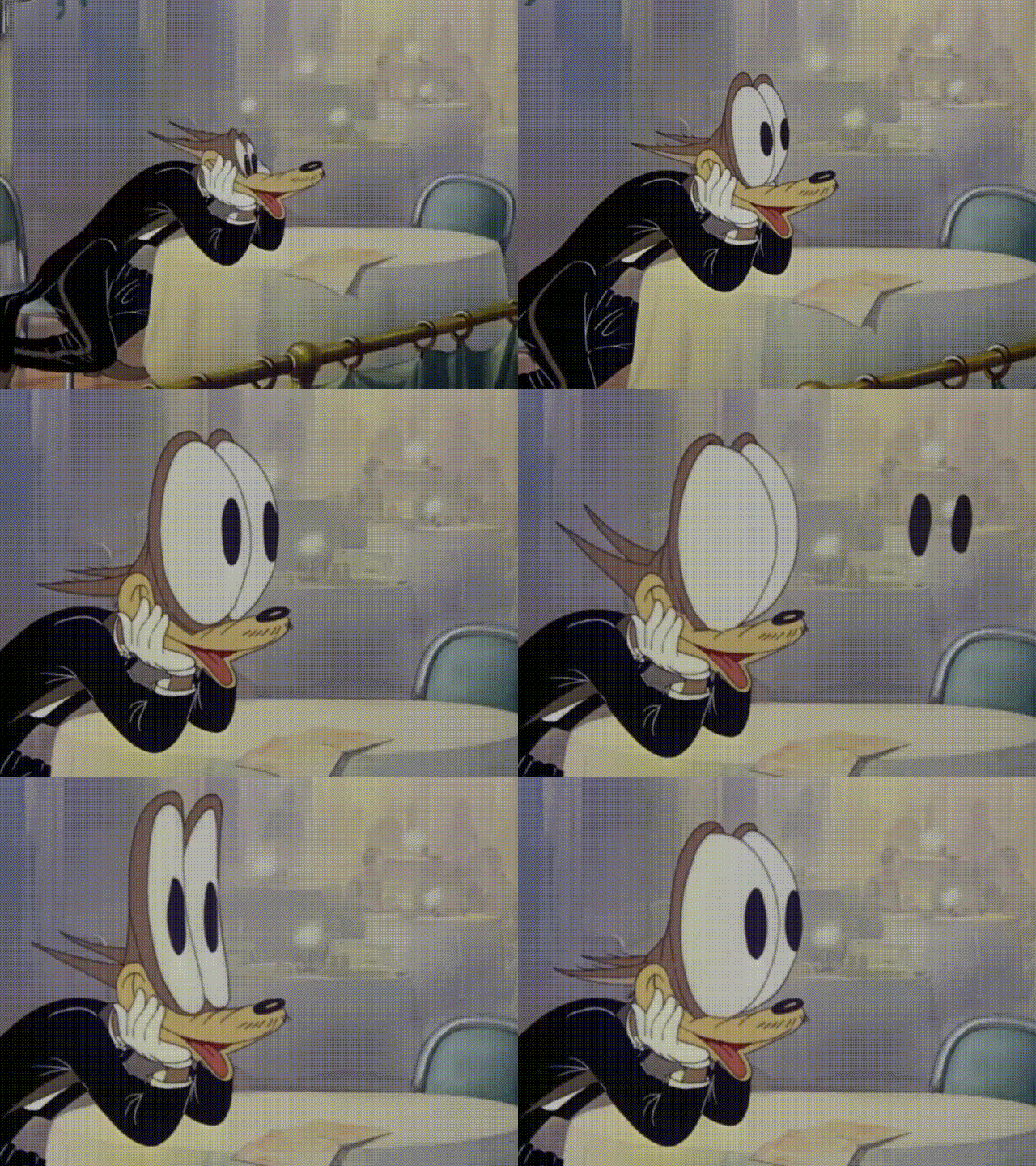
This era is called the Golden Age of American animation. Studios released dozens of short films each year, showing them in theaters before the main feature, and every studio sought its own way to make the audience laugh faster and louder than the rest. Today, the techniques developed then seem natural: speed lines, a cloud of dust where a hero fled, a «smeared» frame, a jaw dropped to the floor. We see them in anime, cartoons, and video games and barely think about where they came from. But each technique has an originator and a moment of appearance. How did deformation evolve over fifteen years from a chance characteristic of a drawing to a conscious artistic decision?
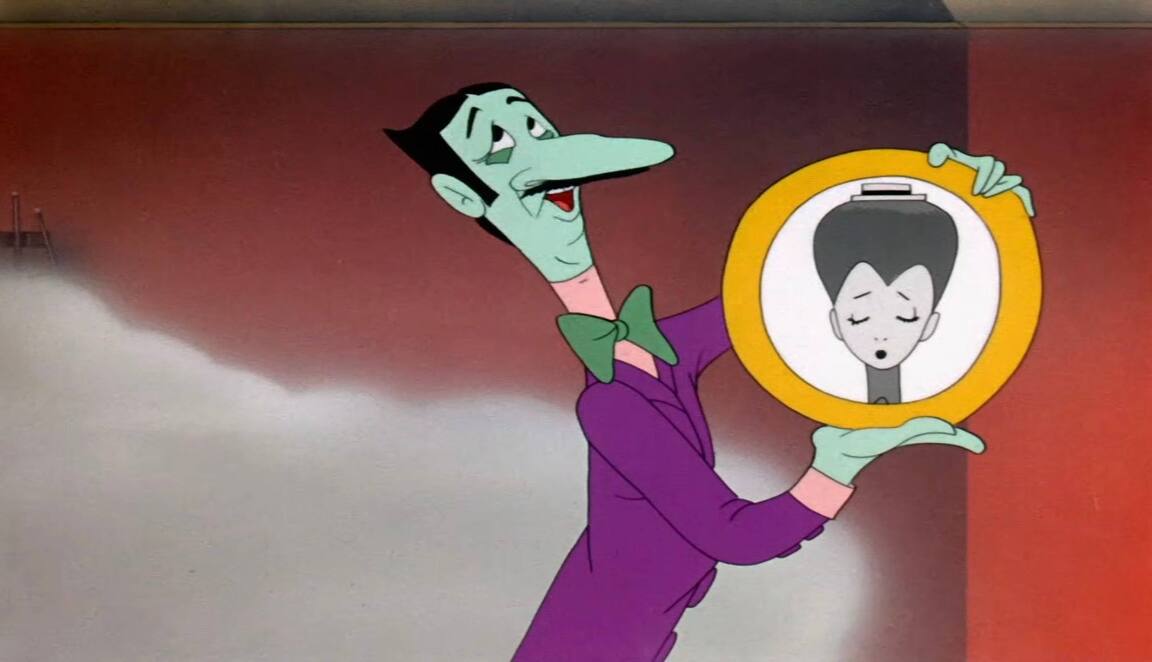
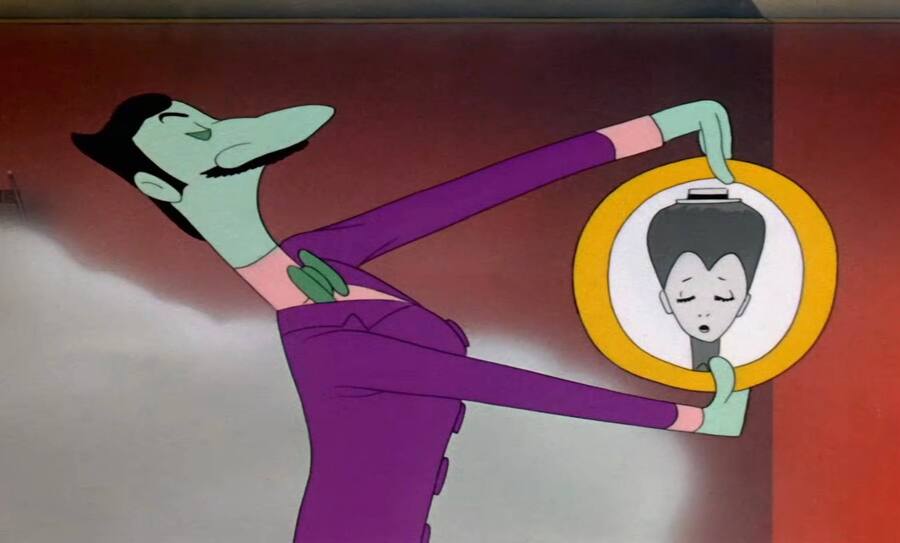
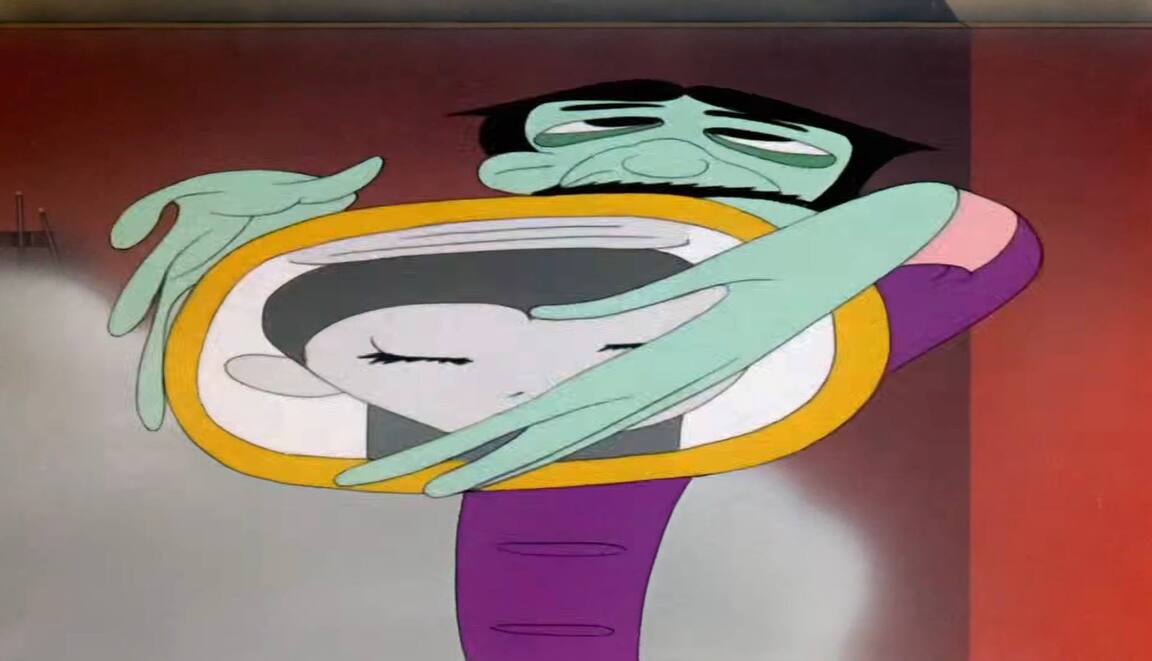
What graphic techniques did animators use to convey speed and intense emotion, and why can the viewer read them without explanation?My hypothesis is that deformation works because it illustrates not how motion looks, but how it feels. The stronger the emotion—fear, exhilaration, haste—the further the body deviates from its normal form. The chronological scope is from 1929 to 1945. My analysis is supported by the works of the animators and historians themselves: Frank Thomas and Ollie Johnston’s «The Illusion of Life» on Disney’s principles, Chuck Jones’s «Chuck Amuck, ” and the works of Michael Barré and Norman Klein on the American studios.Sergei Eisenstein’s texts on Disney and his concept of „plasticty“ provide the theoretical framework. However, the main source is the cartoons themselves: I am analyzing them frame-by-frame because deformation often lasts only one or two frames, and it can only be noticed when paused.
Origins: Rubber Body
In the late 1920s and early 1930s, characters moved as if they had no bones at all. Arms and legs were drawn with simple, flexible lines, lacking elbows and knees, resembling garden hoses. This gave the style its name—rubber hose. Such limbs were easy to draw, and they could bend in any direction.
Even the skeletons in Disney’s first «Symphony of Nonsense» move not like a collection of rigid bones, but like rubber toys. Here, the body isn’t yet «telling» anything about character; it simply follows the rhythm of the music. Deformation in these cartoons is more a property of the material than a conscious technique.
For the Fleischer brothers, rubber wasn’t just about the bodies; it was about the entire world around them. A door could become a mouth, a chair an animal, and a character could morph into anything. In «Minnie the Moocher» (1932), the Fleischer animators took the movements of the ghostly walrus from the actual dancing of musician Cab Calloway and traced them using rotoscoping. Even so, the character flows and bends in ways a real person never could.
Theoretically, this freedom was explained later. In the early 1940s, Sergei Eisenstein, a great admirer of Disney, termed it «plasmaticity.» According to him, form in animation is not fixed; it is alive, dynamic, and can transform into anything. Eisenstein believed this is precisely what attracts the viewer in cartoons. The remaining question was how to harness this freedom.
Disney sets the rules
In November 1932, evening drawing classes began at the Disney studio. They were taught by Don Graham from the School of Visual Arts. Animators drew from life, analyzed slow-motion footage of athletes and dancers, and searched for patterns—how the body contracts before a jump, how it stretches in flight, how hair and clothing trail the body.
From these observations arose the core principle of Disney animation—"squash and stretch.» The concept is simple: the form changes, but the volume remains constant. If a ball flattens vertically, it becomes wider. This allows the viewer to sense the object’s weight and elasticity, even when it is drawn with a single line.
It is important that Disney’s deformation is always justified by physics. A character stretches because they are falling, and flattens because they have impacted something. The goal is not to surprise the viewer with the deformation itself, but to make it so seamless that they simply believe the movement.
Goofy—the most «rubbery» Disney hero of that era. In the «How…» series, he tumbles, rolls, and collides with everything in sight, and his body stretches noticeably. Yet, even in the most absurd situations, he retains weight: his body doesn’t fall apart, and his skis continue to move according to their own laws.
By the early 1940s, the Disney approach had become the gold standard for the entire industry. Competitors watched their cartoons, and some animators even left Disney to join other studios. But it was those very clear rules that gave other studios the opportunity to break them—to know where the line was before you could push it.
Speed as a Graphic Sign
An animator only has 24 frames per second. If a character moves very fast, between neighboring frames they fly across half the screen, and the viewer sees not motion, but jerky teleportation. In film, these movements are naturally blurred on the film stock, but in drawn animation, the blur must be drawn by hand. This is how graphic «speed lines» came into existence.
One of the first cartoons to make speed a central theme is Disney’s «The Tortoise and the Hare» (1935). Max the Rabbit runs so fast that he plays tennis against himself, managing to cross to the other side of the net. We learn about his speed mainly through his environment: through the dust, the wind, and the consequences. Warner Bros. animators later acknowledged that the audacious Max became one of the prototypes for Bugs Bunny.
Six years later, Tex Avery re-shot the same sequence for Warner Bros.—this time with Bugs Bunny in the lead. Here, speed is depicted in a completely different way: Bugs freezes in a pose, and then vanishes instantly, leaving behind a cloud of dust and speed lines. We barely see the running itself; we only see the «before» and the «after.»
This «pause—burst—aftermath» schema became one of the defining hallmarks of the Warner Bros. studio. The pause grants the viewer a moment to anticipate something about to happen. The burst lasts only a couple of frames. And the cloud of dust proves that the character didn’t disappear—they actually ran away. Speed is created not by movement itself, but by the contrast between stillness and explosion.
In «Falling Hare,» Bob Clampett flips the technique on its head. The speed of the diving airplane builds to its limit, and then abruptly cuts to a single frame: the plane is simply hovering above the ground, and the characters explain to the audience that they have run out of gas. In the world of Warner Bros., inertia doesn’t exist if the gag requires it.
The Rubber World of Bob Clampett