Navigation
- Concept
- The Path to Art
- Faith as the Foundation of Identity
- Biblical Narratives and Religious Symbolism
- Visual Language
- The Imagery of Paradise and the New Jerusalem
- Conclusion
Concept
The African American self-taught artist Gertrude Morgan (1900–1980), also known as Sister Gertrude, holds a unique place in American outsider art. Her work is compelling because it was almost entirely devoted to religious themes.
Morgan was born in Alabama, grew up in a religious family, and was closely connected to the Baptist Church from childhood. According to her own recollections, she received a divine calling in 1934 to spread the word of God. Afterward, Gertrude moved to New Orleans, where she engaged in missionary work. She was a street preacher: she walked through the French Quarter in white attire with a bustle, sang gospel music accompanied by a drum, and told passersby about the coming Day of Judgment.
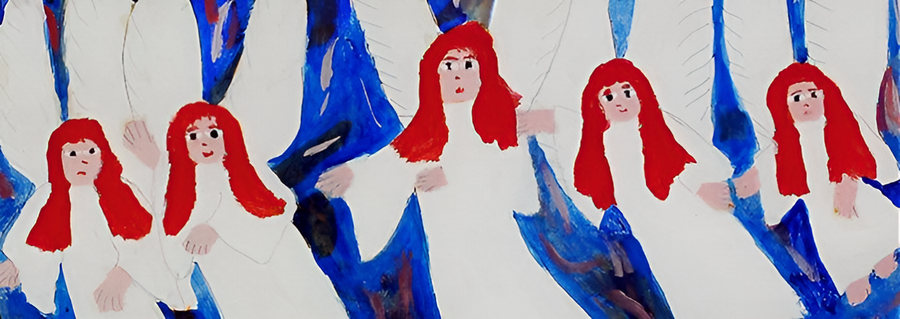
The woman did not have professional art training and viewed creating paintings as a continuation of her religious mission. She was convinced that God Himself had called her to paint to convey biblical truths to people. Thus, in her works, Gertrude Morgan depicts scenes from the Holy Scriptures, Jesus Christ, celestial beings, and scenes of the Last Judgment. Her artwork is characterized by a vivid color palette, simplified forms, expressive characters, and an abundance of handwritten text. The materials the artist used to bring her ideas to life are also interesting. She painted with acrylic and watercolor paints, ink, wax crayons, and ballpoint pens. For surfaces, she used paper, cardboard, window blinds, plastic trays, and other items that were at hand.
Gertrude Morgan’s study of creativity began with her conception of her own religious identity. In the mid-1950s, the woman started positioning herself as the Bride of Christ, believing she needed to enter into a spiritual marriage with Jesus. In her self-portraits, she declared her status to everyone, signing her works as «Bride of Christ.» This conviction was reflected not only in her art but also in her daily life. Gertrude began consistently wearing a white, wedding-dress-like gown and behaved as if the wedding with God had already taken place, but on another level of reality. Her example allows us to examine how a person’s identity, religious beliefs, and artistic self-expression intertwine. She became not merely an observer and illustrator of sacred history, but an active participant. In her work, Morgan places herself within the religious narrative, creating her own artistic world.
In my visual investigation, I intend to explore how Gertrude Morgan’s religious identity shaped her individual artistic language. I will analyze the use of biblical narratives, religious symbols, depictions of the celestial realm, and the interpretation of the New Jerusalem.
The Path to Art
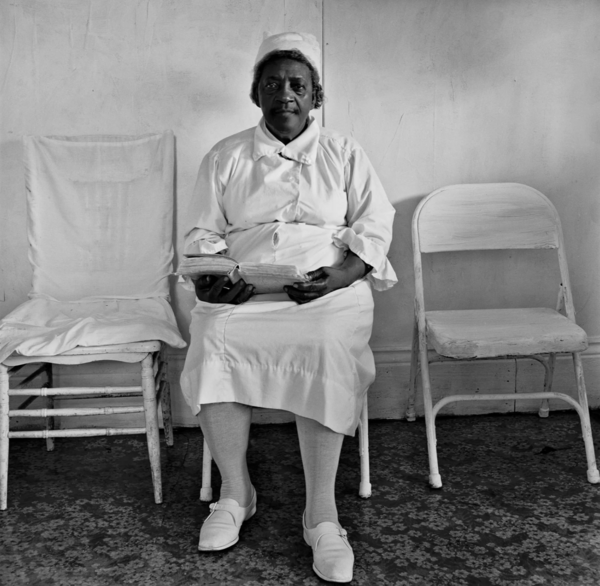
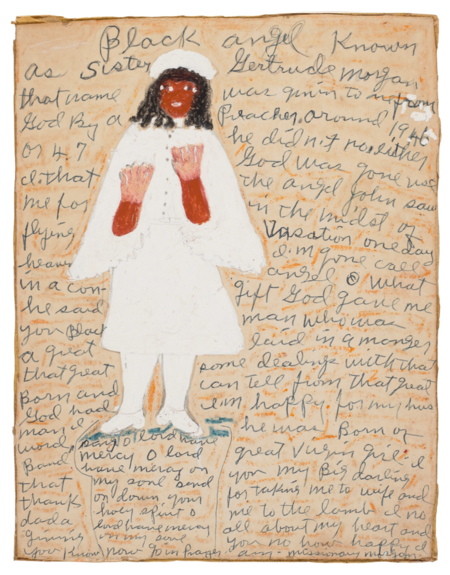
Gertrude Morgan, Black Angel Known As Gertrude Morgan
Gertrude was born into a modest, large family. Her childhood took place in rural Alabama during the Jim Crow era—the segregated South—where the path for a Black farming family was predictable and narrow. Before even finishing elementary school, the girl began working in the fields alongside her family. Interestingly, her inclination toward drawing emerged precisely then. Gertrude would trace patterns in the dirt in front of the house with a stick along with her sister, though, of course, one could not call it art.
Rose Hill Memorial Baptist Church, Columbus, GA, 1920s
Religion played a pivotal role in Morgan’s life from an early age. She was an active member of Rose Hill Memorial Baptist Church. It was likely there that she learned to read and write, and first encountered illustrated scriptures—those very images that would later become the foundation of her artistic work. Later, she dedicated a painting, «The Rose Hill Memorial Baptist Church, Columbus GA, ” to this period, immortalizing her own biography in a work of children’s art.
He That Believeth
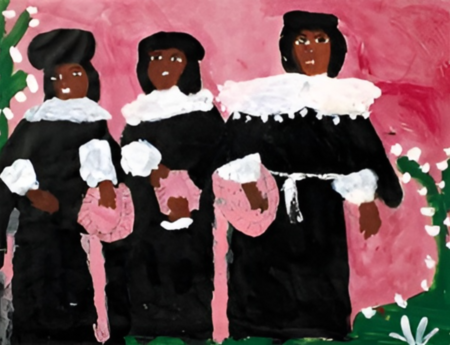
In 1928, Gertrude married Will Morgan. She recalls those years with a smile. Nevertheless, her life plans were increasingly defined by religious convictions. The turning point came at age 34 when she received her first divine revelation. God called her to abandon her former life and dedicate herself to spreading the holy teachings. This became a pivotal moment after which she began to view evangelism as her primary calling. Following the revelation, Gertrude divorced her husband. In New Orleans, a city she considered utterly sinful, the woman resolved to embark on her sacred mission. After meeting Mother Margaret Parker and Sister Cora Williams, they founded a mission and shelter in the Parker home on Flèche Avenue in the Lower Garden District. The three women wore black habits with white collars and cuffs—Morgan later depicted them in his paintings as «prophetesses.»| Mother Margaret Parker, Sister Cora Williams, and Gertrude Morgan, 1960s
Morgan began painting seriously in the mid-1950s. She understood this not as a choice, but as a commission: God commanded her to create images to spread His word. From the beginning, her works served as visual aids for preaching—she never conceived of them as «works of art.» The woman painted only under the inspiration of the «Spirit.» Over time, her work developed a recognizable visual language. Biblical quotes, her own commentary, and religious messages that she incorporated into the paintings held particular significance. In 1974, Gertrude Morgan stopped painting because, according to her own beliefs, God wanted her to focus on preaching and poetry.
Faith as the foundation of identity
For Gertrude Morgan, religion was an intrinsic part of life—the lens through which she perceived the world around her, her relationships with others, and her own purpose.
Her primary life goal became evangelism, and creative work was merely one of the ways to convey the meanings of the Gospel to people. Morgan repeatedly emphasized that she was, first and foremost, a missionary for Christ, not an artist. Most of her works are oriented toward biblical narratives—Paradise, the Second Coming, and the Last Judgment. However, the woman did not just illustrate these themes; she incorporated herself into the images. Thus, she created her own system of imagery, merging events from Holy Scripture with personal revelations and concepts of the spiritual world.
The artist’s work frequently incorporates text. On her «canvases, ” Morgan inscribed Bible quotes, chapter and verse titles, as well as her own religious reflections. These inscriptions became an integral part of the composition, surrounding the figures and filling open spaces. In this way, viewers were able not only to look at her paintings but also to read them.
Bride of Christ
One of the central motifs in her work became the image of the Bride of Christ. In the mid-1950s, Morgan declared that she had received divine revelation regarding her special purpose and has since exclusively worn white clothing.
In her paintings, Gertruda frequently depicted herself alongside Jesus—whether standing hand-in-hand, embracing, or even within the context of a wedding ceremony. In this way, she communicates her spiritual identity to the viewer. Much like in life, the woman portrays herself in white attire, which serves as the primary visual indicator of her new status. Beyond referencing traditional wedding wear, the white color also symbolizes purity, sanctity, and spiritual renewal.
It is fascinating to trace how Morgan depicted God. In her works, he appears as a white man, while the artist herself was dark-skinned. When analyzing these images, it is crucial to consider not only the religious symbolism but also the racial context. Gertrude positions herself as a chosen woman, incorporating herself into the tradition of Christian imagery where dark-skinned individuals rarely held such a central role.
Biblical narratives and religious symbolism
In the creative works of Gertrude Morgan, the Bible served as a source of plots and a unique map for constructing a singular artistic world. She frequently turns to the Book of Revelation, which describes the Second Coming of Christ, the heavenly Jerusalem, angels, and the future transformation of the world.
«The Throne of God»
«The Throne of God, ” circa 1970
One of the most interesting examples of referencing biblical narratives is the work «The Throne of God, ” which was created around 1970. It is based on the fourth chapter of the Book of Revelation, which describes the vision of the heavenly throne.