Concept
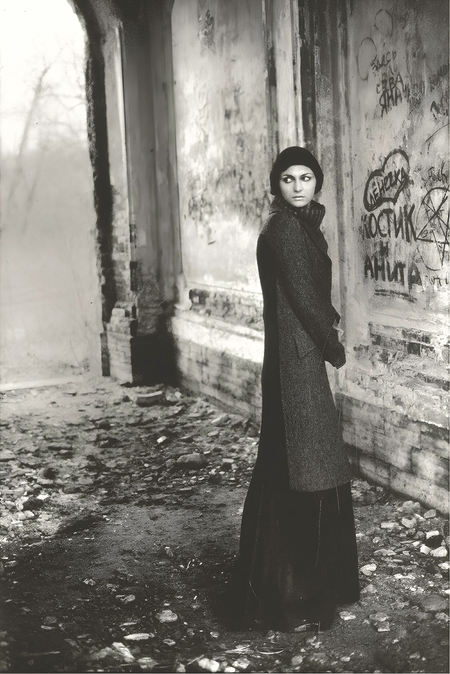
Fashion photography traditionally strives to create an ideal image: flawless appearance, meticulously composed arrangement, and an appealing space. However, in the works of Debora Turbeville, beauty exists in unconventional settings—amidst dilapidated interiors, empty rooms, and traces of decay. Blur, graininess, subdued tones, and unusual framing amplify a sense of anxiety, fragility, and loss. The starting point for this research is the contradiction between the aesthetics of gloss and the visual language of destruction. «Ruins of Gloss» denotes the gradual subversion of the familiar system of idealization: space loses its perfection, composition loses its predictability, and the photographic image loses its technical smoothness. Decay becomes a means of creating a specific psychological atmosphere and a new perception of beauty.The goal of this research is to trace how the motif of destruction manifests in the space, composition, and texture of Debora Turbeville’s photographs, and how these techniques alter the perception of the fashionable image.
Navigation
- Concept
- Main Body 2.1 Space: From Trendy Location to Ruin 2.2 Human Figure: From Display to Presence 2.3 Photographic Image: From Snapshot to Damaged Object
- Conclusion
- Bibliography
- Image Sources
Space: From Trendy Locale to Ruins
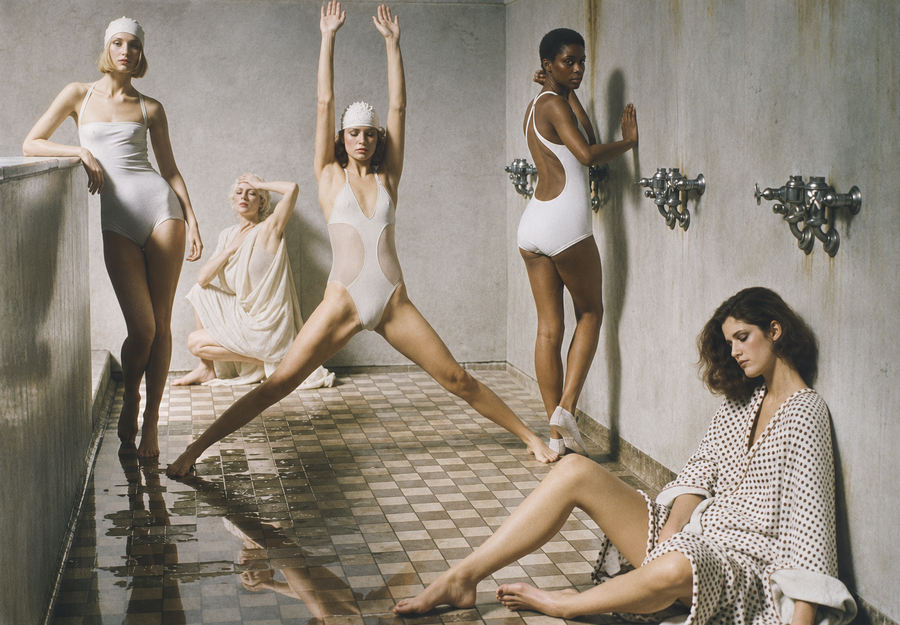
Bathhouse, New York, 1975. American Vogue.
The photoshoot took place at the dilapidated Asser Levy Bathhouse; it is the collision of trendy swimsuits with the crumbling public bath that makes the series the starting point for the theme «the ruins of gloss.» In conventional advertising logic, the space should support the clothing, but here, it begins to compete with it. The long corridor, the wet tiles, the signs of use, and the cold surfaces become so active that the models no longer exist separately from the architecture. The light does not «clean up» the scene; rather, it accentuates the unevenness of the walls and the water on the floor. It is precisely here that the first level of decay emerges: it is not that the clothing doesn’t fit into a beautiful background, but rather that beauty is forced to exist within an environment that possesses its own history and wear.
Untitled (Asser Levy Bathhouse), 1975. American Vogue.
The figures do not form a conventional advertising group: some bodies are cropped by the frame, one model is nearly on the floor, and another is pressed against the wall. The geometry of the tiles directs the viewer’s gaze not toward a specific piece of clothing, but into the depth of the space. Turbeville later spoke about Bathhouse, which attempted to «design five figures in space»; therefore, it is more important to view the frame as a spatial construction rather than a catalog of items. The disruption of the canon begins with the shift in hierarchy: the environment gains the right to be the main character.
Untitled, Unseen Versailles, Versailles, 1980–81.
The furniture is concealed under covers; the palace is presented not in its formal grandeur, but temporarily «deactivated» from representation. In Unseen Versailles, Turbeville gained access to rooms usually closed to visitors—empty chambers, covered furniture, damaged sculptures, and dusty interiors. The space, created to display power and wealth, here is devoid of its public function. The covers visually transform the furniture into undefined objects, almost «ghosts» of former luxury. Therefore, for Turbeville, ruin is not necessarily a collapsed wall; it can be luxury from which the display has vanished.
Damaged Statues, Unseen Versailles, 1980–81.
Classical sculpture is presented not as an idealized museum object, but through grain, soft focus, and physical traces within the image. The statue is historically tied to the concept of a finished form, yet Turbeville portrays it as an object already subject to time. The focus is unevenly distributed, the image surface is littered with traces, and the figures overlap one another. Consequently, the photograph creates a significant transition—it dismantles not just the setting, but also the symbol of the perfect body.
Stables of Strelna, Russian Vogue, St. Petersburg, 2000.
Luxurious fur garments are placed amidst crumbling plaster, exposed brickwork, and construction debris. This is the most direct visual embodiment of the research title. Fur, a long skirt, and a complex silhouette belong to the luxury fashion system; however, they are surrounded not by an interior that reinforces the item’s status, but by actual decay. The figure stands between a bright opening and a torn wall, so architectural trauma becomes part of her silhouette. Pace confirms that four works in the Stables of Strelna series show models directly among the crumbling remains of a St. Petersburg manor house.
Untitled, Studio St. Petersburg, 1990.
The old interior, mirror, and several layers of time within a single frame connect a person to the history of the space. At Studio St. Petersburg, old rooms cease to be mere decoration and instead become carriers of time. The mirror multiplies figures and fractures the clarity of spatial perspective: it is impossible to instantly determine what is «in front of» us and what is a reflection. The uneven surface of the wall and a muted color palette are more significant than the decorative sheen of the furniture. The MUUS archive describes the Russian Turbeville cycle as images of the city, old palaces, and ballet, as if frozen between the present and history.
Views of the staircase, salons, billiard room, and curtained room off the foyer of The Breakers, from the Newport Remembered series, Newport, Rhode Island, 1992–93.
In this work, several interiors of a mansion are connected into a sequence of fragments; instead of one grand image, an archive of space emerges. In the first phase, a recurring principle is revealed: Tourbillon selects spaces that do not confirm the flawless nature of fashion, but rather resist it. The Bathhouse offers physical wear, Versailles presents a luxury removed from its ceremonial mode, Newport depicts the architecture of memory, and St. Petersburg and Strelna showcase a historical surface marked by visible signs of time. Yet, a single space is insufficient—within these locations, the very way the human body exists changes.
The Human Figure: From Demonstration to Presence
Untitled, L’École des Beaux-Arts, Paris, 1977.
The female bodies are dusted with light powder and posed next to a plaster sculpture, making the distinction between the living body and the study cast ambiguous. Instead of the conventional advertising principle—that «clothing accentuates the model’s individuality”—here the body visually approaches the statue. The white powder diminishes the difference between skin, plaster, and walls, causing the figure to seem dissolved within the academy’s institutional space. MUUS notes that Turbeville intentionally transformed the models in this series into „living statues.“ This technique breaks another canon of glossy imagery: the model ceases to be an autonomous center and becomes material for the overall composition.
Untitled, L’École des Beaux-Arts / Stigmata, Paris, 1977.
A close-up of the face intersects with paper traces, a red stain on the palm, and an affixed strip: the human figure is beginning to transform into a montage surface. Glossy photography usually ensures maximum visual readability of the face, as it is what holds the viewer’s attention. Here, the surface intrudes upon the portrait—the paper, the marks, and the color stain act almost like interference. Importantly, Turbeville is not simply photographing an unconventional pose—she is questioning the very necessity of an perfectly preserved face. This shot already links the second and third levels of investigation: the human and the photographic material begin to disintegrate simultaneously.
Untitled, L’École des Beaux-Arts, Paris, 1977.
A woman lies beside a massive stone base; her pose defies the vertical, declarative logic of the classic fashion pose. The figure is not «presenting» the outfit to the viewer: she leans on the architecture, lies down, bends, and occupies a low position in the frame. This doesn’t necessarily have to be read as psychological alienation; it is more accurate to speak of a shift in the body’s plastic regime. Instead of a pose optimized for displaying clothing, there is a pose necessitated by the composition and space. As a result, the fashion image becomes less commodified and more narrative.
Untitled, L’École des Beaux-Arts, 1977.
The model sits on the floor next to a large abstract structure; visible adhesive tape has been added to the image. The large structure occupies the central volume and visually dominates the small figure. The model is positioned almost like another fragment among the studio materials. The adhesive tape turns the frame of the shot into part of the composition, reminding us that what we are seeing is no longer a «window» into an ideal world, but a fabricated object. Thus, the diminishing status of the human figure gradually elevates the status of the photograph itself as an artifact.
Untitled, Unseen Versailles, 1980–81.
A contemporary photographic setup is transformed into an unstable historical scene: the costumes, figures, and interior exist at the boundary between a fashion shoot and a theatrical memory. In fashion photography, clothing typically marks contemporary relevance—it belongs to a specific season and moment. Turbevill intentionally places the figures in historicized costumes and settings, creating the impossibility of pinpointing the scene’s time. The blurring and the light further erase the modernity of the shooting moment. Thus, gloss loses one of its fundamental functions—being visual proof of the «now.»