The Sphinx in Egypt: From Royal Image and Temple Guardian to Monument of Medieval Memory. How the image of the Sphinx evolved in Egypt from the Old Kingdom through the 14th–15th centuries.
Categories
1. Concept
2. The Great Sphinx on the West Bank of the Nile in Giza
3. Avenue of the Sphinxes
4. Cryosphinx
5. Hierosphinx
6. Ancient Egyptian Reliefs
7. Conclusion
8. Photo Sources
9. Bibliography
Concept
The core concept of this research is the understanding of the sphinx as an image whose meaning was shaped not only by its external appearance but also by its context. The sculpture’s scale, its placement, and its relationship to the architectural ensemble determined how it was perceived—whether as a standalone monument, a guardian of a sacred site, or a part of a ritual path. Therefore, when comparing these figures, it is crucial to consider not only the resemblance between the human and lion features but also the role the sphinx played in its specific environment. Modern photography captures the monument’s condition at the time of shooting, but it cannot, on its own, attest to its ancient appearance.
Sphinx statues, despite their similar appearance, could serve various functions; therefore, it is important to view them not just as standalone sculptures, but also in relation to their location, surrounding structures, and the historical period. The sphinx figure unites human and lion attributes, and throughout history, it has represented concepts of power, strength, and the guardianship of sacred spaces. A particularly interesting study involves comparing the Great Sphinx of Giza with temple sphinxes, which allows us to see how the image evolved and was reinterpreted depending on its intended purpose and the impact of the disappearance of its original cultural context. The visual study features images selected to compare the sphinxes across several criteria: physical appearance, placement, relationship to architecture, and presumed function.
The Great Sphinx on the West Bank of the Nile in Giza (Estimated construction date: 2559 BCE)
The Great Sphinx on the West Bank of the Nile in Giza
The Great Sphinx on the west bank of the Nile in Giza (Estimated construction date—c. 2559 BCE)
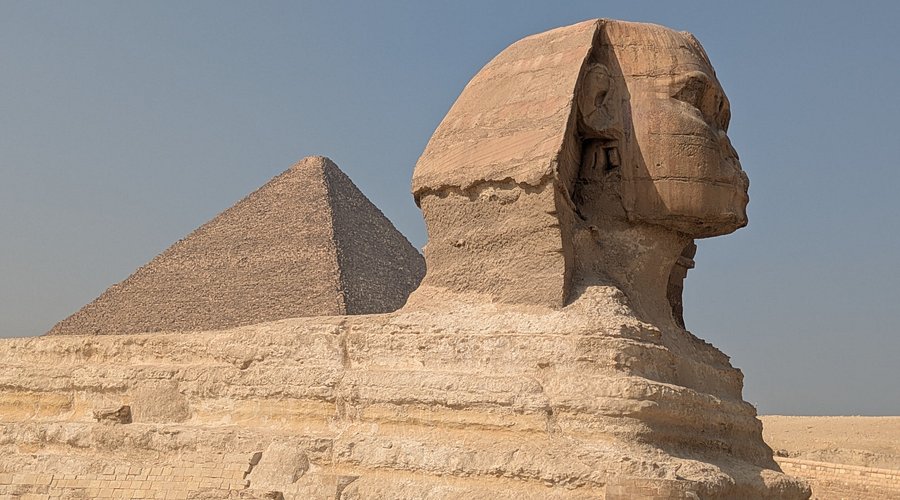
The composition of the Great Sphinx is built upon the juxtaposition of two elements: the horizontal, elongated body conveys a sense of tranquility and stability, while the raised head provides a vertical accent. Because of this, the silhouette can be perceived simultaneously as both static and vigilant, and the human head combined with the lion’s body merges the image of a ruler with the power of the animal.
The Great Sphinx on the West Bank of the Nile in Giza (Presumed construction date: 2559 BCE)
The Great Sphinx’s head features elements of a royal headdress—the nemes. This attribute directly links it to power. The head becomes the primary semantic focus of the composition, even though the body occupies the majority of the sculptural volume. This proportion is perceived simultaneously as a powerful animal and as an image of a ruler.
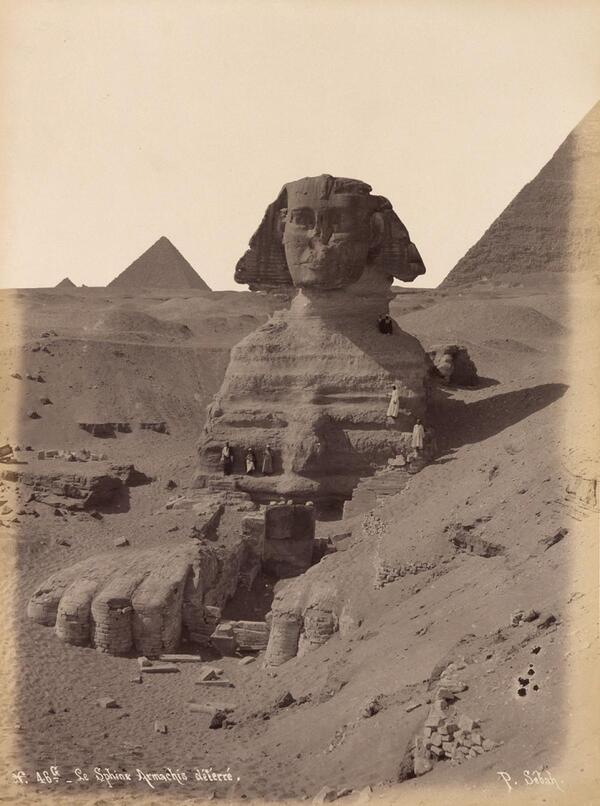
The Great Sphinx on the western bank of the Nile in Giza Cornelis de Bruyn, 1691, published in 1698
The Sphinx’s position on the Giza plateau connects the monument with the other structures within the overall Giza complex. The image reveals how it was integrated into the larger space. The scale of the desert plateau emphasizes the figure’s monumentality, while its proximity to the pyramids and temple complexes places it within a broader architectural context.
The Great Sphinx on the western bank of the Nile in Giza
Either the Sphinx gazes toward the east, toward the rising sun, which suggests its connection to the lion image—a symbol of the solar deity for ancient Eastern civilizations. If you look closely at the head, you can see how the perception of the other features shifts. Without a nose, the eyes appear deeper, and the mouth more distinct. The face looks stern and motionless, as if time has erased not just parts of the stone, but a distinct detail of its expression.
When examining the head, one can observe how the perception of the other features changes. Without a nose, the eyes appear deeper, and the mouth more distinct. The face looks severe and unmoving, as if time has worn away not just a part of the stone, but an individual detail of its expression.
Sphinx Alley, or the Path of Royal Celebrations, also known as Ram’s Road
Sphinx Alley, or the Road of Royal Festivities (380–362 BCE)
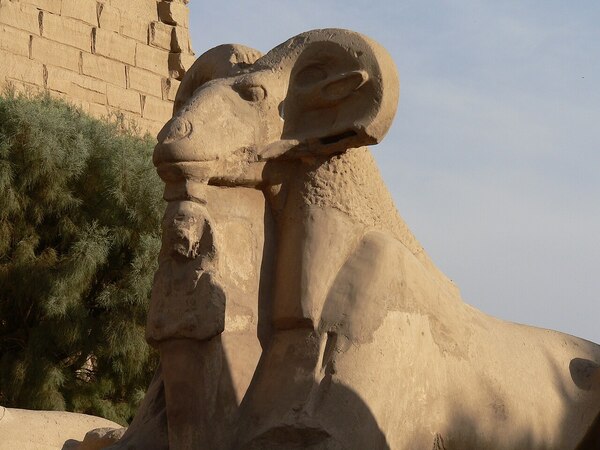
Repetitive figures organize the path to the Temple of Amos. Their repetition creates a sense of order and the continuous presence of divine guardianship, lending a sacred quality to this path.
Its image is less frightening than it is reverent—a tranquil sentinel established at the boundary between ordinary space and the temple grounds.
Karnak Temple on the East Bank
Visually, the cryosphinx functions simultaneously on two scales. Up close, it is perceived as a meticulously crafted sculpture with distinct details; from a distance, however, it presents itself as part of a grand rhythm leading toward the sanctuary. It is this repetition that transforms the individual stone guardians into a unified embodiment of the temple’s order and protection.
Sphinx Alley. Luxor Temple
In some sphinxes, a figure of a king is placed between the forelegs. It is visually incorporated into the animal’s silhouette and appears under its protection—an image that can be interpreted as defense: the ruler is under the god’s aegis and acknowledges its supremacy.
Cryosfinx
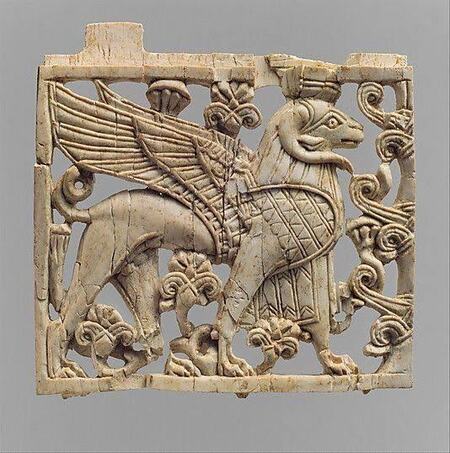
Chrysomphinx, approximately (14th–13th century BCE)
«The Sphinx» is not a single, immutable image. Different variations of the figure could be used in temple complexes, each associated with different deities and functions. The figure is composed of two contrasting parts. The massive lion body is stretched along the ground, with the front paws extended forward and the back forming a calm horizontal line. The horns play the most expressive role; they stand out with a rounded contour against the strict architecture and emphasize the Sphinx’s connection to Amun.
Hieroglyph Sphinx
Images from the Khor Behkhtest Castle. Photograph by Hedwig Storch
The Hieroglyph Sphinx combines the earthly power of the lion with the keen sight of a predatory bird. Its image is perceived as a guardian: its body is firmly rooted to the ground, while its head seems to observe the space from above. Its falcon-like head personifies Horus. Among the line of sphinxes, it stands out not so much because of its pose, but because of its distinctive head profile, which immediately alters the perception of the entire figure.