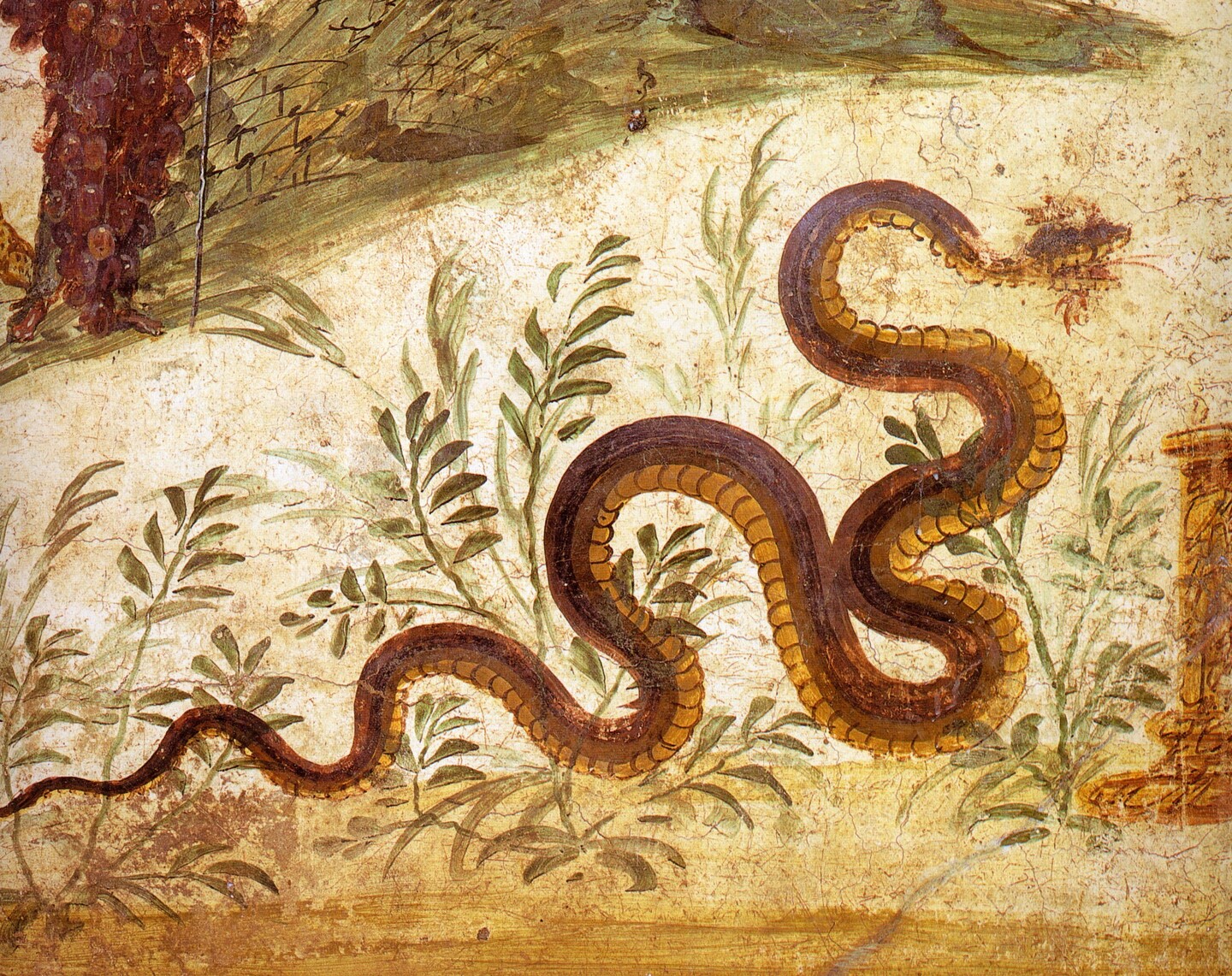
Символ змеи в греко-римской скульптуре и монументальной живописи.
Concept
In Ancient Greece and Ancient Rome, the snake held significant importance. It possessed sacred meaning in both daily life and art. Its imagery is found everywhere: in sculpture, bas-reliefs, temples, and on gravestones. This abundance of the serpent motif in art naturally raises the question:
«What does the snake mean?»
Answering this question is far from simple. The serpent appears in various narratives in Greco-Roman culture, alongside different gods. Even today, the serpent can be associated with various aspects of our lives.
That is precisely why I want to examine one of the ancient civilizations to trace the meanings the serpent held in its culture and how those meanings can be traced in its art. I want to see what ancient Greece and Rome perceived in the image of the snake—why they revered it, and how they depicted it.
The goal of my research is to study how the visual representation of the serpent changes as its meaning evolves.
During my research, I consulted scientific articles and fundamental sources concerning the mythology and religion of ancient Greece, as well as its art. For the visual component of my study, I selected a piece where the image of the serpent is most vividly and recognizably presented. I analyzed the relationship between the composition and the mythology that underpinned the creation of the sculptures and reliefs I chose.
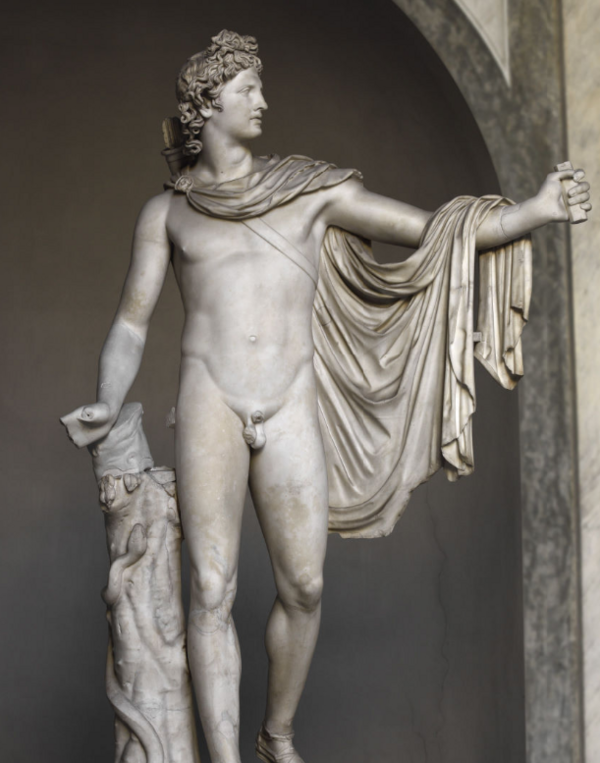
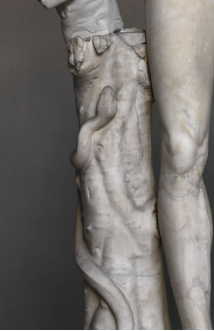
«Apollo Belvedere.» Roman copy, 2nd century CE, from a bronze original from the 4th century BCE.
Thus, the foundation of my visual research is a constructed analysis of Ancient Greek and Roman art, divided into chapters, each exploring one of the meanings of the serpent image during that period and how these meanings were reflected in its depiction in sculpture and monumental painting.
Chapter 1. The Serpent as a Symbol of Medicine and Healing.
The image of the serpent as a symbol of medicine is one of the most recognizable. Its depiction in this specific sense originates from the cult of Asclepius. It is in his statues that we see the symbols we still associate with medicine today.
One of the most enduring patterns in the depiction of the snake as a symbol of medicine is the snake coiled around a staff. This is the core of Asclepius iconography, which is repeated throughout the sculpture.
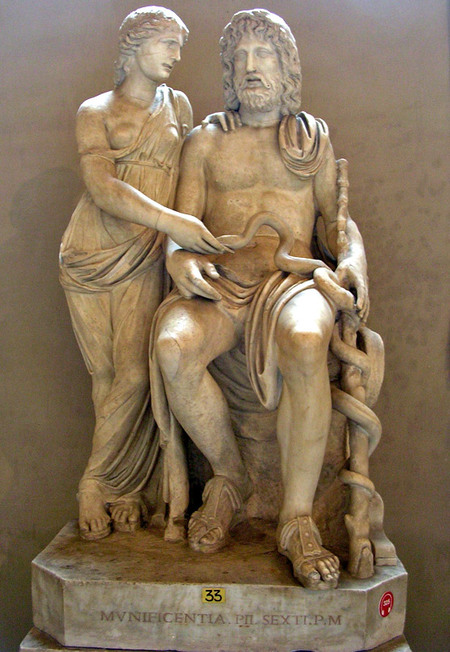
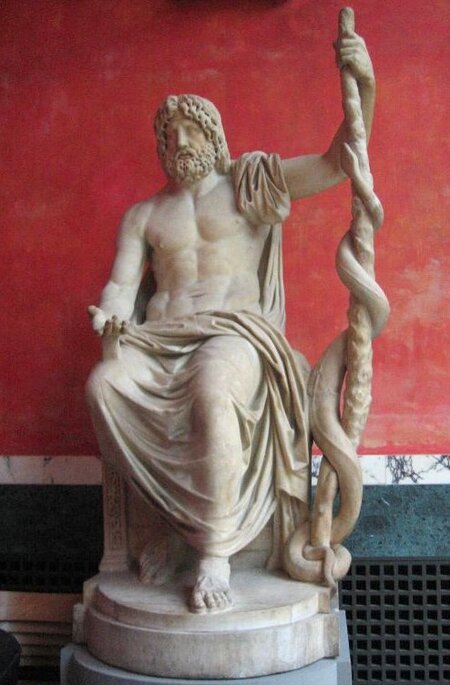
«Group with Asclepius and Hygieia.» 117–138 CE. Copy. «Statue of Asclepius.» 370 BCE
In the statue «Asclepius of Epidaurus, ” one can see the god holding a staff upon which a snake ascends toward Asclepius’s hand. This depiction is primarily linked to the myth in which Asclepius went to King Minos’s palace to resurrect his son. In the legend, the snake crawls to the god carrying medicinal herbs in its mouth and revives the snake that the physician had killed with a blow from a stick.
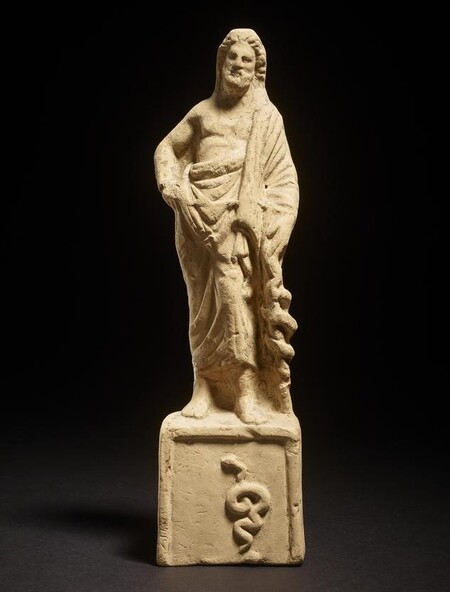
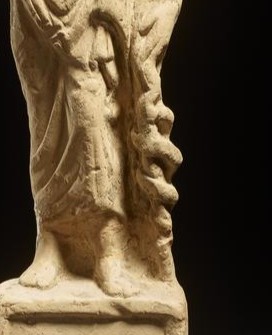
«Terracotta Figurine of Asclepius.» The exact date is unknown.
Beyond its mythological significance, the compositional solution in the depiction of the snake is also notable. One can observe where the straight line of the staff meets the serpent coiling around it. The tree functions as support and structure, while the snake conveys the non-linear path of the organism’s recovery.
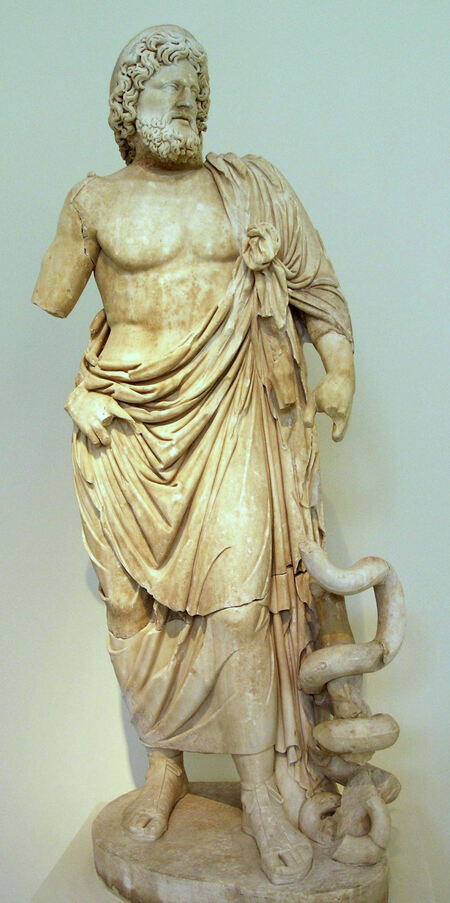
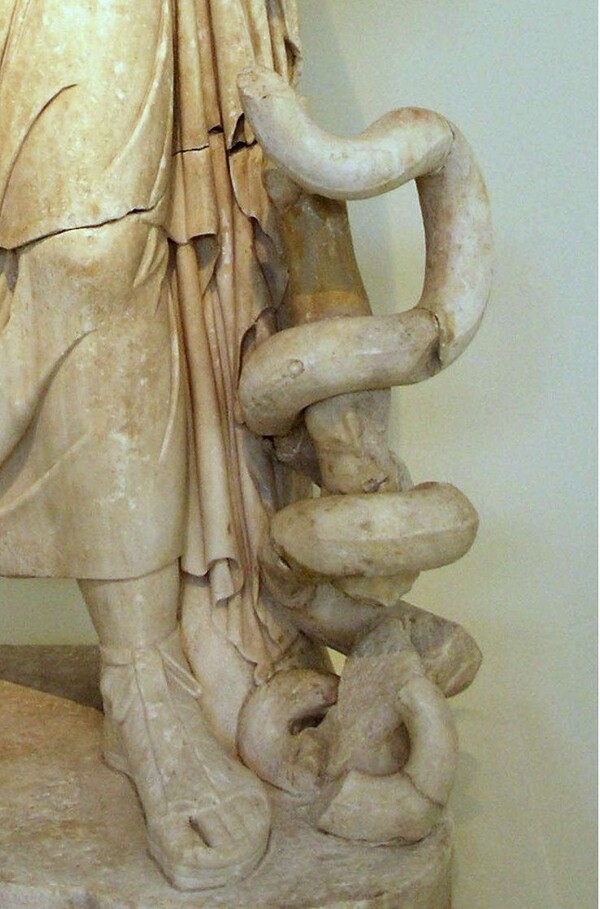
«Asclepius of Epidaurus.» Circa 160 CE.
Both elements function vertically, connecting earth and sky. The snake, crawling upward toward the hand of Asclepius, detaches from its usual habitat—the earth—striving toward the heavens. This renders it a brighter image, symbolizing healing.
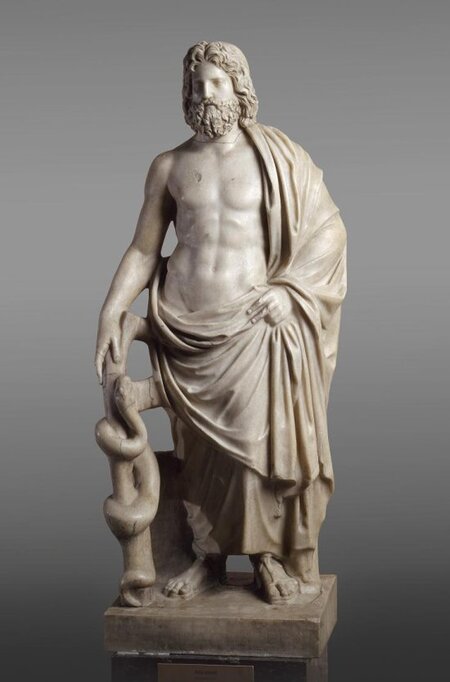
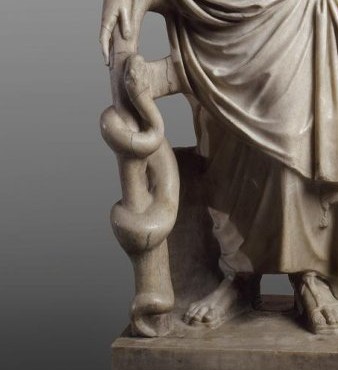
«Statue of Asclepius.» 1st–2nd centuries CE. Copy.
The scale of the serpent also matters. In sculpture, the reptile is scaled to the staff, not to the deity itself. This portrays it not as a terrifying and dominant force, but rather as an attribute that can be controlled.
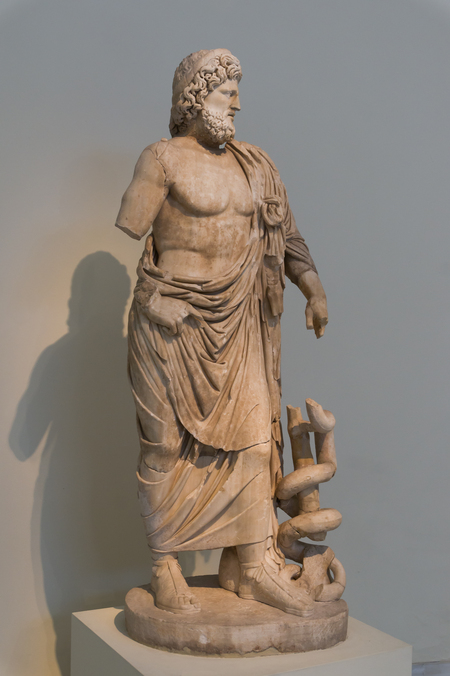
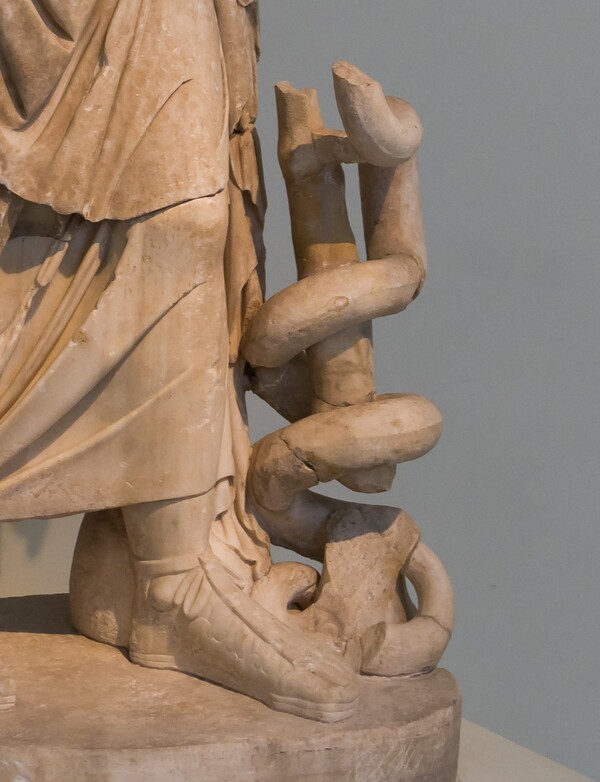
«Asclepius from Epidaurus.» Circa 160 CE.
Another enduring way to represent the snake as a symbol of medicine is the snake drinking from a bowl. This depiction can be found in sculptures and reliefs.
On the relief featuring Asclepius and his daughter Hygieia, one can see the sacred snake drinking from the chalice held by the goddess of health. In the cult of Asclepius, the gesture of feeding or watering the snake held ritual significance, and the chalice in the hand of the goddess Hygieia served as an instrument of a sacred rite. The drinking reptile was considered a sign that the deity accepted the offering.
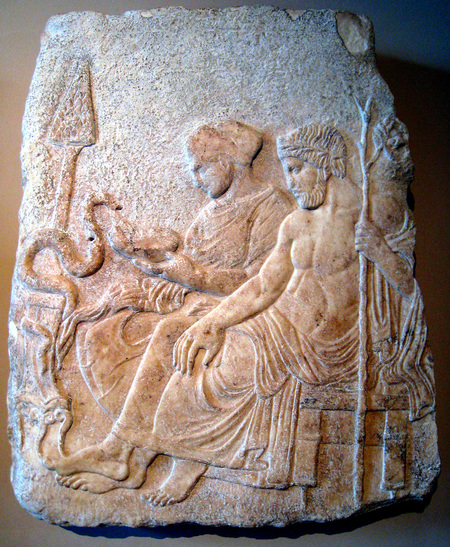
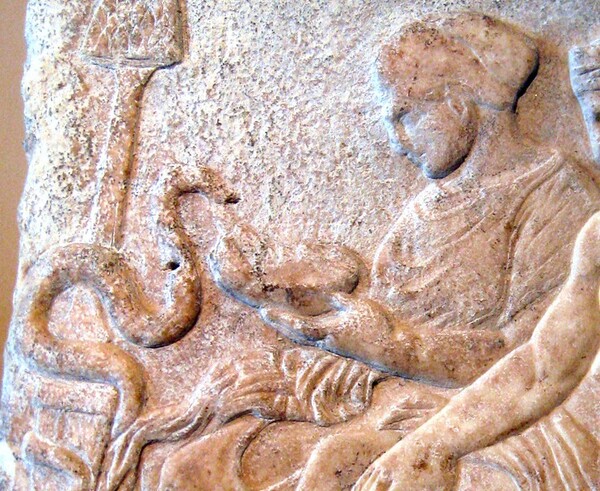
«Funerary Relief of Asclepius and Hygieia.» 420–400 BCE
The bas-reliefs also depict the snake stretching upward toward the chalice or resting on an elevated platform, which connects it more closely to the heavens and portrays it as a sacred creature.
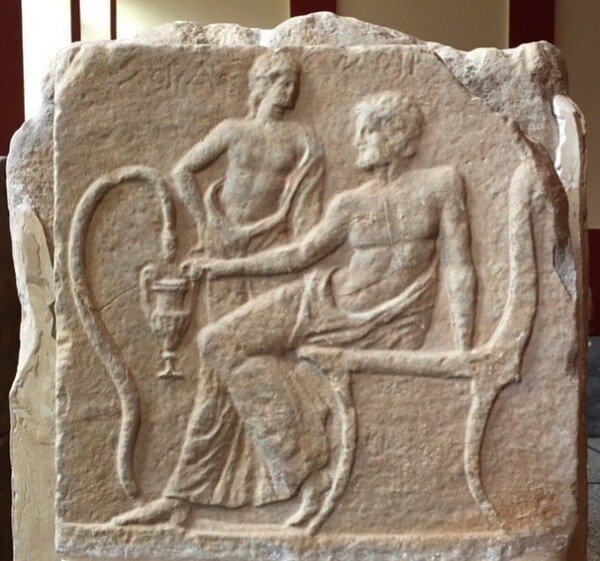
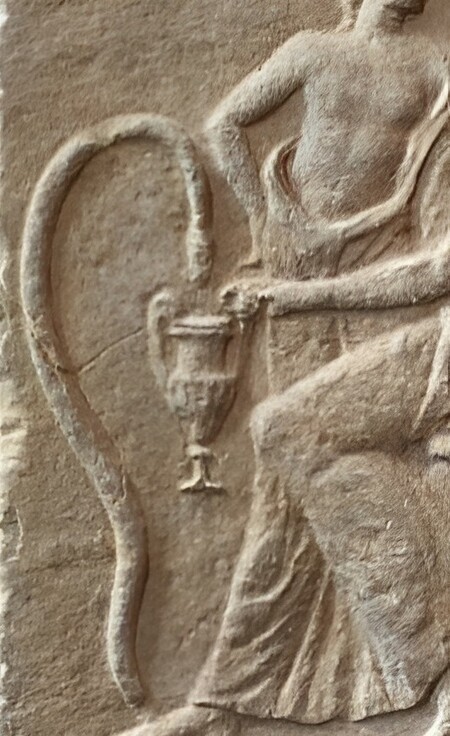
«Funerary Laconic Relief with Inscription.» 300–200 BCE
Thus, the serpent, as a symbol of medicine, healing, and healthcare, is depicted in two primary ways: on the Rod of Asclepius and drinking from the cup of Hygieia. These images trace a tendency for the serpent to ascend, and its vertical posture, which connects it more closely to the celestial and luminous aspects.
Chapter 2. The Image of the Serpent as a Chthonic Being.
The snake has long been considered an animal with chthonic qualities due to its connection with the earth and its way of life. However, the image of the snake as a chthonic creature runs much deeper. Snakes were also regarded as a symbol of the cycle of life and death, given their ability to shed their skin.
This aspect also closely connects them to the afterlife in ancient Greek mythology and art.