Navigation
1. Advertising Campaign Context
2. Target Audience Analysis
3. Goals and Challenges
4. Visuals and Storytelling
5. Psychological Mechanisms
6. Impact on Brand Image
7. Recommendations for Improvement
8. Conclusion
Concept
In Jean Paul Gaultier’s work, provocation transforms into a tool for managing the viewer’s attention, emotion, and memory.
Why does this work? The psychology of perception states that the brain conserves energy by ignoring the predictable. Perfume advertising is a genre where everything is predictable: a beautiful woman, a bottle, Paris. Jean Paul disrupts this expectation at every level. The composition is built on dissonance: a demure silhouette paired with a provocative gesture, laughter instead of a sultry gaze, a pink color that should signify tenderness here functions as aggression. The Gestalt principle of «figure-ground» is inverted: what should be the background (the body, the leg, the laugh) becomes the figure, while the product (the perfume bottle) hides in the details, forcing the viewer to look closer.
However, behind the external lightness lies a rigid structure. In this study, the «Scandal» advertising campaign from 2019–2020 and the «So Scandal!» commercial are examined on three levels: first—the visual construction (composition, color, typeface, characters, video script); second—the psychological mechanisms: which instincts and archetypes are activated; and third—the context and effect: how the campaign fits into the social agenda and what it does to the brand’s image, and how well it aligns with its goals and values. The key research question is: how does a scandal become a manageable technology?
The first step of the research involves immersing ourselves in the social and emotional contexts surrounding the campaign’s emergence, which play a significant role in consumer interaction. Next, we will define the target audience profile. Subsequently, the objectives the brand set for promoting the perfume will be examined, and the visual impact elements employed will be analyzed. The core objective is to understand how the advertising campaign addresses consumer pain points, which benefits it highlights, and why. The study utilizes methods for analyzing advertising effectiveness, techniques for identifying influencing stimuli, as well as concepts such as basic motivations, instincts, attention «buttons,» meme installation, and archetypes. However, the emphasis is placed on: the visual aspects of the advertising design, such as composition, color, typography, characters, and narrative.
In analyzing the «So Scandal!» advertising campaign, we not only review successful aspects but also propose potential improvements and recommendations to enhance visual impact.
Advertising Campaign Context
Advertising does not exist in a vacuum; it responds to the demands of its time. The advertising campaign for the fragrance Scandal by Jean Paul Gaultier (and its key commercial, «So Scandal!») was released between 2019 and 2020. To understand why it succeeded, one must examine the social context. We are in the era of post-feminism and the #MeToo movement. Society has begun to harshly criticize advertising for objectifying the female body. Jean Paul Gaultier (JPG) responds to this with a campaign that walks a tightrope. On one hand, the visual language references the traditional male gaze (a perspective in which the woman is presented solely as an object for viewing). On the other hand, the protagonists control the narrative and openly mock those who are shocked.


An ironic shot of Jade Perfitt in a corset with Jean-Paul Gaultier / March of the Survivors #MeToo (Los Angeles, 2017)
Campaign Slogan and Hashtag: #BeScandal
The values of the JPG brand have historically been built upon rebellion, theatricality, and play with gender roles. The designer himself stated in an interview with Madame Figaro that through this campaign, he wanted to show that women have become equal to men. Thus, controversy for JPG is not an accident, but a conscious part of the brand’s DNA.
Working with the Target Audience
Who is watching this advertisement? Demographically, it is women aged 20–35 who buy perfume and clothing for themselves (as a marker of independence), and men choosing a gift. However, the psychographic profile is more important. The JPG audience is tired of the «perfect glossy aesthetic.» These people value irony and a willingness to break the rules. For them, Scandal is not about «becoming beautiful for someone, ” but about the right to be visible, loud, and inconvenient.


Model in a iconic optical jumpsuit (Total Look) by Jean-Paul Gaultier / Jean-Paul Gaultier with mannequins in corsets from his 2007 spring collection
Objectives and Challenges
The creators faced several strict constraints. First, there was the problem of an invisible product. Perfume cannot be shown. The visual’s task is to «materialize» the scent through imagery: silk, high heels, laughter, the color pink.

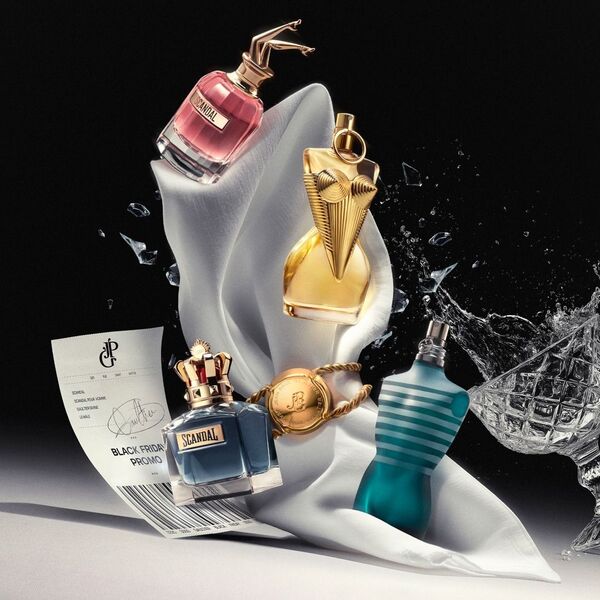
Scandal Era de Parfum (2017) / JPG Fragrance Collection
Secondly, there is the issue of banner blindness—the effect where the brain ignores familiar advertising. Glossy perfume posters are predictable. To break through the attention filter, one must elicit a strong emotional reaction—a shock.
Advertising poster for JPG’s Scandal perfume
Third, the issue of retention. The hook works for the first two seconds. To prevent the viewer from switching channels, you need to employ a technique that compels the brain to keep watching the clip.
Visuals and Storytelling
The video structure is built on a rapid succession of shots: Shake appears → public shock → interaction with De Palma → laughter → the bottle. The editing alternates between close-ups and wide shots. This prevents the viewer from having time for critical evaluation—the perception works on a reflexive level.
In the psychology of perception, there is the Gestalt principle—the brain’s drive to unify disparate elements into a cohesive whole. JPG deliberately violates this principle. The primary compositional techniques are mirrors and «frame within a frame.» Mirrors in interior design create a voyeuristic effect. Furthermore, the figure-ground principle (where we clearly separate the main object from the background) is disrupted here. The frame contains many details, yet the eye is drawn to a bright pink spot (the bottle) or a sharp gesture (laughter). The product is positioned peripherally; it appears in the finale when attention has already been captured.
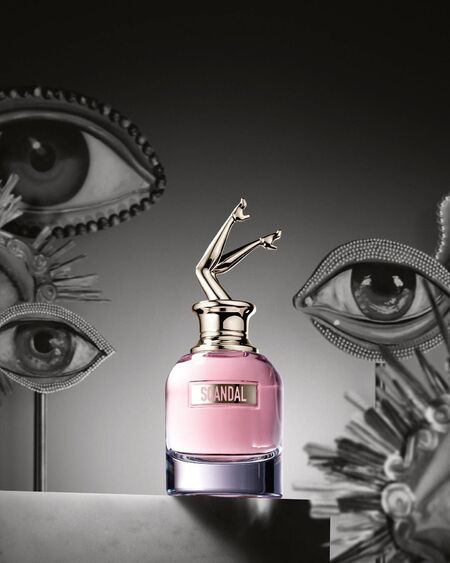

The Aesthetics of «Peeping» in JPG’s Scandal Advertising. A bottle featuring provocative legs set against a background of eyes, referencing a famous '70s poster / Irina Shayk in an outfit playing on the contrast between a tuxedo and bare legs.
The video is primarily black and white, but the final frame introduces color. Red symbolizes passion, gold symbolizes prestige, and pink symbolizes femininity. The contrast between black and white and color creates a «flash» effect: the brain registers the colored frame as an emotional anchor. In the context of JPG, pink represents not «tenderness,» but aggressive femininity.
How does a scandal become a button, and what happens when you press it?
Here, a central perceptual conflict emerges. In the video, Irina Shayk appears in a restaurant wearing a blazer over nothing, causing shock among patrons. The viewer becomes a voyeur. However, Shayk herself is not embarrassed—she looks back and laughs. For one segment of the audience, this is read as empowerment. For another, it is perceived as the veiled exploitation of the same male gaze, masked by irony.