STRUCTURE
1. Research Concept
2. David Bowie and Ziggy Stardust
3. Eminem and The Death of Slim Shady
4. The Weeknd and Hurry Up Tomorrow
5. Husky and the «Lucifer» Project
7. Conclusion
8. References
RESEARCH CONCEPT
A musical artist exists not only through the works they create but also through the public persona they cultivate. The stage identity is constructed from the pseudonym, appearance, wardrobe, the visual presentation of musical releases, music videos, concert performances, interviews, and behavior within the media landscape. Over time, this image evolves into a recognizable character—one that listeners associate with the artist’s music, aesthetics, and personality.
However, stage identity is not always fixed. Many artists change their musical direction or visual style, but only a small fraction resorts to more radical artistic strategies. In such instances, the deconstruction of the stage persona becomes an independent artistic statement, rather than a mere byproduct of creative transformation.
This study examines the visual strategies of symbolically dismantling stage identity within contemporary music culture. Its central premise is to explore the death of the stage persona as a distinct form of artistic expression—a mechanism through which an artist attempts to distance themselves from their created public character, recontextualize their own identity, or declare the necessity of creative rebirth.
Special attention in this research is given to the question of whether it is possible to completely dismantle an established stage identity—not just in the performer’s representation, but in the consciousness of their audience. Can the symbolic death of a character liberate an artist from previous expectations, or does it, conversely, become yet another way to sustain interest in that character?
To address this problem, the study proposes examining several musical case studies that demonstrate different methods of symbolically concluding a stage identity. Among these are David Bowie’s public farewell to the Ziggy Stardust character in 1973, the conceptual death of Eminem’s alter ego Slim Shady in the project The Death of Slim Shady (Coup de Grâce) (2024), and The Weeknd’s conclusion of a particular artistic era within the project Hurry Up Tomorrow (2025). These examples allow for an examination of various forms of artistic departure from a former image.
The central object of this research will be Husky’s project «Lucifer» (2018–2019), where the theme of destroying stage identity receives the most elaborate visual and performative realization. Within this project, the artist engages in staging his own suicide and funeral, destroying the previously recorded album «Gospel of the Dog, ” and reinterpreting his established public persona.
The visual analysis will focus on how artists construct the image of their own death and what artistic devices they employ to signal a break with their past identity. Particular attention will be paid to what happens to the public image following symbolic death.
The central contradiction to explore lies in the fact that the act of destroying a stage identity becomes a part of that identity itself. The artist attempts to discard the image they created, but they do so publicly, transforming their own disappearance into a new artistic statement. Thus, symbolic death may not be a final liberation from a former character, but rather its last and perhaps most expressive form of existence.
DAVID BOWIE AND ZIGGY STARDUST
One of the most famous examples of a conscious conclusion of stage identity is the story of David Bowie and his character Ziggy Stardust.
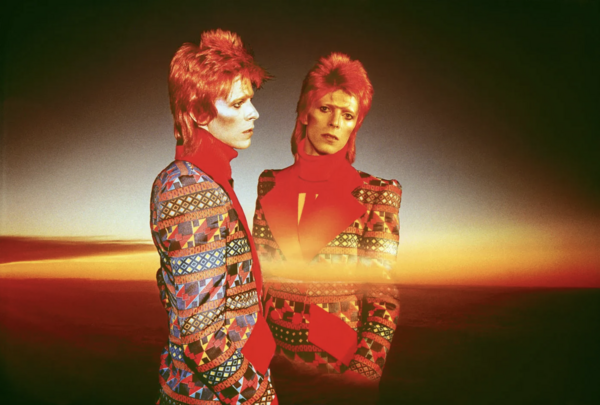
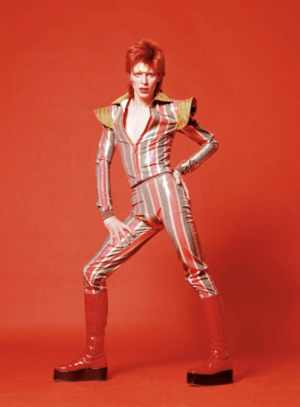
Dawn of Hope (composite image), Radio City Music Hall, New York, 1973 / Untitled (wearing Kansai Yamamoto costume), RCA Studio, New York, 1973.
In the early 1970s, Bowie created the persona of a fictional rock star that became central to his musical and visual artistry. Ziggy Stardust was a fully realized character with his own distinctive appearance, mannerisms, costumes, and backstory. His bright makeup, red hair, futuristic outfits, and androgynous aesthetic made him one of the most recognizable figures in music culture.However, on July 3, 1973, during a concert at London’s Hammersmith Odeon, Bowie unexpectedly announced the end of Ziggy Stardust and the band The Spiders from Mars. This performance served as a public farewell to the character.
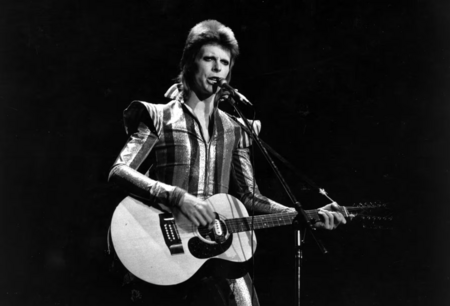
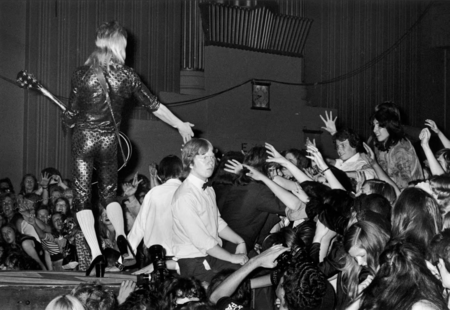
David Bowie at the Hammersmith Odeon concert. London. July 3, 1973.
David Bowie at a concert in Hammersmith Odeon. London. July 3, 1973.
In the case of Bowie, the demise of a stage persona occurs through the character’s final appearance before the audience. Ziggy Stardust, who existed through constant public presence, vanishes the moment its creator announces its cessation. This creates a contradiction, because despite the declared end, Ziggy Stardust persists through photographs, video recordings, and cultural memory. The character’s death does not destroy its image; rather, it solidifies it as a complete artistic form.
EMINEM AND THE DEATH OF SLIM SHADY
Another way to symbolically dismantle stage identity can be seen in Eminem’s project The Death of Slim Shady (Coup de Grâce), released in 2024.
A still from Eminem’s «The Real Slim Shady» music video. 2010.
Slim Shady is the performer’s alter ego, which has existed since the late 1990s. This character has become an integral part of Eminem’s musical identity, associated with provocation, an aggressive performance style, dark humor, and the violation of social norms.In the 2024 project, the confrontation between Eminem and his alter ego becomes the central concept of the album. The theme of Slim Shady’s death develops not only through the musical narrative but also through a visual campaign.
«…I’m who you used to be…»
— a lyric from Eminem’s Guilty Conscience 2
(перевод: Я тот, кем ты раньше был)
«…You created me…» — a line from Eminem’s song Guilty Conscience 2
(перевод: Ты создал меня)
Album cover for Eminem’s The Death of Slim Shady (Coup de Grâce). 2024.
One of the key visual elements is the album cover, which depicts a young Slim Shady in a body bag. The character is no longer presented as an active performer, but as a body subjected to violence—an object of observation.
A still from the Eminem Tobey music video. 2024.
The music video for the composition «Tobey» also employs the motif of the physical destruction of a character. It features a scene where Eminem attacks his alter ego with a chainsaw. Thus, the artist’s internal conflict receives a literal visual expression.
Unlike Bowie, who brings Ziggy Stardust to an end with a final performance, Eminem crafts an entire artistic narrative in which the death of his alter ego becomes a central plot point. It is important to understand, however, that we are discussing the conceptual death of a character within the work, not a proven, final renunciation by the artist. Slim Shady continues to exist in Eminem’s musical legacy, and the very idea of his demise becomes the foundation for a new album. This creates a paradox: to tell the story of a character’s death, the artist must bring him back to the center of attention.
THE WEEKND and HURRY UP TOMORROW
A more nuanced example relates to the project «Last Supper» (The Weeknd Hurry Up Tomorrow,) released in 2025.
A still from the film «The Last Breakfast.» 2025.
Unlike Bowie and Eminem, there is no discussion of the same direct and unambiguous annihilation of a single alter ego here. Rather, the project is viewed as the culmination of a specific artistic cycle linked to the previous albums, After Hours and Dawn FM.
The music and film, Last Breakfast (Hurry Up Tomorrow), address themes of fame, public life, psychological tension, and the artist’s complex relationship with their own persona. The performer embodies an artistically reinterpreted version of themselves, so the boundary between their real self and the stage character becomes part of the narrative.
Still frame from the film «The Last Breakfast.» 2025.