Спасение и наказание в изображениях Страшного суда в европейском искусстве XII–XIV веков
Concept
The Last Judgment is one of the most popular subjects in medieval art. Christ is usually at the center, judging humanity. Some people receive salvation, while others receive punishment. [2]
I decided to choose this topic because I was intrigued by how the same narrative appears drastically different across various works. In some pieces, heaven and hell are clearly delineated; in others, more emphasis is placed on the faces and gestures of the people, and in yet others, the focus is more on the play of color and form. Despite these variations, the artists managed to create a piece where the viewer immediately understands where paradise and the salvation of the righteous lie, and where hell and the punishment of sinners are located.
The central question of my visual research is: what artistic techniques did masters of the 12th–14th centuries use to depict salvation and damnation in scenes of the Last Judgment?
I believe the juxtaposition played an important role: the saved were often depicted more calmly and softly, while the condemned, conversely, were shown in dynamic and tense poses. In my research, I want to investigate how noticeable this is across different works and what other techniques the masters employed.
I chose Western European art from the 12th–14th centuries to compare works from different centuries and techniques.
For my research, I selected works from the 12th–14th centuries: reliefs from Conques, Autun, and Notre-Dame Cathedral in Paris, the stained glass of Chartres Cathedral, the mosaic of the Florentine Baptistery, a book miniature, and frescoes by Giotto and Buffalmacco. The Last Judgment is depicted in all these works. Using them as examples, I will compare how artists emphasized Christ, portrayed the saved and the condemned, and conveyed tranquility, movement, and tension through composition, posture, and gesture.I divided the study into three chapters. In the first, I will examine how artists depicted Christ and how they set him apart from other characters; in the second, I will compare how heaven and the saved were shown; and in the third, I will focus on hell and the condemned. I chose this structure to examine each part of the narrative separately and to compare its depiction across different works.
Chapter 1. The Image of Christ
Unknown Master. «The Last Judgment.» 1130–1135. Stone relief. Conques, France.
The tympanum of St. Foy’s church in Conques depicts numerous characters, yet Christ immediately stands out among them. He is centrally located, his figure significantly larger than the others, and is encircled by an oval, convex frame. All other scenes are situated around and below him. If one looks closely at Christ’s hands, it can be noticed that they point in different directions. His right hand is raised toward the saved, while his left hand is lowered toward the condemned. These gestures help visually divide the composition into two opposing sides.[3]
Unknown masters. Western Rose «Last Judgment.» 13th century. Stained glass. Chartres, France.
The narrative is presented within a large circular frame. Christ is at the center, with the other figures and scenes arranged around him. Unlike the relief of Conca, the composition develops not in tiers, but in a circle. [4]
The artworks employ various methods of focal point creation.
In the Conques panel, the figure of Christ is emphasized by its scale and placement within the horizontal rows of figures. In the Chartres window, the circular shape of the stained glass itself draws attention to him. While artists employed different compositional solutions, in both cases, Christ serves as the centerpiece of the Last Judgment.
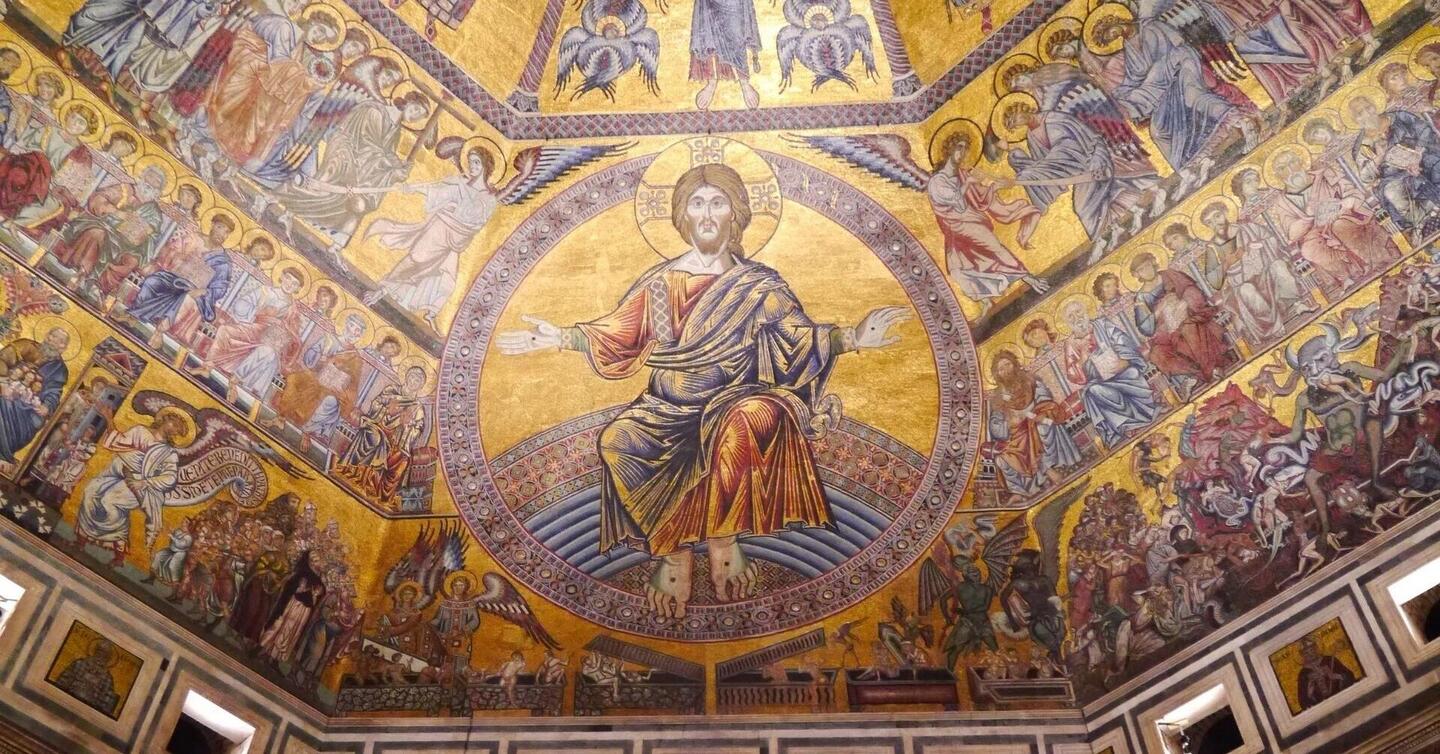
Tuscan Masters. «Last Judgment.» c. 1260–1275. Mosaic. Florence, Italy.
At the center of the mosaic is a massive figure of a seated Christ. He is framed within a circular border and occupies significantly more space than the surrounding characters. The golden background and monumental scale establish him as the composition’s primary element.[5]
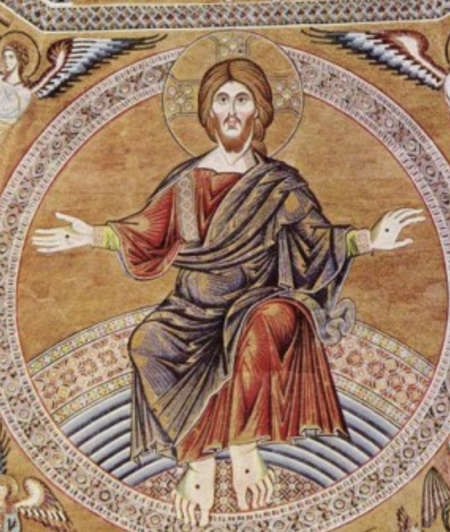
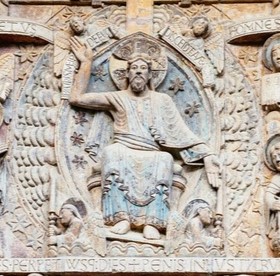
Tuscan Masters. «The Last Judgment.» c. 1260–1275. Mosaic. Florence, Italy. Unknown Artist. «The Last Judgment.» 1130–1135. Stone Relief. Conques, France.
Gesture comparison.
In both works, Christ’s right hand is turned toward the saved, and his left toward the condemned. However, the representations differ noticeably in execution: in Conca, the figure is carved from stone, whereas the mosaic in Florence is composed of colored tesserae. The same gesture retains its meaning, but its artistic rendering changes.
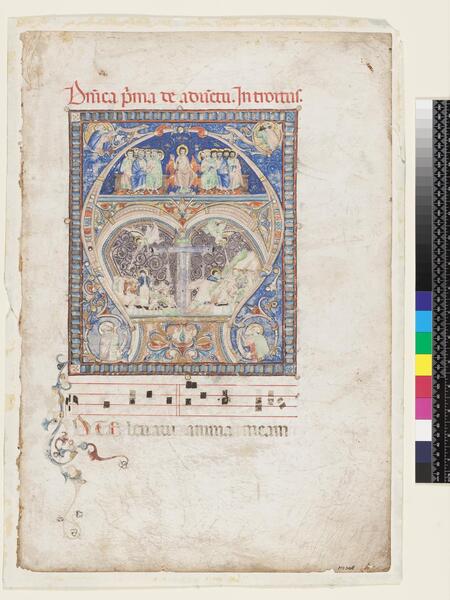
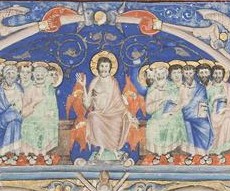
Unknown master. «The Last Judgment with Christ on the Throne.» c. 1325. Miniature within an ornamented initial on a graduall leaf. Siena, Italy. Fitzwilliam Museum, Cambridge, MS 308.
In this work, the Last Judgment is depicted inside a large, ornate letter «A,» which begins the Latin text of the prayer.[6] Christ sits at the top of the composition, with the other participants of the judgment positioned below. Despite the limited space, the artist managed to include several significant narrative episodes.Christ is situated above the other figures. The apostles flank him, and the scenes related to the judgment are located beneath. This arrangement helps to separate the central figure from the others, even in such a small miniature.
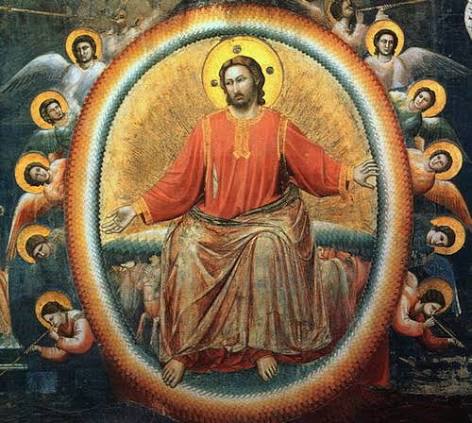
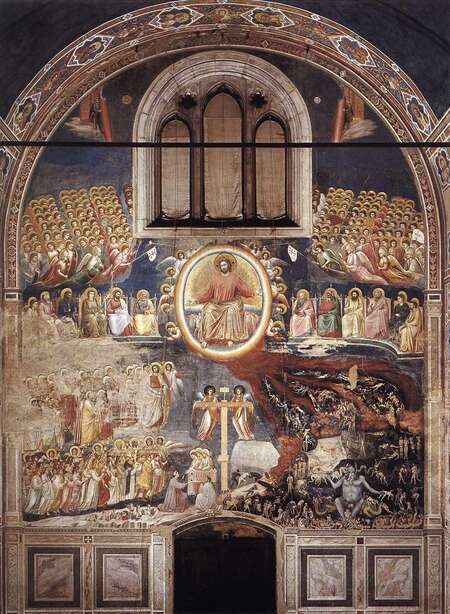
Giotto di Bondone. «The Last Judgment.» 1303–1305. Fresco. Padua, Italy.
Christ is positioned in the center of a large, multi-figure composition. He is surrounded by a vibrant mandorla, and the apostles are seated on either side. [7] Despite the numerous figures, Christ stands out immediately due to the colorful framing and the arrangement of the figures.
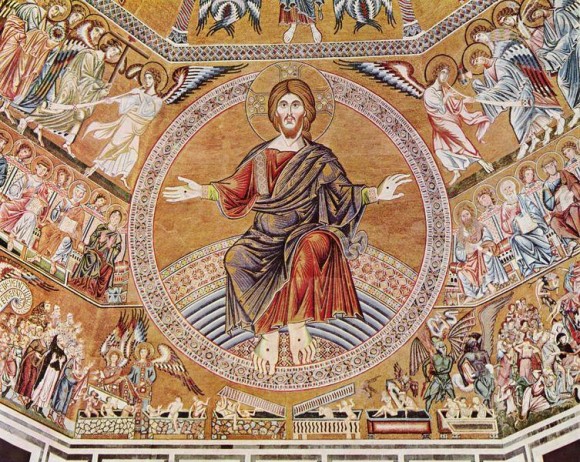
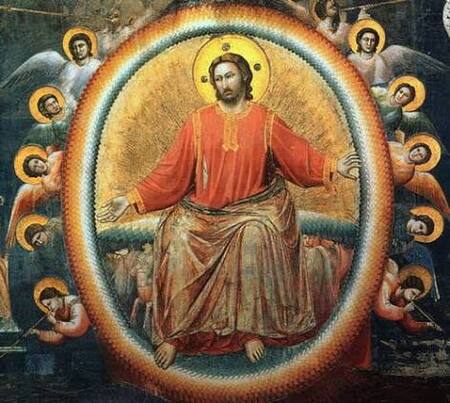
Large fragments of Christ from Conca and the mosaic «Last Judgment» on the vault of the Baptistery of San Giovanni in Florence.
Giotto di Bondone. «Last Judgment.» 1303–1305. Fresco. Padua, Italy.
Both artists set Christ apart using colored framing, but they do so in different ways. In Florence, the figure is set within a massive circle against a golden background. Giotto’s mandorla is composed of several colored bands. In both cases, the framing helps the viewer distinguish Christ from the surrounding scene.
Artwork Comparison
The differences are particularly evident. In Conca and Florence, Christ is highlighted through his large scale; in Chartres, he is emphasized by his central position within the circular stained glass; in the miniature, by his placement above the other figures; and in Giotto’s work, through his bright mandorla.
Despite the variation in materials and the size of the works, the artists employ several similar techniques to emphasize the main character.
The comparison revealed that the primary methods used to highlight Christ were central positioning, increased size, special framing, and gestures. These techniques appear across various art forms, from stone reliefs to illuminated manuscripts.
Thus, while the artists organized the imagery differently, all their choices served to establish Christ as the principal figure in the scene of judgment.
Chapter 2. The Image of Paradise and the Saved
Unknown master. «The Last Judgment.» First half of the 12th century. Stone relief. Saint-Foy Church, Conques, France.