CONCEPT
How does the image of woman change if in one work her body is nude, but in another it is covered in clothing? Why is nudity permissible for depicting a goddess, whereas the images of mortal women are more often associated with drapery? What can fabric reveal about the body, even when it doesn’t allow us to see it?
In this study, I examine the female image in ancient Greek art from the 3rd to 6th centuries BCE. This period was not chosen arbitrarily, but because of the diversity in how the female figure and her status were depicted. In the middle of the 4th century, Praxiteles created Aphrodite of Knidos—one of the most famous images of a nude goddess. Simultaneously, clothed women are depicted in funerary sculpture, vase painting, and terracotta reliefs. Comparing these allows for an examination of nudity and drapery within the same epoch.
Nudity and clothing in Greek art are not merely in opposition; the choice between them depends on the character’s role and the work’s context. Nudity can signify divine nature and idealized beauty, whereas clothing denotes social status and the character of the figure. Moreover, the drapery does more than just cover the body—it lends volume and movement to the form. Depending on their pose, female figures appear ethereal, free, and light, while in other, more somber scenes, the drapery seems incredibly heavy, drawing the figure downward. I will test this hypothesis by comparing works from different art forms within the same period. This will help to better understand and study the issue.
My research is grounded in scholarly foundations. In the chapter «The Female Body: Aphrodite of Cnidos, ” Rosemary Barrow examines the nudity of Aphrodite of Cnidos in relation to the religious context and perception of the goddess. Her study of costume on late Classical funerary and votive reliefs, published in the journal Hesperia, suggests that attire could signify a woman’s social status. These works are exceptionally useful for exploring the body and its covering as interconnected elements of an image.
The research is divided into four chapters. The first is dedicated to Aphrodite of Cnidus and the nude female figure. The second examines clothed women in funerary reliefs and the significance of costume. The third addresses vase painting, where the external appearance depends on the mythological, ritual, or everyday subject. The fourth is dedicated to terracotta sculpture and how fabric folds shape silhouette and movement. Each chapter explores a separate method of depicting the female form.
Museum catalogs, academic articles, and research on the history of Greek art and costume are used for analysis. The catalogs help verify the dating, material, and provenance of the objects, while the scholarly publications help understand their historical context and compare interpretations. First, the characteristics of the imagery are documented, and then their possible significance is examined. Quotes are cited concisely, and the conclusions will be based on the comparison of visual examples.
Chapter 1. The Naked Goddess: Aphrodite of Cnidus
Mid-4th Century BCE
MARBLE, SCULPTURE
SYMBOL: DIVINE BEAUTY AND THE NEW IMAGE OF THE FEMALE FORM
Aphrodite of Knidos is one of the most crucial turning points in the history of Greek sculpture. The sculpture was created by Praxiteles around 360–350 BCE, and it became the first widely known depiction of a nude goddess, as prior to this, nudity in Greek sculpture was predominantly reserved for male figures, while the female body was usually covered, to some extent or another.
According to the account of the Roman writer Pliny the Elder, Praxiteles created two statues of Aphrodite—one clothed and one nude. The residents of Kos chose the clothed version, deeming it more modest, while the inhabitants of Knidos acquired the nude version and placed it in a sanctuary. This particular rendition brought fame to both the sculptor and the city. It is important to remember, however, that Pliny wrote about this several centuries after the statue was created; therefore, his account is not an eyewitness testimony, but rather an ancient literary tradition.
One of the statues was clothed, and it was this one that the residents of Kos preferred… The statue they rejected was acquired by the residents of Knid, and it gained immeasurably greater fame.
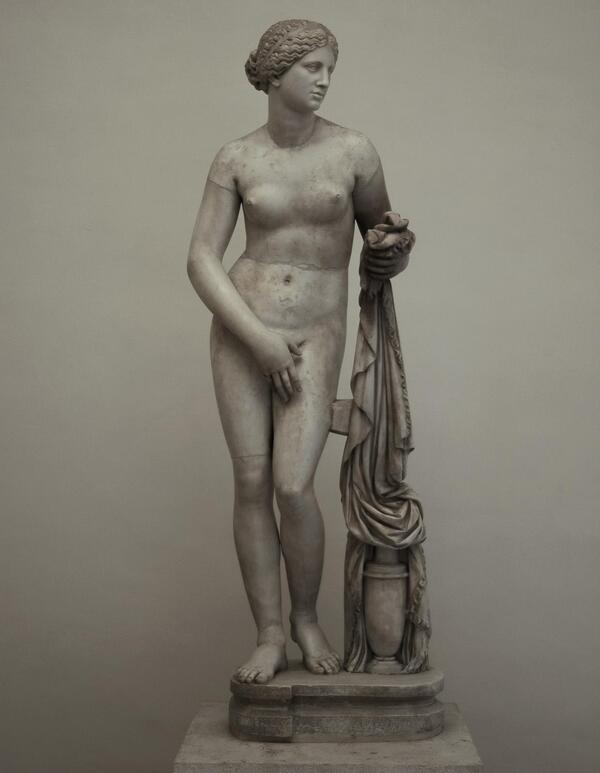
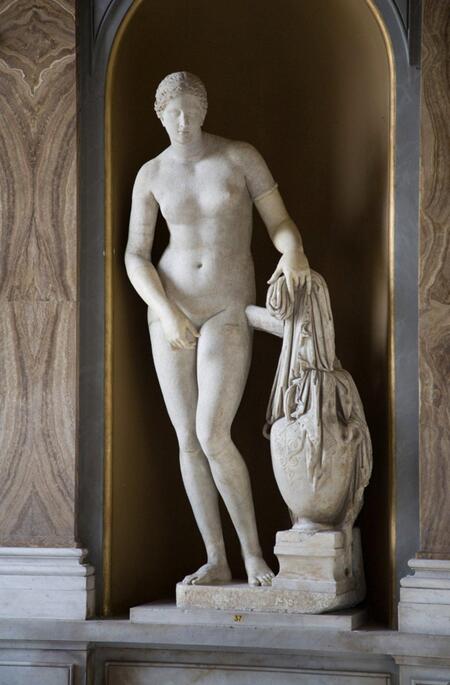
Left — a Roman copy of Aphrodite of Knidos from the Palazzo Altemps, Rome. This is a late version based on the Greek original.Right — Aphrodite of the Column. A Roman marble copy from the 2nd century CE, based on a Greek original by Praxiteles from the 4th century BCE. Vatican Museums, inventory no. 812
At this moment, female nudity is presented not as a sign of vulnerability or low status, but as an attribute of the divine image. Aphrodite is depicted next to a water vessel, appearing as if she is about to bathe or has just completed bathing, and we are viewing the goddess after the action. With one hand, she covers her pubic area; with the other, she touches the cloth lying on the vessel. This gesture does not conceal the nudity entirely; instead, it directs the viewer’s attention toward the body. Aphrodite does not look vulnerable; she does not look like she has been caught off guard. It is this mundane action that becomes part of the image of a goddess connected to birth from the sea and beauty.
Unfortunately, the original Aphrodite of Knidos has not survived to the present day, so all existing copies are replicas, reconstructed based on Roman copies, coins, and descriptions from ancient authors. This presents an important limitation for study: the preserved Roman statue cannot be considered an authentic work by Praxiteles. However, the recurrence of the composition in the copies demonstrates how recognizable and influential the statue he created became.
It is particularly important to note that Aphrodite was not merely a decorative representation of feminine beauty, but a truly iconic statue. As researcher Rosemary Barrow notes, the image of Aphrodite existed simultaneously within religious and aesthetic contexts; therefore, reducing the significance of the sculpture solely to an erotic perception would be fundamentally incorrect. The viewer was confronted by a goddess—a sublime and powerful being—not an ordinary mortal woman. Barrow also considers that the work could be perceived differently depending on the viewer’s background, artistic exposure, and life experience.
Terracotta oinochoe (wine pitcher), made in Attica in the mid-4th century BCE and housed in The Metropolitan Museum of Art collection in New York.
Comparing the Aphrodite of Knidos sculpture with other 4th-century works reveals that nudity was far from the only way to depict the female body. For instance, on an Attic funerary stele from the mid-4th century, a woman is shown seated in a ceremonial posture, situated within a burial context. More complex solutions can be found in the vase painting of the same period. For example, on an Attic ойнохое from the Metropolitan Museum of Art, the female personification of Pompe is depicted with a drapery that does not conceal, but rather emphasizes, her nudity. We can confidently state that these examples clearly demonstrate that the significance of a nude body was determined not only by its pose, but also by the subject matter and the function of the object.
Chapter Conclusion. Aphrodite of Knidos undeniably changed the perception of female nudity in Greek art. The nude body became an acceptable depiction of divine beauty and a subject for monumental sculpture. Despite this, fabric did not disappear from the composition—it retained the role of a kind of support and semantic contrast, separating the exposed body from its surroundings and external gazes. In this work, the body and the covering no longer oppose each other—they jointly form the image of the goddess.
Chapter 2. Clothing: The Body Under Cloak
4th Century BCE
MARBLE, FUNERARY RELIEF
SYMBOL: DIGNITY, STATUS, AND MEMORY
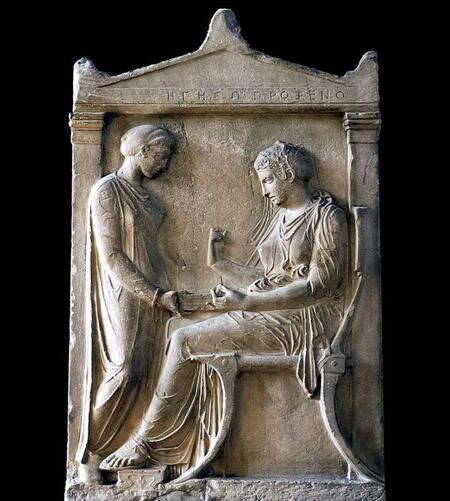
The funerary stele is not merely a monument to the deceased. It is an image meant to preserve her presence in the family’s memory. Women depicted on such reliefs are often shown seated or standing in a tranquil pose, draped in a chiton and himation. Her clothing does not speak to fashion; rather, it shapes an image of reserve and dignity.
The Stele of Hegeso (tomb monument from the late 5th century BCE, housed in the National Archaeological Museum in Athens)
Looking at this stele, one must undoubtedly focus on the folds of the himation. The fabric covers the body but does not transform the figure into an amorphous silhouette. The cloth accentuates the positioning of the arms, knees, and shoulders; the garment becomes a way to suggest the body without exposing it. This is the main difference between the funerary image and Aphrodite of Knidos. While Praxiteles' work concentrates on exposed anatomy, here the focus is on the plasticity of the fabric, the context, and the mood.
The costumes worn by young women on Attic funerary reliefs are particularly interesting. Researcher Linda Jones Rocco notes in her article a distinctive combination of the peplos and a cloak fastened at the back. This type of attire is seen on young women whom artists deliberately set apart from other female figures. According to the researcher, this method served to signify the specific social and family status of the young woman. In other words, the clothing could communicate a character’s life status even before the viewer learned their name or identity.
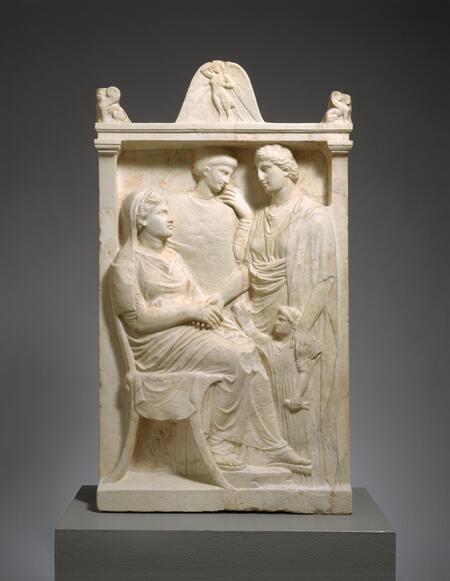
On this same stele, it is important not just how the women are dressed, but also how they are positioned in relation to one another. The seated figure occupies a central place, while the standing figure faces her. The inscription allows us to connect the figures in the composition with specific names, yet the composition itself preserves their relationship within the family monument. The relief does not depict a dramatic event—far from it—it creates an image of an enduring bond that death cannot sever.
Attic marble funerary stele of a woman (c. 375–350 BCE), housed at the Metropolitan Museum of Art in New York (Accession No. 65.11.11).
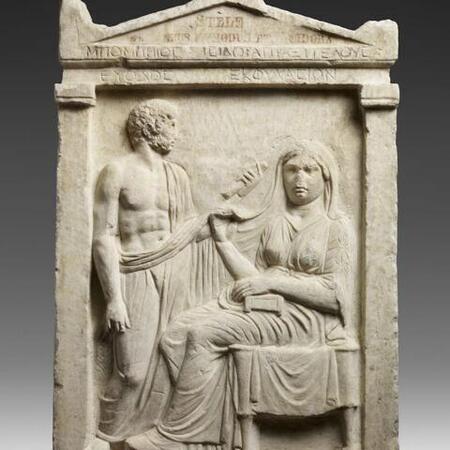
This stela demonstrates that clothing serves to unify the characters, yet it does not make them identical. The positioning of the fabric, cloaks, and bodies differs according to each figure’s role. A seated woman is depicted at the center of the scene, toward whom the man is turned. The drapery helps establish a subtle hierarchy within the composition.
A marble funerary stela from Athens (c. 150 CE, Inv. No. Ma 810), held in the Louvre in Paris.
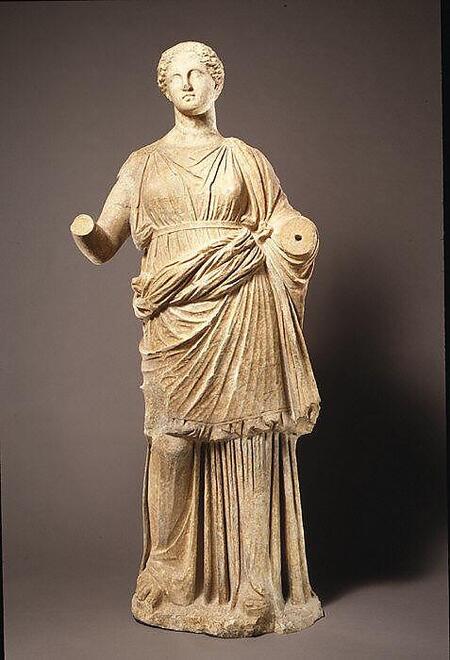
In turn, this monument demonstrates that draping was dependent not only on the figure but also on the architectural space. The sculptor meticulously rendered the side visible to the viewer, paying less attention to the concealed parts. Here, the clothing becomes an integral part of the overall composition of the funerary monument.
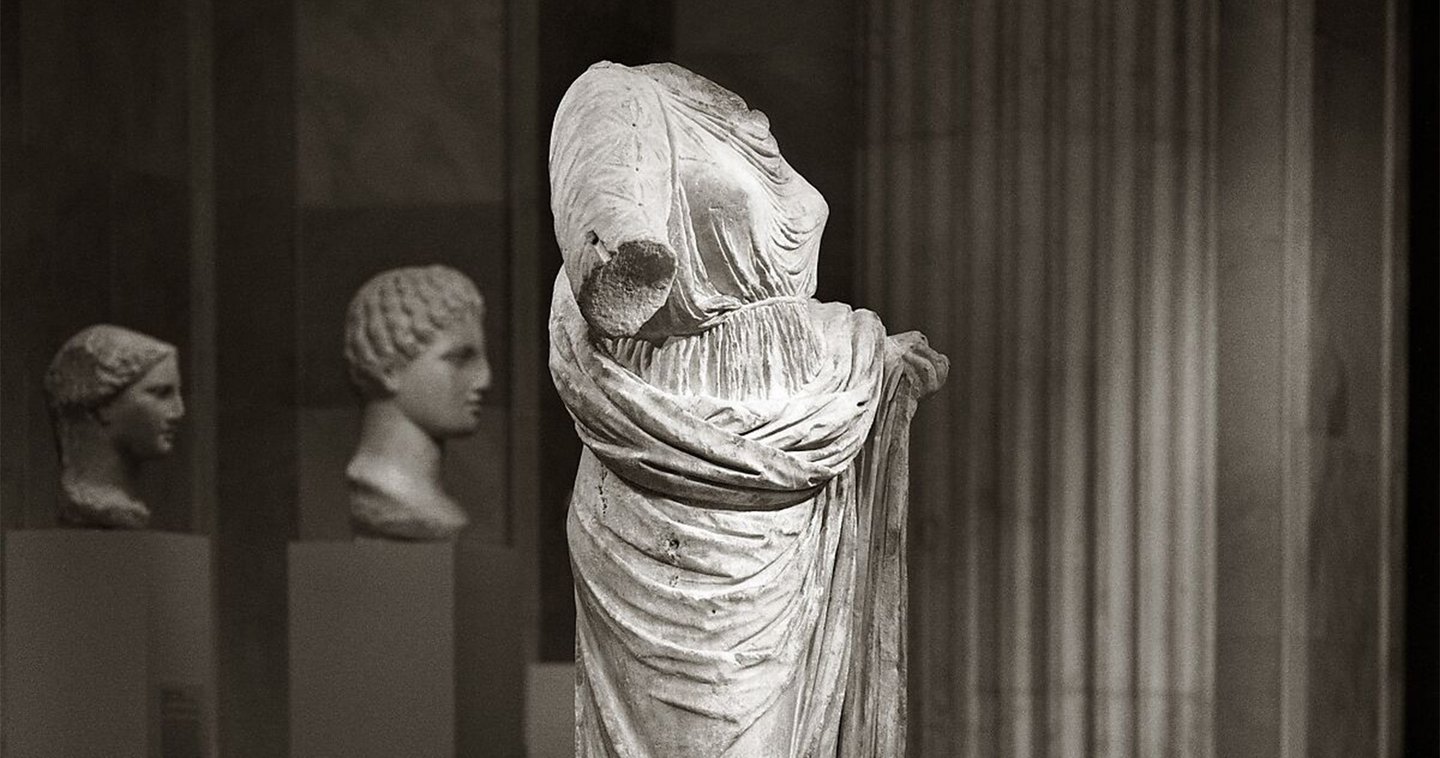
Attic marble statue of a woman (late 4th century BCE, Pentelic marble, Inv. No. 10.210.21) from the Metropolitan Museum of Art collection in New York.