
Rubricator
1. Introduction
2. The Idea: Copying the Ear
3. The Machine
4. The Phonautogram: Sound as a Line
5. Visible but Silent
6. Legacy: From the Laboratory to 2008
7. Conclusion
1. Introduction
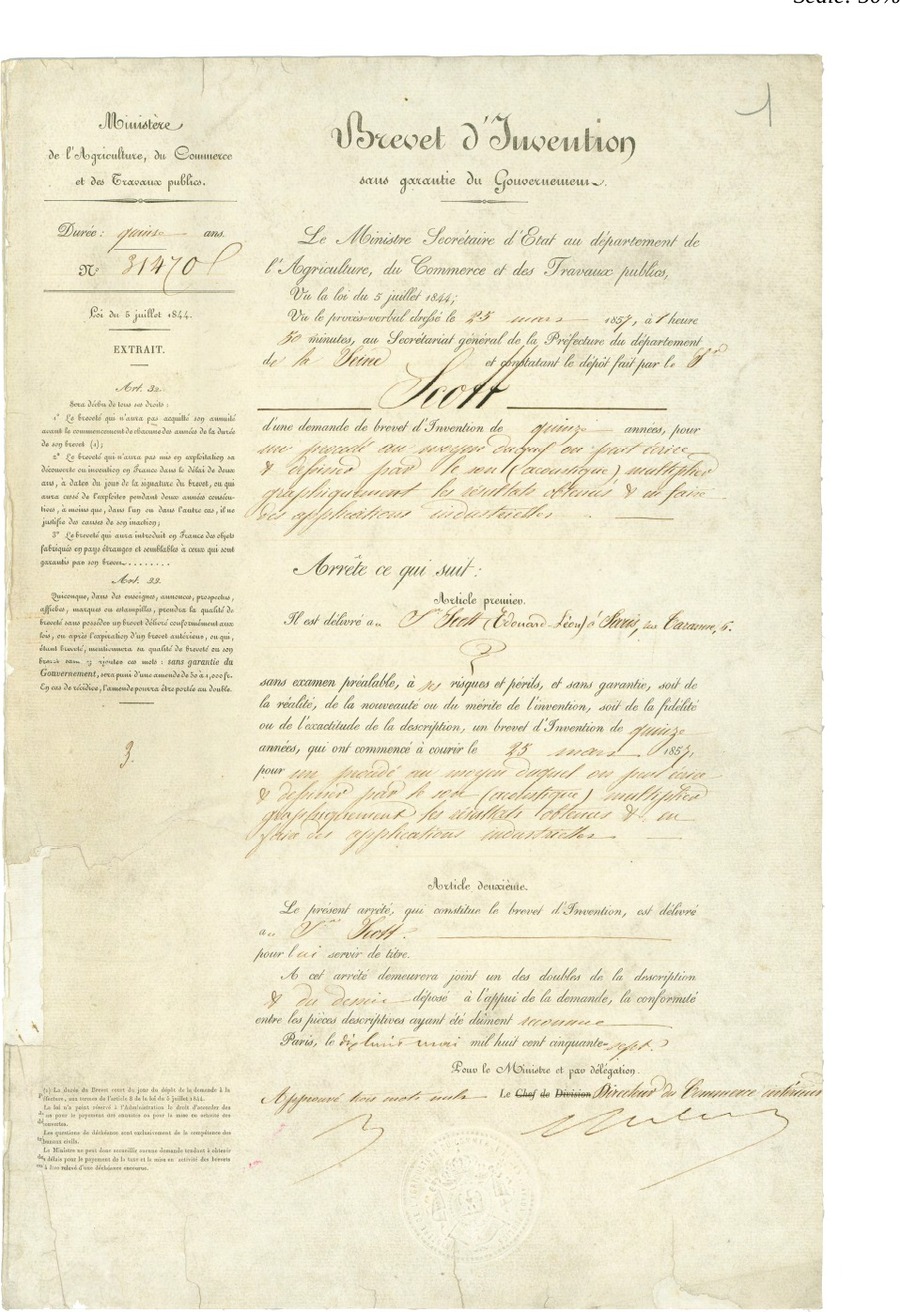
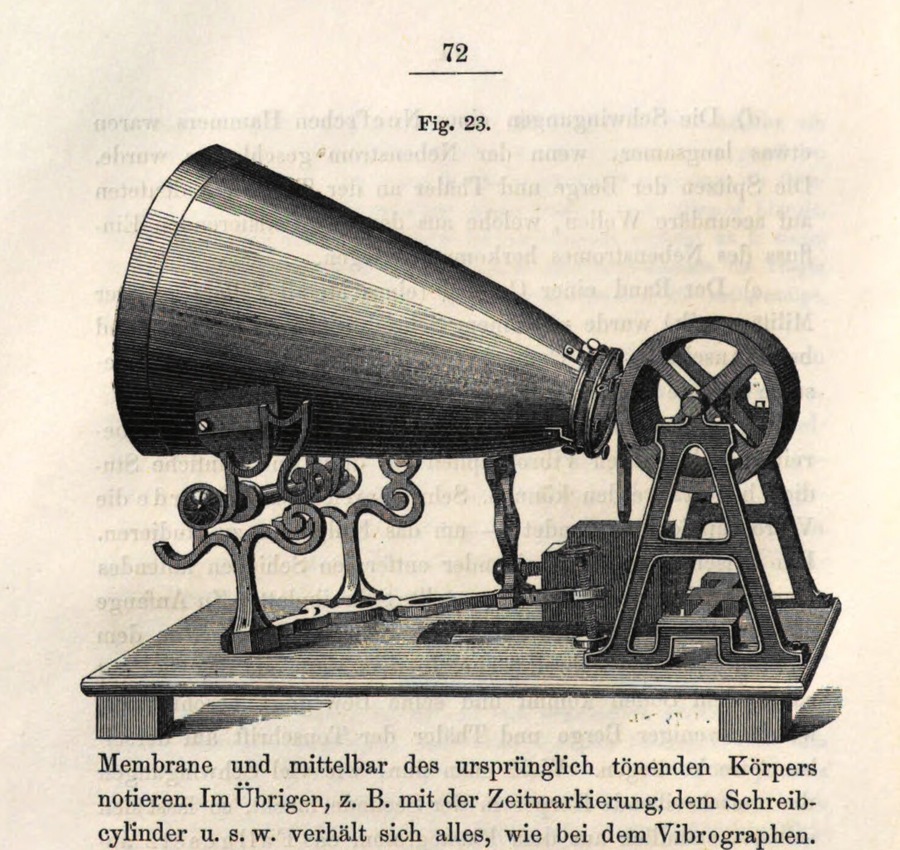
(1) The 1859 model of Scott de Martinville’s phonautograph. Engraving from F. J. Pisko, Die neueren Apparate der Akustik, Vienna, 1865 (2) First page of Scott’s French patent no. 17,897 / 31,470, March 1857
The history of sound recording usually starts with Thomas Edison and his phonograph of 1877. But twenty years earlier, a machine in Paris was already catching the human voice. In 1857 the typographer Édouard-Léon Scott de Martinville patented the phonautograph. It turned sound waves in the air into a wavy line on paper blackened with soot.The machine had a strange limit. It could record sound, but it could not play it back. This was not a mistake. Scott did not want playback at all. He wanted people to see sound and read it, the way they read text.
The object of study is the phonautograph in its two versions: the patent model of 1857 and the cylinder model of 1859, built with the instrument maker Rudolph Koenig. The study also looks at the phonautograms, the sheets the machine wrote on, and at two later stories: Bell and Blake’s ear phonautograph of 1874, and the digital playback of the recordings in 2008.The main question is why the first sound recorder in history was built without playback, and what this says about how the 19th century thought about sound. The hypothesis is that the phonautograph was not an unfinished phonograph. It was a tool with a different logic: it turned sound into an image, because at the time knowledge was trusted when it could be written down and looked at.
The Idea: Copying the Ear
Scott de Martinville (1817–1879) was not a scientist. He worked as an editor and typographer at a scientific publishing house in Paris, so his whole life was about writing. Shorthand interested him most: it was too slow and lost the tone of a voice. This led to his question: could speech be made to write itself down?
Photography gave him the idea. If the camera copies the eye and keeps an image, then a machine that copies the ear might keep a sound. Scott later called this his «imprudent idea of photographing the word»
While working on a physiology textbook, Professor Longet’s Traité de physiologie, Scott studied an engraving of the human ear. It shows how sound travels down the ear canal, shakes the eardrum and passes through the small bones of the middle ear. The ear turned out to be a mechanism, and a mechanism can be built.So Scott gave every part of the ear a match in his machine. The horn plays the ear canal, the membrane plays the eardrum, and a lever with a bristle plays the small bones. Only the last part was new. Instead of a brain that hears and forgets, the machine had a layer of soot that remembers.
The parts of the ear and the parts of the phonautograph that copy them.
This already shows that Scott copied hearing, not the voice. The machine was made to take sound in, not to give it out. Playback would have needed a second model, a mouth, and that was never part of the plan.
The Machine
Scott began work on the machine in 1853 or 1854 (he gave both dates himself). On 25 March 1857 he received a French patent. The design was simple and worked in four steps.
The voice enters a large horn and gathers on a thin membrane at its narrow end. The membrane starts to tremble. A stiff boar’s bristle, about a centimetre long, is fixed to it through a small lever and follows every movement. The bristle touches a surface coated with lampblack (soot) and scratches a thin pale line into it.
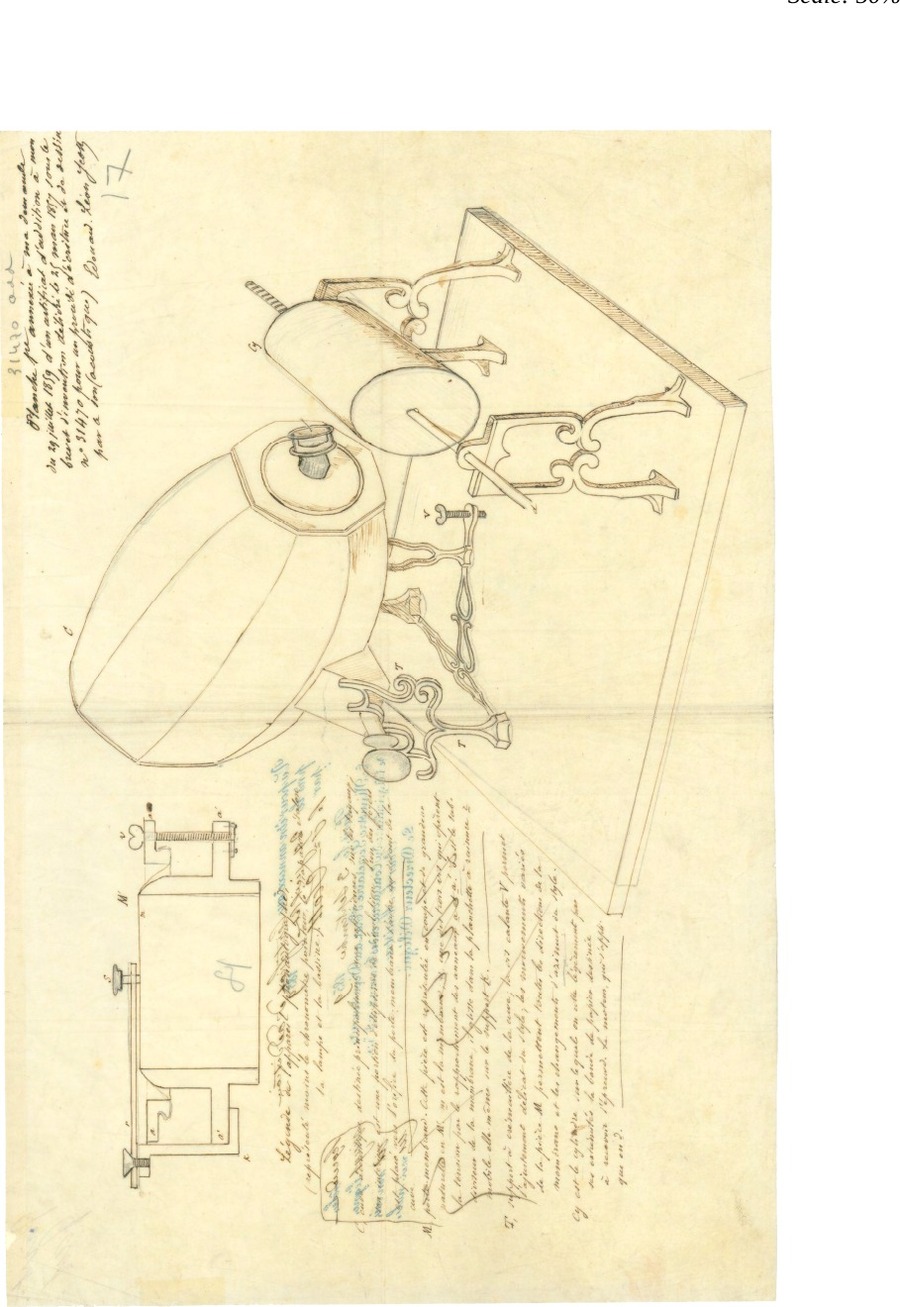
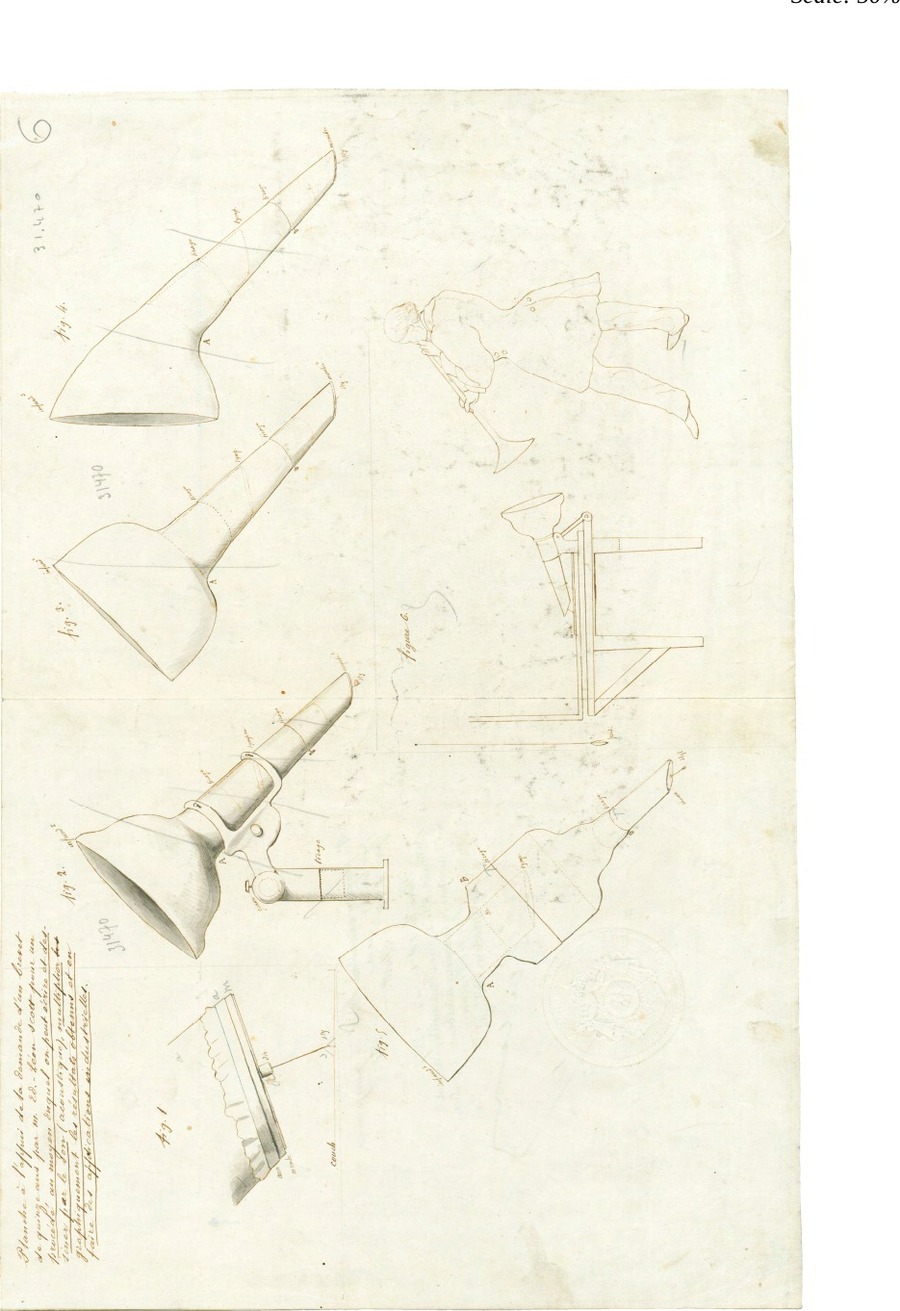
(1) Scott’s drawings of horns and membranes in his patent of 1857 (2) Scott’s drawing of the cylinder phonautograph in his certificate of addition, 1859
In the 1857 patent model, the bristle wrote on a glass plate covered with soot. A clockwork driven by a falling weight moved the plate along a groove at about one metre per second. Only a short piece of sound fitted on it.In 1859 Scott and the Paris instrument maker Rudolph Koenig built a new version. Now the sooted paper was wrapped around a cylinder turned by a hand crank. A threaded shaft moved the cylinder sideways as it turned, so the line ran in a spiral. Recordings became longer, about 20 seconds. Koenig sold the phonautograph as a laboratory instrument.
The 1859 phonautograph in motion: horn, membrane, bristle, sooted cylinder, thread and crank.
Left, the glass plate of 1857. Right, the cylinder of 1859 with its spiral trace.
The move from plate to cylinder matters for more than technical reasons. Eighteen years later the cylinder became the shape of Edison’s phonograph. The difference is that Edison’s needle pressed into tinfoil and left a groove, while Scott’s bristle only slid across the soot.
The Phonautogram: Sound as a Line
Sound became a line.
What the machine produced is called a phonautogram: a sheet of black paper with a trembling white line running across it. For the first time, a sound that lasts only a moment left a permanent trace.The word itself is built from three Greek roots: phōnē, «sound», autos, «self», and graphein, «to write». Sound that writes itself. Scott’s whole programme is already in the name: no listening, only writing.
One of Scott’s earliest phonautograms, attached to his patent of 1857
A phonautogram shows three things. The height of the wave shows how loud the sound is. The spacing of the waves shows the pitch: the closer they are, the higher the note. The shape of the wave is linked to timbre, the quality that makes one vowel different from another.Time was the problem. A person turned the crank, so the speed kept changing. That is why a second line was often recorded next to the voice, made by a tuning fork with a known frequency. It worked like a clock: by counting the tuning-fork waves, one could tell how long each part of the voice lasted.
A reconstructed phonautogram: the voice above, the steady tuning-fork line below.
A phonautogram tells more about a sound than the ear does, but only to someone who can read it. By ear you cannot measure a frequency or compare two sounds exactly. By the line, you can.
Visible but Silent
Today recording and playback feel like two sides of one process. The phonautograph shows that they are not. It kept sound safely, but it could not give it back. A line in soot is flat: there is no groove for a needle to follow and set a membrane shaking again.
Scott did not see this as a flaw. He hoped people would learn to read phonautograms the way they read shorthand. In his mind it would be a «natural stenography»: writing made not by a person but by speech itself. For a typographer, the idea made perfect sense.
A page from Scott’s 1859 patent papers: traced lines with handwritten words beneath them
The dream did not come true. Reading words from waves proved impossible, because the same word looks different from one speaker to the next. But this failure shows what the machine really was: visualization without reproduction. It made sound visible and permanent, but left it silent.The idea of giving recorded sound back came only in 1877. The French poet and inventor Charles Cros suggested engraving a phonautogram line into metal so that a needle could follow it. The same year, Edison built the phonograph. In 1878 Scott published a pamphlet defending his priority, but the fame had already gone to others.