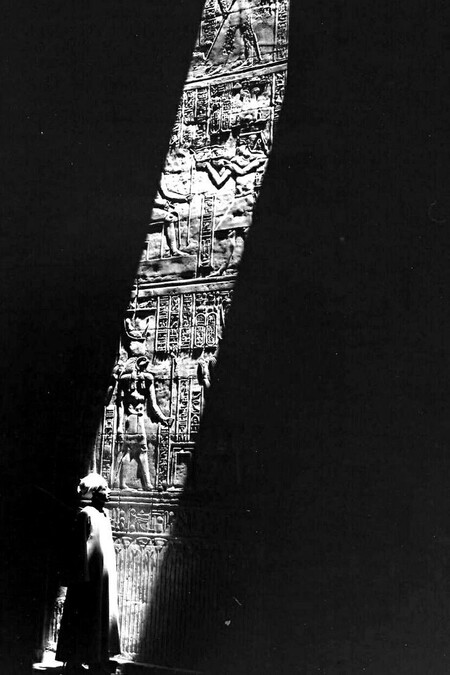
Throughout human history, art and architecture have served as tools to influence the viewer’s mind and emotions, compelling them to see the world through the creator’s perspective. Different eras have chosen different mediums: ancient builders carved multi-ton blocks of stone, while modern directors and set designers frame scenes on a film set. Nevertheless, the mechanisms for emotionally engaging a person remain similar. It is even more compelling to trace these parallels to uncover timeless principles of working with light and composition.
The goal of this research is to analyze the architectural techniques employed in ancient Egyptian temple and funerary complexes that were designed to generate suspense and suppress the viewer’s will, and to trace their transformation in contemporary cinema.
Relevance and topic selection. Examining similar techniques for building tension across such disparate mediums—monumental architecture and film—will allow me to deeply study the principles of narrative through environment, for the subsequent application of these tools in my own design projects.
To fully immerse yourself in the study and achieve comprehensive understanding of the material, you must organize your research according to a clearly conceived plan. This approach will help systematize the information and facilitate the analysis process.
Thus, this research is structured from a general compositional principle to specific spatial and lighting tools: 1. Path to God, 2. Light Dramaturgy, 3. Gigantism and Sand Grains. Each section first presents Ancient Egyptian techniques, which are then compared with cinematic techniques.
The selection of textual sources is based on their scholarly significance and historical accuracy: the work incorporates academic articles on architecture and lighting design, treatises on art history, as well as scientific publications and interviews dedicated to film scenography.
When analyzing textual sources, I will adhere to the following principles: 1. Contextualization: 2. Visual Analysis; 3. Critical Analysis.
Applying these analytical methods will allow me to comprehensively study the sources, form an objective opinion on the topic, and conduct a thorough comparison.
The Path to God: The Temple as a Psychophysical Filter
The core of ancient Egyptian temples (particularly during the New Kingdom) and funerary complexes of the Old Kingdom was a strict longitudinal axis, embodying a ritualistic «path to the god”—a movement from the chaos of the outside world toward sacred order. As architectural researchers note, the temple complex functioned as a gigantic hierarchical sieve, sequentially filtering sunlight, space, and people.
The Temple of Khonsu at Karnak. 12th century BCE. Plan
This principle manifested both externally, in the building’s layout, and internally, in the sanctuary’s planning.
The complex of Pharaoh Khafre in Giza was built as if on the boundary between two worlds: the lower temple abutted the green fields of the Nile Valley, and traveling away from it along a long covered passage, one physically crossed the boundary between «the realm of the living and the realm of the dead, ” arriving in the lifeless desert of the Libyan Plateau where the pyramid was located.
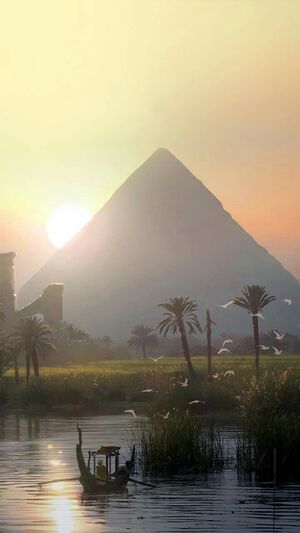
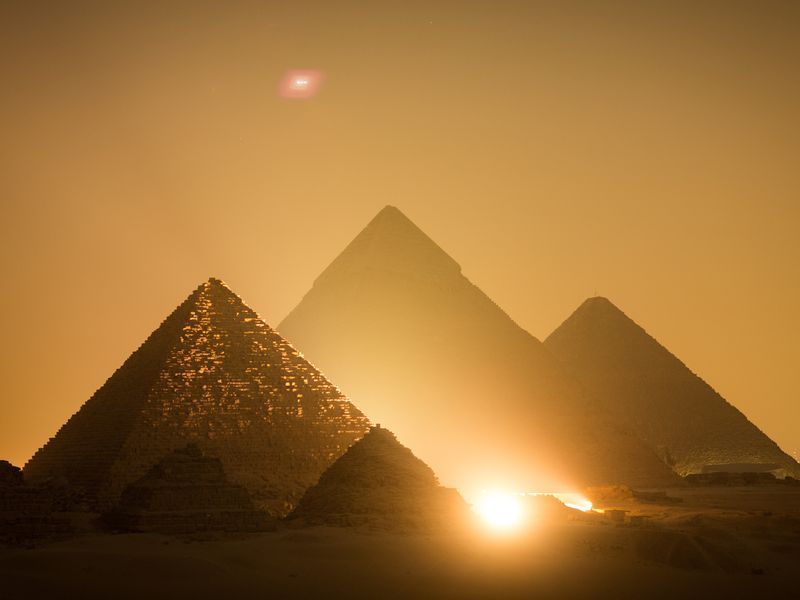
Реконструкция заупокойного ансамбля Великих пирамид в Гизе (IV династия, XXVII–XXVI вв. до н. э.)
Inside the temple itself, this filter continued to narrow: the sun-drenched open courtyard (peristyle) was accessible to the nobility, the semi-dark hypostyle hall was reserved only for the chosen few, and the Sekos, steeped in darkness, admitted only the pharaoh and the high priest. This gradual severing from everyday reality primed the individual for an experience of mystical awe and suspense.
In cinema, this principle of the «hierarchical filter"—the sharp transition between the outside world and the enclosed space of power—became a classic trope for initiating a hero.
A striking example is Denis Villeneuve’s film Dune (2021). Production Designer Patrice Vermett noted in an interview that he drew inspiration from the architecture of Egyptian pyramids, ziggurats, and Brutalism. The transition of the characters from the blinding, scorching desert of Arrakis into the vast, dimly lit halls of the palace in Arrakis functions like an entrance into an Egyptian temple: the sharp contrast in light, temperature, and enclosure instantly separates the character from the outside world and subjects them to the laws of sacred hierarchy.
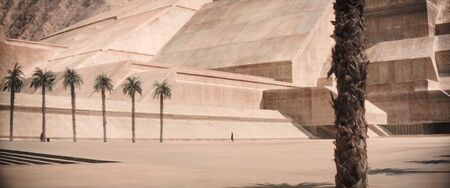
кадры из фильма «Дюна» 2021
Dramaturgy of Light and Darkness
The lighting environment of the Egyptian temple was constructed on a sharp gradient: from the dazzling southern sun in the courtyard to the twilight of the hypostyle hall and the complete darkness of the sanctuary.
Lattice windows in the clerestory of the Great Hypostyle Hall at Karnak (14th–13th centuries BCE)
In the hypostyle halls, light penetrated only through narrow latticed windows under the ceiling—the clerestory. According to studies of light modeling in Egyptian temples, the essence of this solution was not the quantity of light, but the exquisite management of this limited light flow.
Modeling the distribution of daylight in an ancient Egyptian temple (based on N. Sh. Ramzy’s research)
Placing the openings above eye level eliminated glare discomfort, but it created extreme contrast between the bright beam and deep shadow, inducing a feeling of spiritual elevation and detachment from the earth. Furthermore, the directed beam possessed dynamism: throughout the day, it moved across the hall following the sun, alternately illuminating reliefs and columns from the darkness.
In rock-cut temples, such as Abu Simbel, astronomical calculations of the axis allowed a sunbeam to pierce through sixty meters of darkness, illuminating the statues of the gods deep within the sanctuary only twice a year, transforming light into an instrument of divine manifestation (theophany).
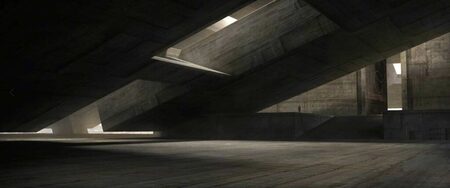
In cinema, techniques for working with top-down lighting, such as chiaroscuro and light wells, are used to visualize omnipresent power and sacralize space.
In Denis Villeneuve’s film Blade Runner 2049, the Wallace Corporation headquarters is visualized as a windowless monolith, bisected by narrow beams of moving light. This dynamic ray materializes the presence of the «creator-god» Niander Wallace and evokes an unsettling sense of a sterile, inhuman environment. The same technique is developed in Dune (2021), where «light shafts» in the dusty air make the space tangible and the human figure vulnerable.
Blade Runner 2049
Gigantism and Dust Motes: Perspective, Scale, and Rhythm
Emotional subjugation of the viewer in Ancient Egypt was achieved through the absolute dominance of monolithic stone mass over space, rigid axial symmetry, and optical illusions.