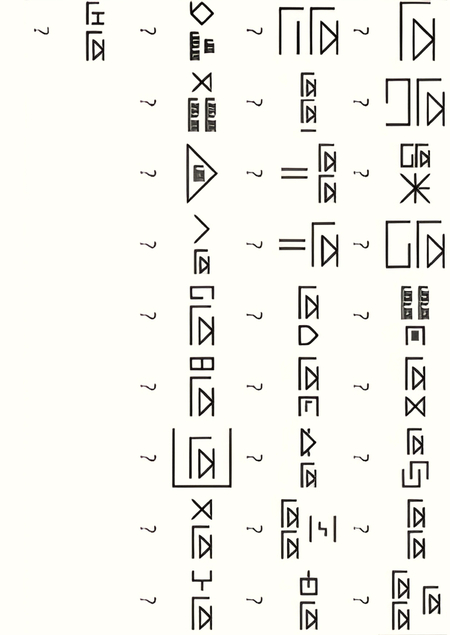
Contact with an alien intelligence is one of the central themes in science fiction, and a written message serves as tangible proof of an alien consciousness. Speech can be conveyed through sound, but a letter must be visualized—the audience must believe that before them is not an ornament or a random collection of lines, but a system underpinned by thought. Therefore, creators of sci-fi films, games, and illustrations repeatedly tackle one challenge: to construct a script that appears inhuman.
The solutions employed vary radically. Some authors build upon familiar human writing systems and reinterpret them; others derive symbols from the appearance and nature of the fictional creature; and a third group attempts to move entirely beyond conventional notions of script.
The research hypothesis is that fictional nonhuman writing systems are built upon one of three visual foundations—the reinterpretation of existing terrestrial scripts, the physical form of the extraterrestrial being, or the rejection of known writing systems in favor of universal, mathematical, or other patterns. The choice of foundation allows authors not only to signify that the writing belongs to another civilization but also to shape the viewer’s perception of its carrier, their culture, nature, and even the structure of their society.
Глава 1
From Ornament to Lettering
The visual boundary between graphic design and typography is subtle. The sequence of repeating symbols, their ordered arrangement, and the overall style are also inherent in ornament, which raises a logical question:
What allows us to perceive a set of graphic signs as a writing system?
1.1 Characteristics of Writing
What can be considered writing in general? From a linguistic perspective, writing is a method of graphically fixing and transmitting linguistic information through conventional signs. Unlike other graphical systems, writing allows linguistic messages to be preserved and reproduced independently of the author. Thus, the visual form of writing is the external expression of a system governed by specific rules for encoding and reading information. Globally, the following characteristics can be identified, the combination of which constitutes writing:
- Presence of a stable set of signs
- Established relationship between signs and sounds, syllables, morphemes, words, or meanings
- Rules of organization
- Reproducibility
1.2 Forms of Writing and Why It Matters
The combinations of the aforementioned characteristics, along with the specific ways they are depicted and transformed, account for the impressive diversity of writing systems in visual and semantic interpretation. In the context of this research, we will not isolate every existing form of writing, but only those that are pertinent as tools for the future analysis of «non-human» scripts.
The main task is to begin with the concepts of «glottographic» and «semasiographic.»
Глава 2
How Writing Illustrates a Way of Thinking
1
1