Navigation
1. Concept 2. Aesthetics of Asymmetry 3. The Collision of Two Systems 4. The Northern Style in New Rules 5. Transformation of Asymmetry: From Military Strategy to Folk Games 6. ConclusionConcept
A tabletop game is not merely a pastime; it is a reflection of the culture in which it emerged. Through the game board’s design, materials, and the appearance of the pieces, one can trace how a society perceived war, power, and social hierarchy.
In the history of Northern Europe, this process was particularly vivid because, over several centuries, a radical shift in gaming paradigms took place there. During the Viking Age (8th–11th centuries), the main board games of Scandinavia belonged to the tavle family. Their key feature was asymmetry: players began the game with unequal numbers of pieces and different objectives—while one side defended the king in the center of the board, attempting to move him toward the edge, the other side would surround and besiege him. However, during the 11th–13th centuries, symmetrical European chess arrived from the south into Scandinavia, where the armies were equal in composition and adhered to a strict feudal hierarchy. Thus, chess gradually displaced the traditional northern games, pushing the latter to the geographical and cultural periphery.
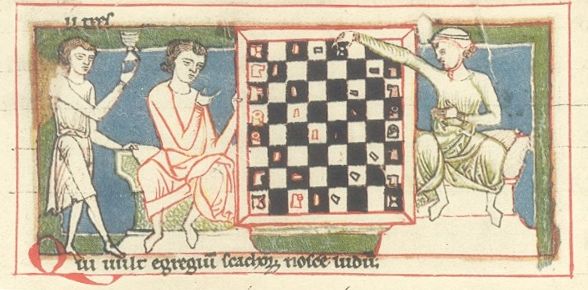
Miniature featuring players from the 13th-century Carmina Burana manuscript
How has the transition from asymmetrical games in the Taffl family to symmetrical chess influenced the visual language of Scandinavian board games?
I surmise that the displacement of traditional Scandinavian games by European chess led to a complete transformation of gameplay geometry and piece hierarchy (from abstract cones and irregular grids to detailed imagery and an 8×8 board); however, the visual code of the North—materials, carving, and distinct artistic motifs—did not disappear, but rather adapted to the new rules, while older mechanics persisted in a simplified form.
Chess game between King Knud the Great and Earl Ulf Thorgilsson. Morris Meredith Williams. 1913
The relevance of this research stems from the growing interest of the modern gaming industry and visual culture in Scandinavian heritage.The focus of the visual study is the connection between game mechanics and visual form: this work will fill a gap in the understanding of how changes in game rules transform its visual appearance.The theoretical significance of the research lies in systematizing the visual evolution of Nordic board games across different eras.
Principle for Selecting Visual and Textual Sources
To test the hypothesis in this research, we collected and organized visual sources divided into two categories, with the primary selection criterion being the high visual informational density of the object itself. The categories are:Archaeological Artifacts: fragments of game boards and pieces from museum collections in Scandinavia and the British Isles; Historical Graphics: medieval miniatures, engravings, and ethnographic sketches.The theoretical foundation of the research is based on seminal works in the history and philosophy of games. Drawing upon Johan Huizinga’s concept of the connection between play and culture [1], this research examines board games as a reflection of social shifts.The factual basis is constructed from the classic works of Harold Murray [2], David Parlett [3], and Robert Bell [4], who most comprehensively described the typology, geographical distribution, and historical transformation of pre-digital European board games.
The Aesthetics of Asymmetry
Field Geometry: Why must the grid always be odd?
At the core of the visual design of the Tafl family of games (derived from Old Norse tafl—meaning «board») lies the principle of asymmetric siege. Unlike a familiar chessboard, the fields for Hnefatafl and its regional variations almost always featured an odd number of squares: 7×7, 9×9, 11×11, or 13×13.
Example of a contemporary Kheneftafla board (11×11)
This geometry is dictated by mechanics because an odd grid allows for the demarcation of a geometric center—the «throne» (konakis)—where the king is initially positioned, surrounded by defenders. Meanwhile, the board space itself sets the rules for the uneven conflict: center versus periphery and defense versus encirclement. The outer perimeter and corner squares (sanctuaries toward which the king must break through) were visually marked with carvings, crosses, or additional borders.
The Board as Artifact: From Ship Deck to Status Symbol
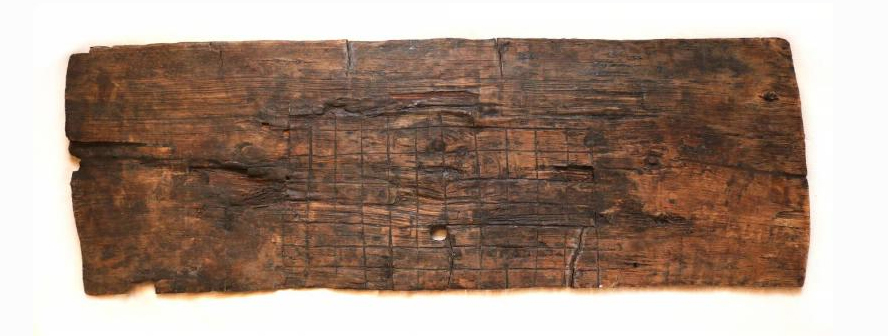
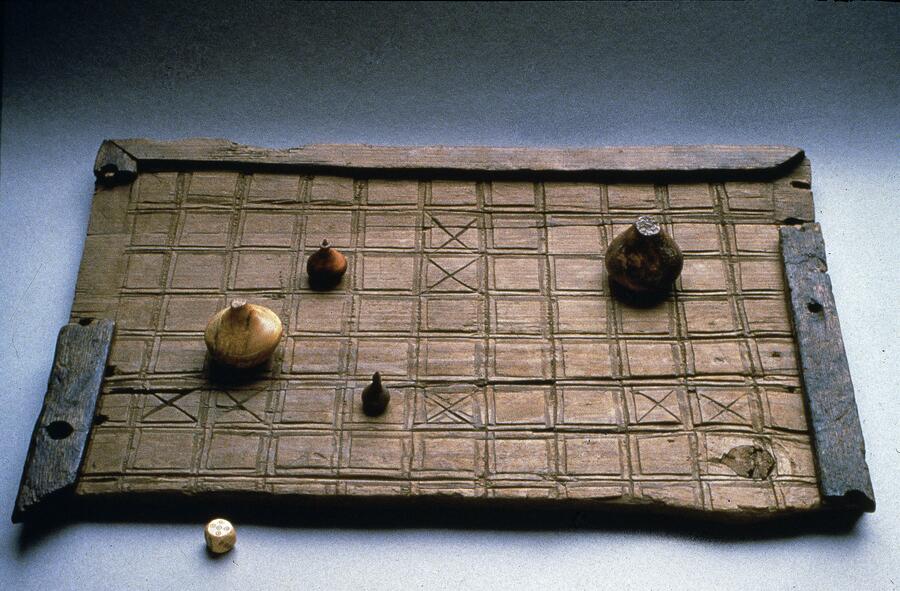
1. 2. —
Archaeological finds from the Viking Age (8th–11th centuries) indicate that the tafl was not exclusively an aristocratic or, conversely, a commoner’s pastime—its visual appearance directly depended on the environment in which it was used.On one hand, utilitarian travel boards have been preserved, carved from remnants of ship hull planks, wooden lids, and stone slabs. They were often double-sided: one side featured a grid for tafl, and the other held the «Mill» board. On the other hand, opulent burials contain ceremonial boards with fine carving, animal ornamentation, and holes for pegs on the playing pieces—this allowed players to continue the game on a rocking ship without losing their position.
Collision of two systems
Northern style in the new guidelines
The Transformation of Asymmetry: From Military Strategy to Folk Games
Conclusion