This study explores the parallels between 20th-century Pop Art and Greta Gerwig’s film Barbie (2023). In this paper, we aim to identify which Pop Art techniques are employed in the film’s visual language and whether their function has shifted. We will examine six Pop Art works and six stills from the film, providing a brief background overview. This comparison allows us to reveal the similarities in visual solutions and their significance across different contexts.
Pop Art, which emerged in the mid-20th century, became one of the art movements that engaged with everyday culture. Artists utilized imagery from advertising, consumer goods, comics, and celebrities, reinterpreting familiar ways of depicting the surrounding world.[5; 6] Graphics, image repetition, bright colors, and a focus on mass visual motifs became characteristic elements of this movement’s works. The visual techniques typical of Pop Art can still be found in contemporary art. For instance, in Greta Gerwig’s film «Barbie» (2023), the doll originally released by Mattel in 1959 becomes not merely the central character but the foundation of a distinct visual universe—Barbieland. This world is constructed from vibrant colors, stylized interiors, repeating forms, and the artificiality of a space resembling a perfect display window.
Concept
Relevance Film as a mass phenomenon. According to Box Office Mojo, Greta Gerwig’s film «Barbie» became the highest-grossing film of 2023. Its release was followed by a large-scale marketing campaign that generated the Barbiecore trend. The color pink spilled out of the screen and into the real world. Scholarly context The film attracted attention not only from the mass audience but also from the academic community, serving as a starting point for research regarding feminism, consumer culture, and marketing. For instance, in the study «Siswanti S. D. Consumerism on Popular Literature: A Postmodernism Analysis of Baudrillard in the Film Barbie (2023)» [10], the author views the movie as a hyperreal world according to Baudrillard while simultaneously analyzing it as a critique and participation in consumer culture. The film features a strong heroine who encourages self-expression, yet she is ensnared in the consumer network she critiques. In academic articles, the film’s visual language is discussed as ideology or marketing tool, but its connection to 20th-century art is not examined. Problem Nevertheless, many visual techniques present in the film were reflected in 1950s–1960s Pop Art. Examples include flat, vibrant colors, image repetition, scale, and comic book aesthetics. The Barbie doll itself emerged from a similar environment as Hamilton, Warhol, and Lichtenstein, and its history traces back to the Bild Lilli doll, which in turn originated from newspaper comics—much like some Pop Art artists were inspired by comic aesthetics. Mass-produced commodities were becoming subjects of critical examination; the film employs a similar language where consumption is actively critiqued yet remains part of the same brand.[2; 5; 6] In our work, we test, using specific images, the degree of correspondence between the techniques in the film and Pop Art, and how their function changes. Greta Gerwig. Barbie (Film still).. 2023
Question and Hypotheses
How are Pop Art techniques manifested in the visual language of the film «Barbie» (2023), and does their function change? The film «Barbie» (2023) employs several Pop Art techniques from the 20th century (bright colors, seriality, scale, simulation of mass production), but the underlying stance of the statement evolves: it is no longer purely an irony directed at mass culture, but also incorporates brand recognition, an appealing visual language, and commentary on gender expectations. Visual Pop Art techniques can be observed in specific shots within the film. We anticipate consistency in the use of color, seriality, and scale. Functional The function and meaning of these techniques shift: Pop Art observes from the outside—critically—whereas the film offers an inside perspective and becomes part of a mass brand. Verification Criterion: For each of the six pairs, we document two answers: whether the technique matches and whether its function changes. The hypothesis is considered confirmed if both the technique match and the change in its function are identified in at least four out of the six pairs.
Selection
Subject and Focus The visual language of Pop Art and its utilization in 20th–21st century mass culture. The use of color and composition in six Pop Art works and six stills from the film «Barbie» (2023), along with an analysis of how the function of these techniques evolves. Timeline: 1947–2023. In this study, we do not select random works or film stills; each pair was chosen specifically to illustrate predefined techniques. The decision to use «Barbie» (2023) is justified by its popularity, as we required material directly from mass culture. Furthermore, there is a historical coincidence with Pop Art: the doll gained prominence around the same time American Pop Art was developing, and the visual language is highly expressive, meaning the necessary techniques are visible in the scenes themselves rather than in minute details. 1) We identified six traits that define Pop Art as a visual language: bright flat color, seriality, scale, text within the image, simulation of mass production, and artificiality. 2) For each technique, we selected a work where it is most vividly expressed. 3) A still from the film was selected for every work. The Pop Art works were selected based on the clarity of the technique, the availability of high-quality images, and the diversity of the artists. Warhol is included twice because in one piece, seriality is expressed through an image, whereas in the other, it is expressed through an object.
The literature and sources were selected based on four criteria that should become clear throughout the research: The History of Pop Art and Dolls. To describe the techniques and context, we draw on the works of H. Foster[5] and L. Lipard[6], and we also reference the history of the doll from sources [7] and [8]. This allows us to demonstrate that Pop Art and Barbie developed within the same environment. Analytical Method. For interpreting the image, we utilize R. Barthes[1], as he provides a descriptive language applicable to both works of art and film cadres, enabling us to build a comparison based on unified criteria. Serialization, Commodity, and Artifice. To determine what constitutes repetition and the «unreal» world, we consulted J. Baudrillard, V. Benjamin, and S. Sontag[2; 3; 4]. The work of these authors helps distinguish precisely what each technique we analyze accomplishes. Analysis of the Film Itself. We use contemporary scholarly articles to test the second part of the hypothesis and to understand how the film’s visual language operates, but the existing film studies primarily focus on feminism, consumerism, and marketing. Therefore, we substantiate the link to 20th-century art ourselves by comparing the images and relying on theoretical frameworks.
Main Body
CONTEXT: ONE ENVIRONMENT
Eduardo Paolozzi. I Was a Rich Man’s Plaything. 1947 Collage of magazine clippings: a woman, advertising slogans, and logos of prominent brands from the time. Advertising as artistic material.
Greiner & Hausser. Picture Lilli. 1955 Doll, 1955, based on a heroine from newspaper comics. Mattel created Barbie based on this very figure.
Richard Hamilton. Just what is it that makes today’s homes so different, so appealing? 1956 A mid-century living room, filled with logos, images of consumer goods, human figures relegated to the background. The house looks like a display case.
Mattel. Barbie Teen-Age Fashion Model (Barbie #1). 1959 The first Barbie doll was unveiled on March 9, 1959, at the American International Toy Fair in New York. She wears a black-and-white striped swimsuit, and the entire aesthetic embodies the «ideal» woman of that era.
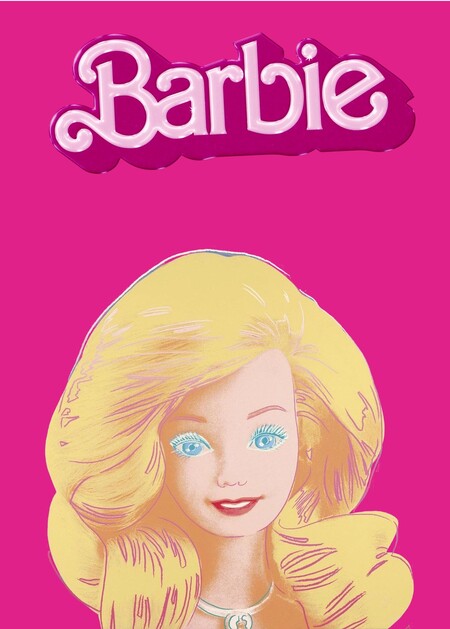
Andy Warhol. Barbie Portrait of BillyBoy blue*. 1986 The pop artist directly addresses the doll archetype. The work becomes a bridge between the two lines we are examining.
FILM WORLD
The film features two visual modes. Barbieland is constructed as if from plastic: a flat sky, saturated color, and a flat light that functions like paint. The real world looks exactly as the viewer sees it every day. A clear boundary exists between the two, which allows shots of Barbieland to be easily compared to Pop Art, as it presents itself as a hyperreal space.
Greta Gerwig. Barbie (film still). 2023 Barbie Land by day: blue sky, houses, and palms. The color is bright and flat—the entire space looks like a toy.
Greta Gerwig. Barbie (film still). 2023 BarbieLand in the second part of the film: the artificiality of space and the world of things. The viewer first sees a large number of objects, and only then people. The image of the horse symbolizes traditional masculinity.
Greta Gerwig. Barbie (a movie still). 2023 Barbie, dressed in various outfits, sits next to other versions. Although they are played by different actresses, their looks strongly mimic each other, much like dolls from a single series line.
Greta Gerwig. Barbie (film still). 2023 The corporate world is also becoming «doll-like.» The strict appearance of the employees contrasts with the attributes of the furniture: pink chairs, a bright pink heart-shaped lamp.
Greta Gerwig. Barbie (movie still). 2023 The real world in the film. It lacks sets, the colors are normal and unsaturated, and the lighting is daylight.
COMPARISON
Seriality
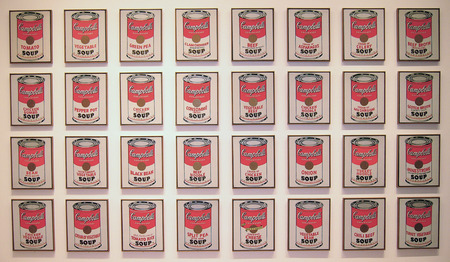
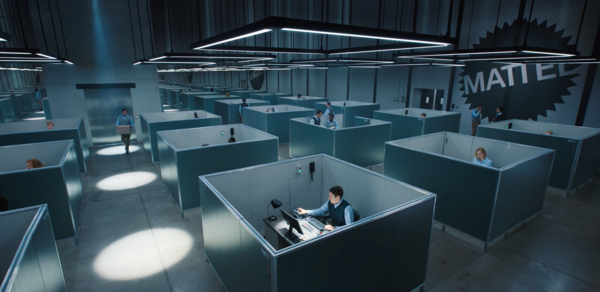
(1) Andy Warhol. Campbell’s Soup Cans. 1962 (2) Greta Gerwig. Barbie (film still). 2023
In Warhol’s work, there are thirty-two canvases depicting soup cans, arranged like merchandise on a store shelf. The same logic of a row is present in the frame, but the focus shifts from the product to the production process: identical booths and nearly identical employees. The MATTEL trademark on the wall appears like a label. In this case, the series showcases not the product, but the system that creates it.
Image Redo
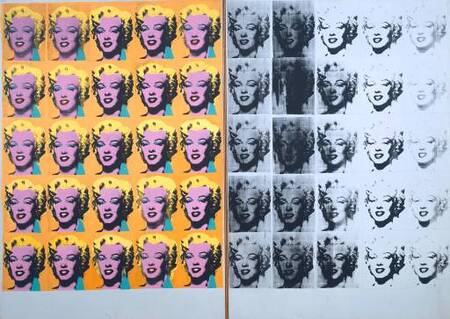
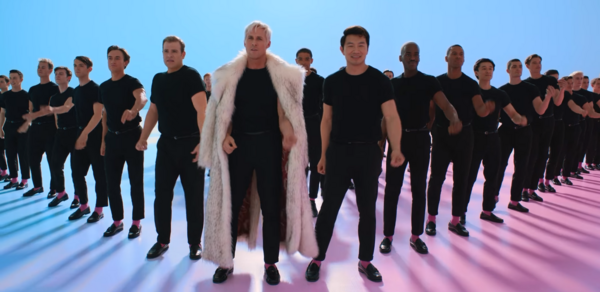
(1) Andy Warhol. Marilyn Diptych. 1962 (2) Greta Gerwig. Barbie (film still). 2023
The diptych repeats the same portrait, but one panel is in color while the other fades. The image of the Kenns is also repeated in the film, albeit with minor variations. The irony and focus are directed at the very idea of a series of identical figures.