Discovering the Silhouette: How Anna Akhmatova’s Visual Image Was Created
Research Concept
The visual image of Anna Akhmatova often seems complete: an expressive profile, dark hair with bangs, a long neck, a shawl, and a reserved posture. These traits appear in very different portrayals and gradually begin to be perceived as obligatory. I became interested in how this representation was formed and what it excludes from the conventional portrait. For a designer, the process itself is crucial: the appearance of a specific person transforms into a set of repeatable forms that can function in drawing, photography, sculpture, and book design.
The object of study is Akhmatova’s contemporary iconography—that is, the totality of her images created by her contemporaries. The subject is the visual techniques by which individual physical features are linked to the perception of the poet and her literary authority. By authority, I mean the culturally recognized right of an author to speak in their own voice and be heard. An image can express and support this status, but it does not, by itself, prove the person’s greatness or the quality of her poems.
The key research question is: how do profile, hairstyle, clothing, and posture become recognizable signifiers of literary authority? My hypothesis is that the stability of the image arises through the repetition and selection of several attributes across different techniques. Their meaning shifts alongside Akhmatova’s age, her literary reputation, and the venue of the portrait’s publication. Furthermore, the visual canon is constructed collaboratively—it involves the model, the artist or photographer, the publisher, and subsequent viewers. Based on these images, one cannot reconstruct a single, preconceived self-presentation strategy devised by Akhmatova.
The chronological boundaries of the main building span 1911–1965. The lower limit is linked to a surviving drawing by Modigliani, and the upper limit is linked to the contemporaneous collection «The Flight of Time» and a photograph of Akhmatova in Oxford. Later reproductions are used as accessible copies of earlier works. Material was selected based on the possibility of verifying the author and dating, the quality of the reproduction, and its suitability for comparison.
The research method is comparative visual analysis. First, I examine the works as a whole, then isolate details and assemble comparative series. Fragments do not replace the originals.
The structure moves from the appearance of an early image to its repetition, variability, and public use. The first section compares portraits from 1911–1914. Next, the profile and hairstyle, clothing, and gesture are examined separately. The following section is dedicated to images that deviate from the expected formula. Later portraits allow for verification of whether recognizability is maintained despite changes in age and silhouette. The study concludes with the transition of the portrait into a public context.
The sources are divided by function. Museum cards are used for attribution, materials, and dates; in case of discrepancies, preference is given to the description of the institution holding the work. Facts from the sources are separated from my interpretation of the visible form.
One Person in Different Images
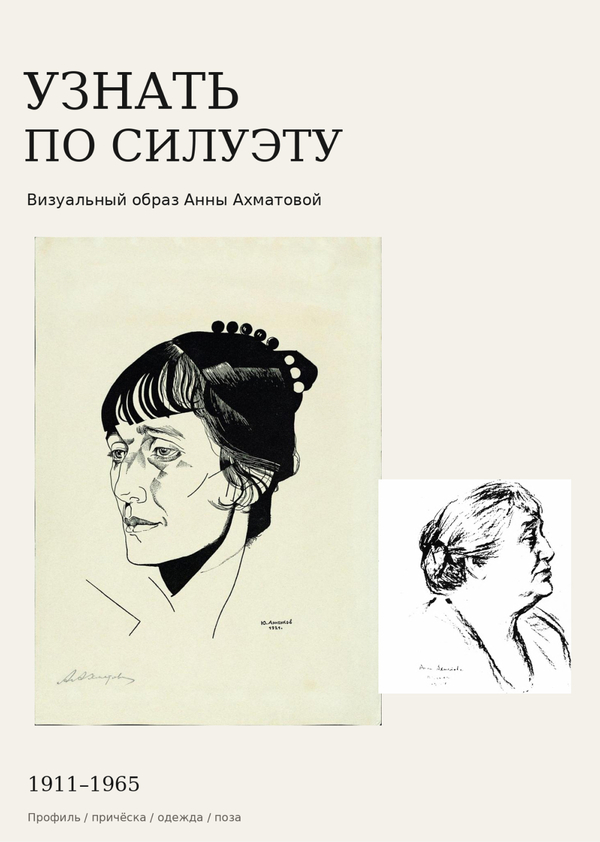
Atan Altman. Portrait of A. A. Akhmatova. 1914. Canvas, oil. JB-1311. State Russian Museum. [I02]. Yuri Annenkov. Portrait of A. A. Akhmatova. 1921. Paper, print. [I04]. Kuzma Petrov-Vodkin. Portrait of A. A. Akhmatova. 1922. Canvas, oil. Z-2407. State Russian Museum. [I16]. Moisei Langleben. Anna Akhmatova. 1964. Drawing. [I24]
At the beginning of the study, I place four portraits side by side. The technique, angle, and model’s age vary, but connections remain between the images: the line of the nose, the contours of the hair, the gathered position of the head. Simultaneously, it becomes apparent that the familiar formula does not explain every instance. Petrov-Vodkin lacks a dramatic profile turn, and the early bangs disappear in later Langenbein. This means we must seek not a single mandatory detail, but combinations of characteristics.
What exactly am I comparing?
The appearance and artistic solution of a portrait cannot be treated as the same thing. While the long neck belongs to the model, its length in the image is further altered by the tilt of the head, the neckline of the dress, and the framing. Therefore, the analysis is divided into observable elements: the facial contour, the mass of the hair, the shape of the clothing, the position of the arms, and the figure’s relationship to the background. This sequence allows the impression to be explained through visible decisions rather than through general terms about grandeur.
Early concept
Modigliani 1911
Amedeo Modigliani. Portrait of Anna Akhmatova. 1911. Drawing. [I01].
In Modigliani’s drawing, the figure unfolds horizontally. Separate lines connect the head, shoulders, bent arm, and extended legs. The face occupies only a small part of the page, so the image is primarily perceived through the body’s posture. Most of the details that would later become familiar are absent here—the shawls, expressive ornamentation, and pronounced profile angle. This early depiction shows that plastic recognizability can be established even without the complete set of future attributes.
Whole and Contour
Amedeo Modigliani. Portrait of Anna Akhmatova. 1911. Drawing
If you zoom in on the upper part of the drawing, the difference between the dense cross-hatching of the hair and the nearly continuous contour of the shoulders is striking. The dark area anchors the gaze on the head, while the free lines guide it further along the figure. I do not view this scheme as proof of Akhmatova’s future fame. Rather, it demonstrates a specific method for isolating a figure on a blank page—a task that requires only a few elements of varying density from the artist.
Altman 1914
Nathan Altman. Portrait of A. A. Akhmatova. 1914. Canvas, oil. JB-1311. State Russian Museum.
Altman’s portrait is structured differently. The figure fills almost the entire canvas, and the blue and green planes of the background continue the bends in her posture. The blue dress binds the body into a large color form; the yellow fabric highlights the arms and the edge of the chair. Akhmatova is present in the space with confidence, but this confidence is built by the entire composition. She cannot be reduced to just her facial expression. The dating of 1914 is based on the Russian Museum’s record card.
Clothing as a Body Construct
Nathan Altman. Portrait of Anna Akhmatova. 1914. Canvas, oil. JB-1311. State Russian Museum.
These fragments showcase two distinct apparel concepts. A light neckline separates the neck and shoulders from the blue dress. The yellow fabric gathers into angular pleats, echoing the geometry of the surrounding space. Here, the shawl does more than merely indicate that a specific item is being worn by the model; it connects the figure to the artistic language of the portrait. Consequently, the external attribute is remembered alongside the form the artist imparted to it.
Della-Vos-Kardovskaya 1914
Olga Della-Vos-Kardovskaya. Portrait of Anna Akhmatova. 1914. Canvas, oil. State Tretyakov Gallery.
The portrait of Della-Vos-Kardovskaya was created in the same year but conveys a different impression. The profile is more distinctly separated from the background, the clothing forms a calm vertical line, and the arm rests freely on the support. The reddish-brown fabric occupies a significant portion of the canvas, softening the transition between the figure and the landscape. The recognizable features are already present, but their combination allows for a softer, more contemplative image. One year and one model do not dictate a single visual interpretation.
Two Portraits from the Same Year
Nathan Altman. Portrait of A. A. Akhmatova. 1914. Canvas, oil. ZhB-1311. The State Russian Museum. [I02]. Olga Della-Vos-Kardovskaya. Portrait of A. A. Akhmatova. 1914. Canvas, oil. The State Tretyakov Gallery