Navigator
0. Concept
1. The Object as a Connection to the Past
2. The Illusion of Presence
3. Memory of an Attack
4. Sammy’s Story
5. Hero Substitution
6. Two Versions of the Past
7. The Image of Conclusion
8. Research Findings and Hypothesis Answer
Concept
In «Memento, ” the viewer discovers Leonard’s past through the protagonist’s narratives and accompanying images, gradually noticing inconsistencies between them. A recurring image might maintain a familiar setting, yet the action or person within it may have changed. Consequently, the scene remains recognizable but no longer confirms the explanation that seemed convincing at first glance. This characteristic allows an examination of the role visual resemblance plays in trusting memory. The research theme relates to the difference between recognizing an event and verifying its veracity. When observing a familiar object or arrangement of figures, the viewer establishes a connection between frames, but this connection alone does not explain what actually transpired. This issue is particularly evident in „Memento, ” as Leonard’s personal experience forms the basis of his decisions, and information about the past often comes from the protagonist himself. An image can appear as an independent piece of evidence while simultaneously conveying the content of his story.
Hypothesis: In «Memento,» the repetition of objects and composition links incompatible versions of the past, but it does not indicate which version is accurate.
This determination applies to episodes where similar images present different interpretations of an event or alter its participants. The check requires identifying what is repeated and whether the presentation allows a convincing option to stand out. If this feature is consistently present, the hypothesis must be reevaluated; if the choice depends on additional information, the mere similarity does not confirm the past. Recollection in the work differs from the visualization of a narrative in relation to the hero’s experience: another person’s story may include circumstances the narrator personally did not witness. An imagined image can be considered a presumed or desired state if the scene supports such an interpretation. These definitions allow for discussion of the origin of an insertion without pre-classifying all shots as truthful or false.
The material consists of seven selections featuring repeating objects, actions, or spatial arrangements of characters. The selection is based on the possibility of specific comparison: a preserved detail must help notice a change or connect images whose meaning is clarified later. The sample also includes cases without direct substitution, allowing for the distinction between contradictions between versions and incomplete information. This means that not every ambiguity is prematurely attributed to memory distortion, and the hypothesis is tested through different methods of scene construction.
In the analysis, the difference between a visible detail and information obtained from dialogue or adjacent shots is taken into account. A still frame allows for the examination of hand positions, objects, or inscriptions, but it does not independently explain the reason for an action or the insertion’s place in the narrative. Therefore, the images are compared with the film’s context, and the words of Leonard and Teddy are considered character versions that must be correlated with what is shown.
The film remains the primary source, and the script is used to clarify circumstances while accounting for possible differences from the final edit. Textual sources are selected based on their connection to specific techniques of memory representation. The research objective is to determine which conclusions are supported by the shots and at what point their recognizability is mistakenly taken as confirmation of an event.
1. Subject as a connection to the past
A still from the film «Memento,» directed by Christopher Nolan, 2000.
A still from the film «Memento,» directed by Christopher Nolan, 2000.
A still from the film «Memento,» directed by Christopher Nolan, 2000.
The book found near Leonard by the campfire later appears in his wife’s hands, linking two distinct settings through a single object. This repetition ensures that the shift in location is not perceived as the beginning of a separate narrative; the image of the reading woman relates to the object the protagonist holds in the present. The connection is established at the level of the object before the viewer has a chance to judge the content of the conversation. This construction allows the audience to recognize a reference to the past without explicit captions or time markers. The insertion gains contextual grounding because the book pertains both to Leonard’s current action and the shared life that is being depicted. Yet, the clarity of the transition explains the origin of the image without offering separate evidence regarding the precision of its details.
A still from the film Memento, directed by Christopher Nolan, 2000.
The burning book brings attention back to the present while maintaining a connection to the wife who was just shown. The change in the object’s state makes the loss palpable: an item that was part of daily life is now being destroyed. The preceding image gives the action a personal significance, allowing the viewer to read the burning as an attempt to change one’s own relationship with the past through the remaining object. The sequence frames the memory on two sides, placing it between the actions by the fire. The viewer understands what triggered the insertion and which situation the film has returned to, so they can confidently link the image to Leonardo. However, there is no competing version here that allows for a verification of the memory’s content. The segment establishes the function of object repetition without turning the absence of contradiction into proof of authenticity.
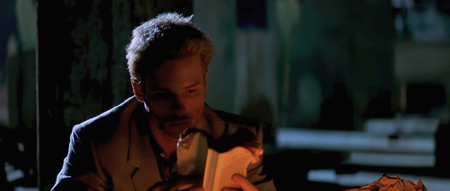
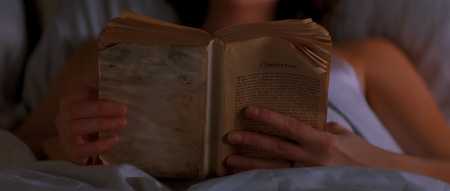
Stills from the film «Memento,» directed by Christopher Nolan, 2000.
In the two images, the book held by the reading wife initially occupies space in front of her face; subsequently, her face becomes more open. The object that provided recognition yields focus to the person with whom it is associated. Therefore, the book is perceived not merely as a preserved object, but as a component of the couple’s habitual interaction, anchoring Leonard to a specific domestic moment. Comparing these frames does not reveal a substitution of characters or an incompatible action, as the changes continue a single scene. This example is crucial for testing the hypothesis as a case where repetition maintains the coherence of memory rather than creating a contradiction. Consequently, the repetition technique itself cannot be considered a sign of substitution—its meaning depends on the content it unifies.
2. Illusion of Presence
A still from the film «Memento,» directed by Christopher Nolan, 2000.
Waking up and reaching out to the adjacent spot, Leonard acts as if he expects to find another person nearby. This gesture precedes a check of the room, so it can be read as a habitual movement continuing a familiar scenario. The frame itself does not yet define the identity of the absent person, but it directs attention to the empty space and prepares the viewer for the objects that appear next.
A still from the film «Memento,» directed by Christopher Nolan, 2000.
A still from the film Memento, directed by Christopher Nolan, 2000.
His wife’s belongings tie the room to her, even though the woman herself is not visible in these frames. The image provides a concrete basis for identification, which subsequently leads to the assumption of the owner’s presence. There is a difference between these two conclusions: the ownership of an object can remain unchanged even when its placement is no longer connected to the owner’s actions. A closed door supports this assumption, leaving part of the space unseen. While the bathroom is concealed, the wife’s absence near the bed can be explained by her being in another part of the room. The objects and the door work in tandem: the former creates expectation, and the latter prevents an immediate connection to who is actually in the room.
Still from the film Memento, directed by Christopher Nolan, 2000.
Discovering another woman, Leonard encounters a circumstance that defies expectation. The visible elements do not disappear or change, meaning the error cannot be attributed to the falsehood of any single image. The revision requires examining the relationship established between the objects and the assumed presence of a wife. The woman’s appearance allows the viewer to revisit previous frames with a different question in mind. Instead of searching for the missing owner, the focus shifts to understanding how her belongings ended up in the room. The film alters the explanation of the situation while retaining the previously shown details, thus demonstrating that the accuracy of the details does not guarantee the correctness of the narrative built from them.
A still from the film Memento, directed by Christopher Nolan, 2000.
The preparation scene connects objects to Leonard’s own actions, recreating a familiar setting with the participation of another woman. After waking up, he confronts the result of his own decision without retaining any memory of the circumstances surrounding his arrival. Recognizing the objects, the protagonist explains them through his past life together, even though the immediate reason for their placement is recent. Here, the error has a specific source and is explained within the film. He retains the memory of his wife’s belongings, but the knowledge of the preparation is inaccessible; consequently, the constructed setting is perceived as independent evidence. The episode is set in the present and does not prove memory distortion, but it establishes an important limitation on recognition: a familiar detail can support an incorrect version if it is unknown how it came to be before the protagonist.
3. Memory of the Attack
Still from the film «Memento,» directed by Christopher Nolan, 2000.
Leonard, depicted on the floor, is presented as a participant in the assault, which connects the episode to his own experience. At the same time, this positioning does not support the idea that he was an observer of the entire sequence of events. The image confirms the protagonist’s involvement in the situation but does not show what portion of the events involving his wife he might have witnessed. The angle that allows us to see Leonard himself also does not render the scene an independent testimony. Film can represent a personal memory by showing the remembering individual from an outside perspective, so the camera’s placement cannot be equated directly to anyone’s actual view. The significance lies in the insertion’s relationship to the protagonist’s experience, not in a literal match between the image and what his eyes could have seen.
A frame from the film «Memento,» directed by Christopher Nolan, 2000.
A still from the film Memento, directed by Christopher Nolan, 2000.