Hooligan Go with field rotation and movement:)

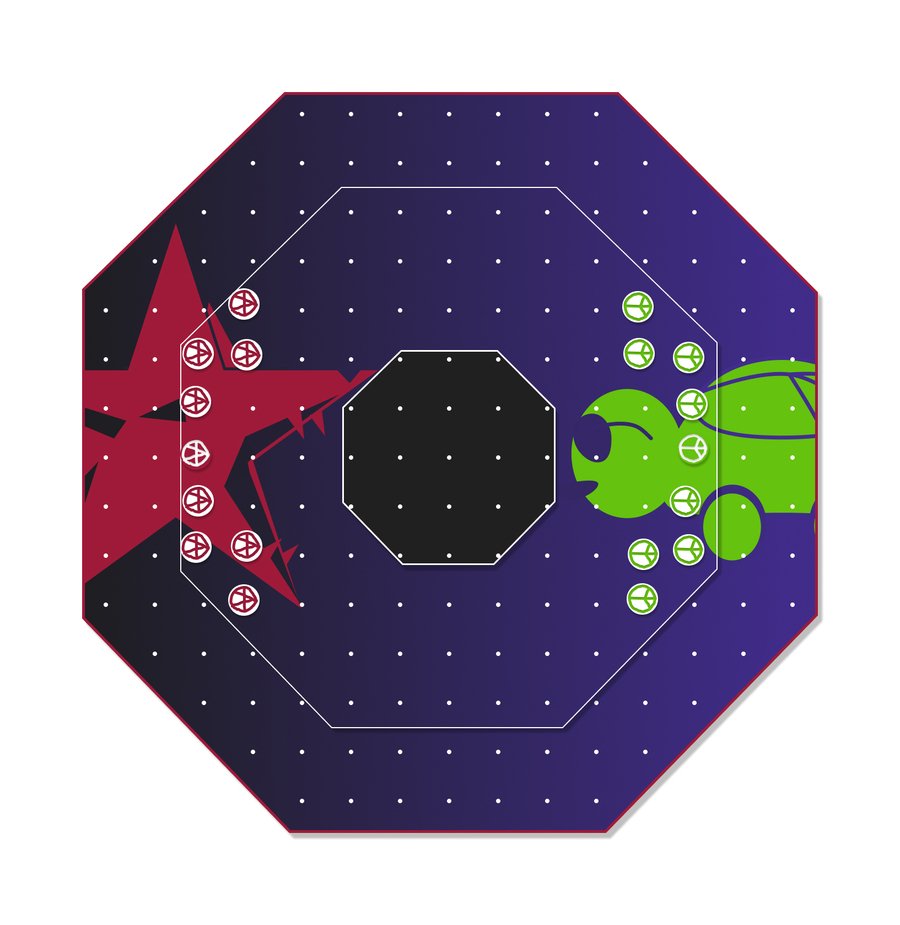


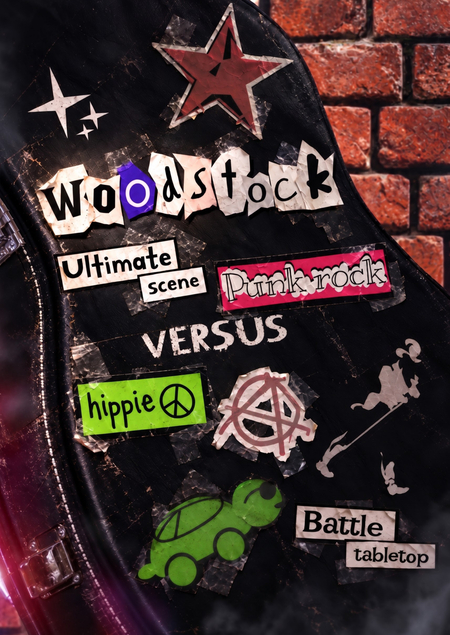
One day, hippies and punks meet at a club. Only one bottle of Johnnie Walker is left, and it won’t be enough for everyone.
It’s a duel game where players must move their hippies to reach their own half while obstructing each other, as well as carrying the opponent’s hippies. When the Johnnie Walker is moved, the entire board spins.
References
Gameplay References
Initially, we conceptualized a game centered on environmental control and enemy capture, building upon the foundations of tic-tac-toe and a point-based system. We continued developing this concept until we recognized the influence of the game Go. Subsequently, we retained the core mechanics of unit capture and immobilization from Go.
To add originality, we enabled the units (=hip-hop characters) to move. Additionally, we reworked the consumption mechanic. Drawing inspiration from the conciseness of games like Chess and Corridor, we adapted the movement formula without incorporating specific theft mechanics.
Game World References
The original setting was inspired by the phenomenon of fan fights between different music groups at the stage during the peak of a performance. Two opposing factions were stylized after two different punk groups, one of which later evolved into a hippie subculture.
As the game developed, the idea arose to transform one of the punk groups into a hippie group. As followers of the ideologies of both subcultures from the future, we decided to embody them in our game to add depth and context.
In the first version of the game, there was supposed to be a shot glass of vodka in the center of the field, but taking a more Western approach, the vodka was replaced with another hard liquor.
Component References
We took the point field and supplemented it with units more similar to chess pieces. We wanted to add a rotation axis, like in a roulette wheel, and rotating discs on them to implement the mechanics for turning field sections. This would work if the field were round. With the octagonal field, during section rotation, the players' units would be knocked over. Therefore, we decided that simply lifting and flipping them was easier.
Game Phases
At the start, you need to place three circular field mats on top of each other and position two teams of hip-hop dancers on their respective halves according to the diagram. Place Johnny Walker in the center of the field.
Players take turns. On a turn, a player can make three movements for their lead hip-hop dancer and three movements for their squad of hip-hop dancers.
Initially, players must work toward both capturing the baton and occupying a strong position on the field. As the baton moves, the field arrangement changes more and more due to the rotation of the rings, requiring them to adapt their strategy.
Players can immobilize and drag units from one another. They can obstruct the opponent’s movement toward a designated objective. They can take the relic for themselves using a ritual. They can interfere with the casting of a ritual.
Progression
When the marker moves outside of any section, the field sections rotate more frequently. Consequently, the further the Johnnie Walker marker is from the center of the field (closer to one of the halves), the more unpredictable its position on the field becomes. During gameplay, players distribute their units across the field to form unique positions.
Strategies
Player strategies are built around the position of the meeples on the board. Players have the option to stun the opponent’s hippankers and remove them from the board. The only source of randomness in our game is a six-sided die (d6), which is used after moving the Johnnie Walker checker and determines which section rotates and in what direction. In the players' interest, they will position their hippankers so that they do not scatter in different directions.