Navigation Menu
- Concept
- Ukiyo-e
- Product Advertising
- Hikifuda
- Kabuki Theater Posters
- Conclusion
Concept
This visual study explores how, during the Edo period in Japan, printed imagery became integrated into urban life, drawing attention to theater, sumo wrestling, commerce, and popular entertainers.
Its theme is framed as «Edo-period Japanese Posters, ” but the term „poster“ requires qualification. In its modern sense, a poster is a distinct visual-textual message designed for public display to promote an event, idea, or product. For the Edo period, this definition is not always applicable: many images were distributed as collectible sheets, souvenirs, or portraits, rather than as street-posted advertisements. Therefore, the study will not discuss the poster in a strict historical sense, but rather proto-poster forms—printed materials that performed functions later associated with advertising and announcements.
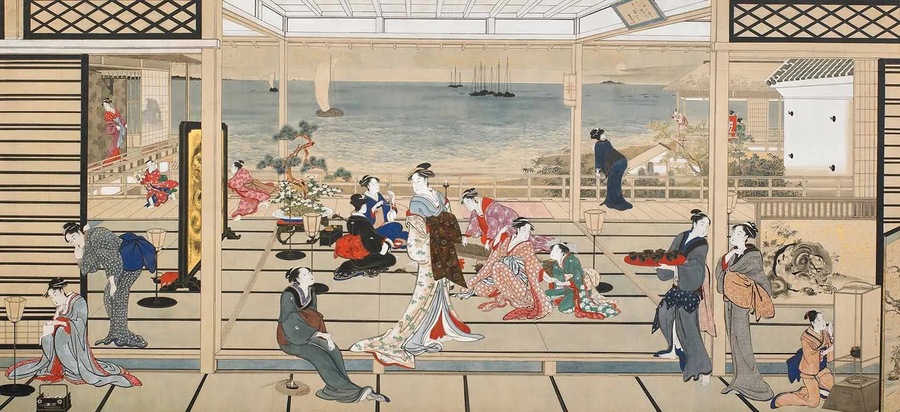
Moon at Shinagawa (or Moonlight Revelry at Dozo Sagami) by Kitagawa Utamaro, circa 1788
The study examines Edo print culture not just as a history of artistic style, but as a history of how images engaged with the public. The focus is on the connection between the image, the text, the event, and the viewer.Unlike the common perception of a poster as a large announcement pasted on a wall, printed communication in the Edo period could function in several ways: through theatrical programs, participant lists, celebrity portraits, promotional leaflets, and city signage. Some materials conveyed facts, while others generated interest and recognition.It is this combination of information, entertainment, and promotion that forms the basis of this visual investigation.
Surimono: Fox and Otafuku by Kitagawa Utamaro
In this study, it is important not to present this culture as entirely monolithic. The Edo period spans over two and a half centuries, and the methods of producing, printing, distributing, and perceiving images evolved throughout that time. Therefore, the work will focus on printed sheets from the 18th and 19th centuries, a period when the urban culture of ukiyo-e and interest in artists, theater, and popular entertainment developed significantly.Earlier materials can be included for context, while later pieces will form part of the discussion on the transformation of visual advertising toward the end of the Edo period.The research will not assert that every ukiyo-e print was an advertisement. Ukiyo-e is a broad field of printed and painted culture, not the name of a specific advertising genre. A celebrity portrait might have promoted their fame and encouraged the viewer to be interested in the theater, but this is an indirect function, not a direct announcement of a performance. Consequently, in this work, each object will be described according to its specific function, rather than solely by its superficial resemblance to a modern poster.
Katsukawa Shunshō: Sumo wrestlers Kajigahama and Sekimoto, and referee Kimura Shōnosuke. 1784
The central idea of this project is to present Edo as a city that markets itself. Theatre, sumo, commerce, and the world of celebrities existed not just in the space of the street or the stage, but also within the realm of printed images. Engravings could transport a stage persona beyond the theatre, transform an artist into a recognizable figure, and link a visual sign to a specific event or establishment.
The working hypothesis is that different genres utilized certain common visual tools—expressive imagery, contrast, element hierarchy, recognizable signs, and the combination of image and text—but directed them toward different objectives. A theatre poster might be centered around the actor, the role, or the stage character. A sumo-related piece might emphasize key participants, their ranks, and the composition of figures. A commercial poster might highlight the product, the name, the owner, or the trademark.
This assumption does not imply that each genre adhered to a single visual template: the goal of this research is to identify the differences and similarities through specific examples.
Ukiyo-e
Ukiyo-e (Japanese: 浮世絵, «pictures of the floating world») is a genre of Japanese art, most renowned for its woodblock prints. The word «ukiyo» literally refers to the «floating world,» but in Edo-period culture, it was also associated with urban life and its pleasures. Artists depicted Kabuki actors, beautiful women, city entertainments, landscapes, travel, historical scenes, and slices of everyday life.
Ukiyo-e first emerged in the 17th century. Initially, drawings and prints executed predominantly in black ink were common. Important subjects included beautiful city women, popular actors, and the life of entertainment districts. These themes reflected the urban public’s interest in contemporary celebrities and leisure.
The production of silk (seamstresses and artisans) by Hishikawa Moronobu, 17th century
Among the early masters of the Edo period in the ukiyo-e genre is Hishikawa Moronobu (c. 1618–1694). He created illustrated books and individual prints, depicting daily life and urban amusements. His works help reveal how ukiyo-e developed from a combination of print illustration and independent imagery.
Lovers in an Upstairs Room by Hishikawa Moronobu, 17th Century
This painting is a classic example of the nishiki-e technique, or «brocade pictures, ” which revolutionized the ukiyo-e genre.Before Harunobu, ukiyo-e prints were predominantly black and white or colorized by hand using a limited palette. In 1765, Harunobu perfected the technique of full-color printing, which allowed for the use of numerous woodblocks.Harunobu moved away from depicting the large figures of courtesans typical of the early period, instead focusing on creating more intimate, lyrical scenes. His works are distinguished by their subtlety, the use of complex literary allusions, and the conveyance of elusive emotions.
In the 18th century, a significant development was the advancement of color woodblock printing. Early methods of hand-coloring gradually gave way to printing with multiple colors from separate blocks. In the 1760s, a format of multi-color engraving known as nishiki-e—or «brocade pictures”—emerged. This allowed for the creation of more intricate and richly colored sheets.
During this same period, images of Kabuki actors and beautiful women were particularly popular. Artists did not merely document the appearance of the characters; they created recognizable icons by relying on pose, costume, gesture, and characteristic features.
Three Beauties of the Kansei Era by Torii Kiyonaga, 1784
Torii Kiyonaga is considered one of the greatest masters of the «Golden Age» of ukiyo-e. Kiyonaga introduced the trend of tall, slender, and graceful female figures (the so-called «Kiyonaga style»), which was a departure from the more grounded and rounded depictions of his predecessors.Unlike artists who focused solely on portraits, Kiyonaga often created elaborate scenes where the interaction between characters established a natural and relaxed atmosphere.
At the turn of the 18th and 19th centuries, ukiyo-e continued to evolve in the portrait genre, but landscapes and travel imagery gradually became more prominent. In the first half of the 19th century, series dedicated to famous places and roads gained significant popularity. This was facilitated by the growth of domestic tourism and the demand for images related to journeys.Concurrently, artists continued to work with theatrical and historical themes, and the formats of the prints and composition techniques became more varied. Ukiyo-e was no longer limited to depicting urban «everyday life»; it turned toward nature, travel, and images associated with historical memory.
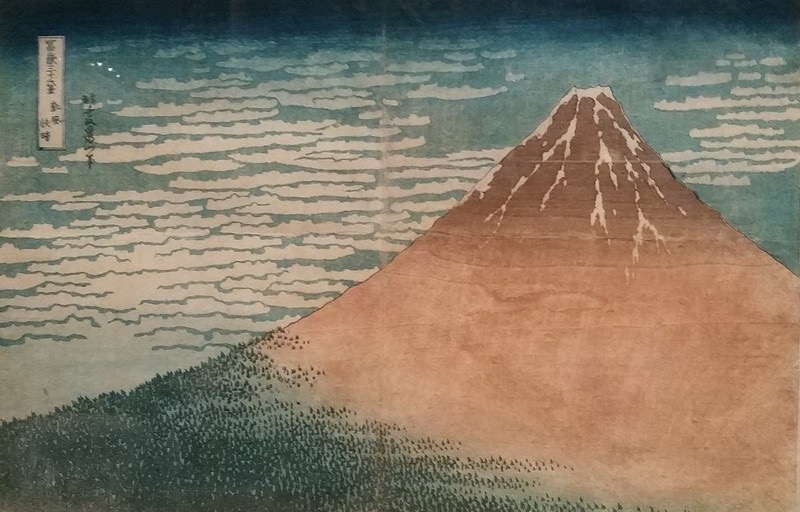
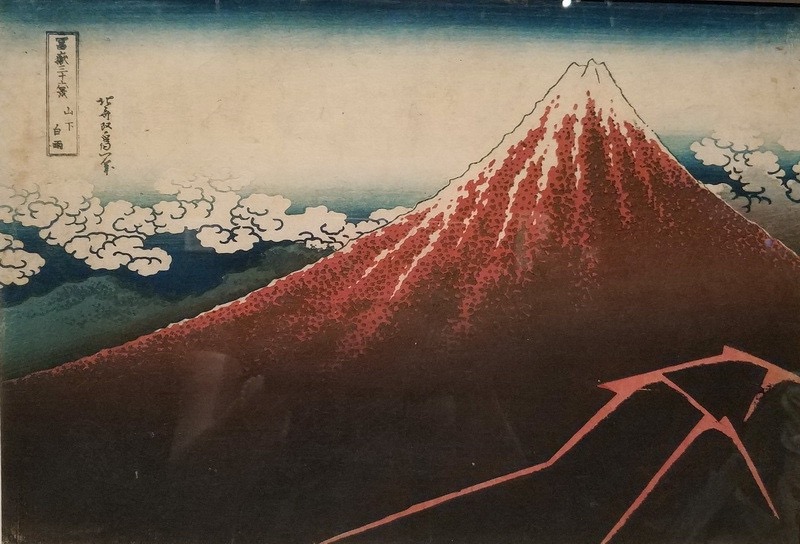
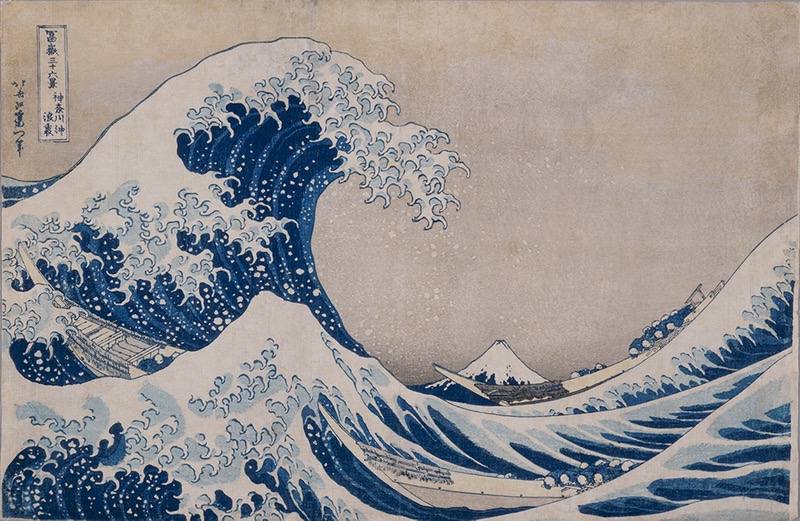
the series 36 Views of Fuji by Katsushika Hokusai, 1831–1833