Navigation
Mirrors allow the artist to present a space inaccessible to the primary gaze. Within a single painting, a second view emerges: it can lead us back to already depicted figures, reveal the opposite side of a room, or draw the eye outside. This reflection is interesting not only for its content. Its effect depends on where the artist places the mirror and how they connect the small reflected scene to the rest of the composition.
This study focuses on five works: Jan van Eyck’s «Arnolfini Portrait,» the wing of the altarpiece «Henry von Werl with St. John the Baptist» by a follower of the Master of Flémalle, Petrus Christus’s «Jeweler in His Shop,» Hans Memling’s «Diptych,» and Quentin Matsys’s «Menas with Wife.» The chronological scope, 1434–1514, is determined by the dates of the selected works. The corpus encompasses portraiture, religious, and professional scenes but does not claim to offer a comprehensive history of the motif.
What and How We Compare
The basis for comparison is the general method of organizing the image: an interior space featuring human figures that includes a mirror, whose reflection significantly supplements the main view. However, the works differ in subject matter and function. Therefore, we compare specific spatial techniques rather than assuming a complete similarity in the artists' intentions. While chronological order helps examine different solutions, it does not, by itself, prove direct borrowing.
The main research question is: How does the placement of a convex mirror alter the relationship between the depicted interior and the space in front of the painting? The working hypothesis is that answering this question requires more than simply listing the reflected objects. It is necessary to simultaneously consider the mirror’s position, the direction of the view it reveals, and the relationship between the main scene and the reflected scene.
Methodology and Sources
In each chapter, the general view is compared with an enlarged fragment. The analysis sequentially examines the placement of the mirror, the content of the reflection, and the hypothesized position of the observer. The «position» refers to the role suggested by the composition, not the precisely reconstructed point of view. Subsequently, five cases are compared based on identical criteria. Historical data and external interpretations are supported by citations; spatial comparisons and the final conclusion are presented as the author’s analysis of the selected corpus.
Textual sources are selected based on their connection to specific artworks and the nature of the information they contain. Museum catalogs are used to verify dates, titles, and storage locations. The National Gallery catalog and the studies of Brett Rothstein allow for the correlation of image descriptions with an argued interpretation. Museum educational materials assist in highlighting spatial relationships, but they are considered with regard to the time of their preparation—outdated definitions are not automatically transferred into the research. Where sources conflict, the distinction between an observed detail, a historical fact, and the researcher’s hypothesis is maintained.
From left to right: Jan van Eyck, 1434; follower of the Master of Flemmel, Altar of Verl, 1438; Petrus Christus, 1449; Hans Memling, Diptych, 1487; Quentin Matsys, 1514. General views; scales vary. Full titles and sources are available in the concept and illustration list.
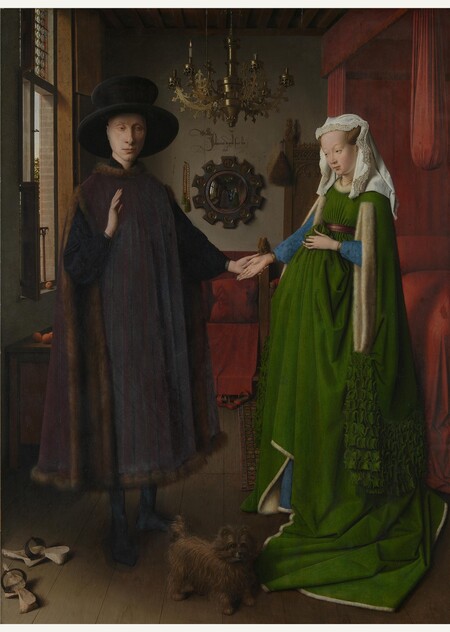
Overall view → mirror placement → reflection. Jan van Eyck. Arnolfini Portrait. 1434. National Gallery, London. Original framing of the reproduction.
Jan van Eyck. The Arnolfini Portrait. 1434. National Gallery, London. Full view. Two figures organize the foreground, and the mirror on the far wall becomes a small focal point of the second scene.
Jan van Eyck. Portrait of the Arnolfini Couple. 1434. Fragment. The mirror is situated between the figures, in the depth of the room. Initially, the gaze travels to the far wall, and then the reflection draws it back to the opposite side of the interior.
Jan van Eyck. The Arnolfini Portrait. 1434. Mirror and frame. The Scenes of the Passion on the border belong to a separate series of images. They should be distinguished from the room and figures visible in the reflective surface. [1]
Jan van Eyck. The Arnolfini Portrait. 1434. Overview and Reflection. The familiar figures are shown from the reverse side; the mirror completes the main view, linking two perspectives of the same room.
Jan van Eyck. The Arnolfini Portrait. 1434. Reflection and fragment of a doorway. Two additional figures are visible in the depth of the reflected scene. Their presence expands the cast of characters, yet the image itself does not establish their identities. [1]
Jan van Eyck. The Arnolfini Portrait. 1434. Window in the main view and mirror. The repetition of room elements helps correlate the gaze directions. This correlation is not equivalent to an accurate optical reconstruction of the space.
Jan van Eyck. Arnolfini Portrait. 1434. Inscription and Mirror. The inscription above the mirror and the reflected visitors link the painting to the theme of presence. Identifying one of the figures with the artist remains an interpretation, not an unequivocally readable detail. [1]
Jan van Eyck. The Arnolfini Portrait. 1434. Three scales of examination: the room $\rightarrow$ the far wall $\rightarrow$ the reflection. The mirror offers a reverse perspective, making the space in front of the depicted figures an integral part of the painting. The composition illustrates a path of attention, rather than the geometric layout of the room.
Follower of the Master from Flemalle. Henry von Werl with St. John the Baptist. Left wing of the Werl altarpiece. 1438. Prado, Madrid, P001513. General view. Attribution provided based on the museum’s current research. [8]
Altar of Verlia. 1438. Donor and Saint. Heinrich von Verl praying is depicted in a religious scene. The function of the panel differs from the portrait by Arnolfini; a similar motif of a mirror operates within a different type of image. [8, 9]
Verlya Altarpiece. 1438. Mirror on a wooden wall. It is embedded deep within a narrow interior. The surrounding environment allows one to understand its place in the room even before examining the reflected figures.
Altar of Verlya. 1438. Mirror placement and frame fragment. The circular surface is contained within a subject frame. Distinguishing the frame from the reflection helps avoid confusing the mirror’s structure with the content of the visible scene.
Altar in Verlia. 1438. General view and reflection. Lawrence Campbell describes the additional figures in the mirror as a monk and an acolyte. This reading is based on research material; the available reproduction limits independent verification of fine details. [1]
Left: Jan van Eyck. Portrait of the Arnolfini Couple. 1434. Right: Verla Altarpiece. 1438. Fragments. In both cases, the mirror is positioned deep within the room. The similarity in placement provides a basis for spatial comparison, despite the difference in subjects.
Portrait of the Arnolfini Couple, 1434, and the Altar of Verlia, 1438. Reflections. Lawn Campbell discusses the connection between the solutions. The similarity in approach is not independent documentary proof of direct borrowing. The size and quality of the fragments differ. [1]
Arnolfini Portrait, 1434, and the left wing of the Vierzehnheiligen Altar, 1438. General views. Additional figures appear both in reflection and elsewhere, but their meaning depends on the painting’s purpose—be it a portrait or a religious panel.
Petrus Christus. Jeweler in His Shop. 1449. Metropolitan Museum of Art, New York, Robert Lehman Collection, 1975. General view. The mirror is placed next to the merchandise on the front edge of the counter. [2]
Petrus Christus. Jeweler in His Shop. 1449. Counter. A horizontal surface separates the master’s space from the space in front of the painting. A mirror is located at this boundary, drawing the viewer’s attention beyond the main scene.
Petrus Christus. Jeweler in his Shop. 1449. Mirror Among Objects. Its frame and support emphasize its materiality: we are looking at an object on a counter. At the same time, the surface reveals a different view that cannot be achieved by simply looking deeper into the shop.
Petrus Christus. Jeweler in His Shop. 1449. Reflection. The mirror shows two figures and the streetscape. It connects the interior of the workshop with the exterior scene, which is absent from the main viewpoint. [2, 3]
Petrus Christus. Goldsmith in his Shop. 1449. Main figures and mirror. The people at the counter and the reflected passersby belong to different spatial zones. The mirror expands the trading scene without transforming it into a single frontal view of the street and the interior.
Petrus Christus. Jeweler in His Shop. 1449. Fragment of hands and counter. Brett Rothstein connects the attentive viewing of this painting to questions of interest and evaluation. The comparison of gestures and reflections allows one to question different ways of looking at things. [4, pp. 1–6]
Left: Portrait of the Arnolfini Couple, 1434. Right: Jeweler in his Shop, 1449. Fragments. The mirror is moved from the back wall to the foreground of the composition. The path of the gaze changes: the reflection meets the viewer at the boundary of the depicted world.
Petrus Christus. Jeweler in His Shop. 1449. General View and Reflection. The main perspective keeps us at the counter, while the mirror reflects the street. Its function in this comparison is to connect the interior scene with the exterior space.