Navigation
Concepts
- Pleasantness and Grace According to Kant
- Grace: The Schneider Table
- Pleasantness: The Blogger’s Table
- The Object as an Object of Desire
- Between the Tables
- Does the Thing Exist? Conclusion
Concept
The inquiry begins with a single detail from «Critique of Judgment.» Kant divides aesthetic art into the pleasant and the graceful. He dedicates dozens of pages to the graceful, while giving mere lines to the pleasant, and almost all his examples fall from the dinner table.
Kant defines them as follows: «Pleasant arts are those whose sole purpose is to provide pleasure» [1, p. 146]. He includes everything that entertains society during a meal: «an engaging story, the ability to spark lively conversation, to set a cheerful mood with jokes and laughter, ” table setting, music at feasts, which „strangely creates only a pleasing noise,“ and „all kinds of games whose only purpose is to kill time“ [1, p. 146].
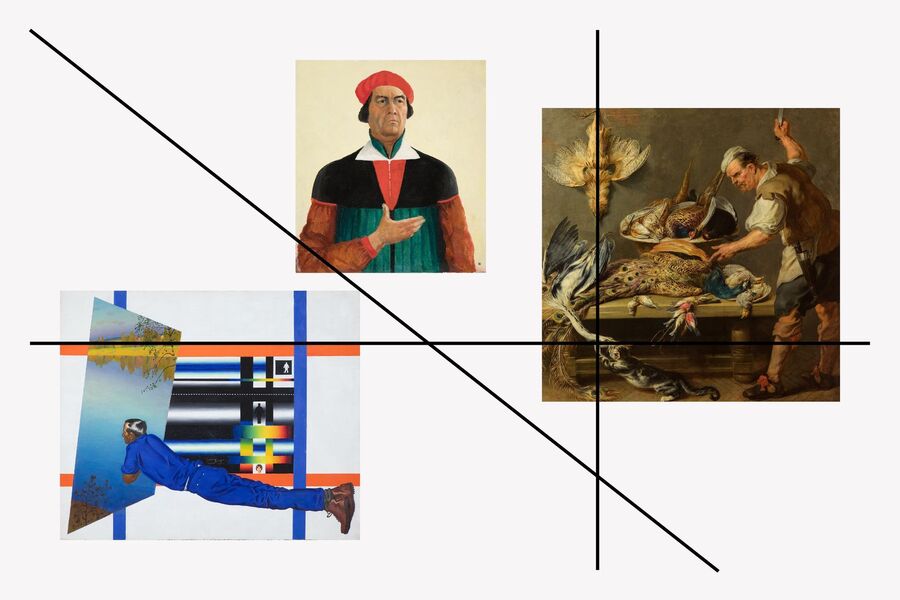
Key visual for the exhibition «Still Life. Portrait. Landscape. After Genre, ” 2026. GES-2 Culture House
At the GES-2 Culture House, the exhibition «Still Life. Portrait. Landscape. Beyond Genre» [6] is running from October 15, 2026, to April 25, 2027. In the «Still Life» section, 17th-century Flemish painting is displayed alongside mukbangs [5]—videos where bloggers eat on camera and converse with viewers [2]. According to Alice Prudnikova, the Program Director of GES-2, «we compare the bloggers' food-laden tables, for example, to the still lifes of Frans Snyders» [4].
In a Mukbang, you find the complete Kantian checklist: conversation with the viewer, humor, table setting, and the crunching and smacking serve as «pleasant noise.» This new format almost literally replicates the old example, and it is displayed next to a painting depicting the same table.
Question: How does contemplating a still life differ from the «non-contact» pleasure of a Mukbang if the viewer of the video is not eating or experiencing taste?
Hypothesis: The boundary between the pleasant and the elegant does not run between the old and the new, nor between the canvas and the screen, but along the orientation of pleasure: toward the object’s form or toward the sensation and desire it evokes. Therefore, the same abundance can be both pleasant and elegant.
Mukbangs are displayed in a separate room [2] as exhibits without author names [9]. Therefore, I am analyzing videos of the same type—not specific works—but the very nature of the pleasure. Each example illustrates one aspect of pleasantness: abundance, the appeal of the sensation, conversation, laughter, or remuneration (the distinction between free and paid art, § 43).
Method. I am drawing theory solely from «Critique of Judgment» (translated by M. I. Levina), and the articles about the exhibition are only for describing the display. The sections follow Kant’s concepts.
Structure: Kant’s distinction between the pleasant and the beautiful → the pictorial and the screen table → the display case and the candy → works between poles → an installation that measures the existence of things. In the conclusion, all the works are arranged on a scale of «pleasant — beautiful.»
1. Pleasant and Elegant in Kant
Three Forms of Incense
The key concept here is interest: «the favorable regard we associate with the notion of the existence of some object» [1, p. 41]. Interest arises when we care whether a thing exists—whether it can be eaten, purchased, or held. Among the three types of favorable regard (agreeable, beautiful, and good), «only the favorable regard for the beautiful is disinterested and free» [1, p. 47].
The agreeable is «that which pleases the senses in the feeling» [1, p. 42]. It «arouses a desire to possess such objects, ” which is why it is described as „not only that it is pleasing, but that it is gratifying“ [1, p. 44]. For my topic, the most precise example from Kant relates to food: „hunger is the best chef“ [1, pp. 47–48]. One can judge taste „only when the need is satisfied“ [1, p. 48]. Taste begins where pleasure ceases to depend on appetite.
Taste that requires a mixture of appeal and touching sentiment (Reiz and Rührung) is, according to Kant, «still barbaric» [1, p. 60]. In the visual arts, «the essential is the drawing, ” and colors „relate to attractiveness“ [1, p. 63].
Free art succeeds „as a game, ” whereas craft is an endeavor „attractive only by its result (for example, payment)“ (§ 43) [1, p. 145].
Pleasant art „is calculated for momentary entertainment, not to serve as material for reflection and repetition“ (§ 44) [1, p. 146]. Gracefulness „is guided by the reflective capacity of judgment, not by sensual feeling“ [1, p. 147]. Art that relies solely on pleasure „dulls the spirit“ (§ 52) [1, p. 167].
From these distinctions, I gather a tool—five questions for each piece:
- Is it appreciated through feeling or through judgment?
- Does the viewer care whether the object exists and can be acquired?
- Is it a matter of „one’s own taste, ” or does the judgment await universal agreement?
- What is more important—color and sound, or form, drawing, and composition?
- Does the work provide momentary entertainment or sustenance for reflection?
2. Elegant: Schneider’s Table
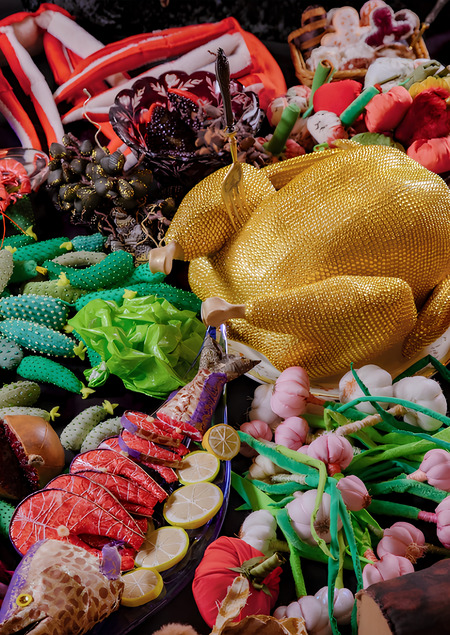
The «Still Life» section opens with two large 17th-century Flemish paintings and Dmitry Tsvetkov’s installation, «Feast» [2]. The exhibition is structured like a rhyme: in the center of the room is a long black table laden with textile food, and against the dark walls behind it are paintings featuring similar tables.
Excerpt from the «Still Life» section exhibition: Dmitry Tsvetkov’s installation «Feast» and 17th-century Flemish paintings. Photo: Daniil Annenkov / GES-2 House of Culture
The first canvas is «The Cook at the Table with Game» by Franz Sneyders and Jan van Bouckehorst, from the Hermitage collection [6]. The composition is nearly square and extremely dense. On the low table are a peacock, pheasants, and small birds; a bittern hangs on the wall. The cook, wielding a raised knife, looms over the table, while below, a cat tugs at a hanging heron. The gaze moves diagonally—from the suspended bird across a mound of game to the cook and back down to the cat. The collection of items includes the same table featured in the blogger’s content—an abundance put on display.
Francis Sneders, Jan van Borkhorst. Cook at the Table with Game, 1630s. Canvas, oil. 171 × 173 cm. State Hermitage Museum
Videos from the «GES-2» hall found in public sources are unsigned, so I am analyzing mukbangs of a similar type—through a curatorial comparison with «Schneider’s tables.» The footage is taken from videos by Korean bloggers Chan Pa and Yumden, which were published under a free license. Examples of other bloggers are described in the article «Lenty.ru» on mukbangs [8].
Disinterest (§ 2). You cannot eat a drawn monstrosity, and it does not matter whether it actually existed. The pleasure derived from a painting does not depend on the existence of the subject—that is, it is not tied to interest. This is precisely what Kant requires of a judgment of beauty. The Free Play of Imagination and Understanding (§ 9). The eye does not «taste» food; rather, it connects objects to each other and to figures. Imagination grasps the rich diversity, and understanding seeks order within it. Pleasure arises from this interaction—for Kant, it is the state of the «free play of imagination and understanding» [1, p. 55]. Drawing and Attractiveness (§ 14). Sneider’s palette is rich: the iridescence of peacock feathers, the red feet of birds, the white plumage of a heron. For Kant, color itself relates to attractiveness, but here it is subordinated to the composition, manifesting form rather than replacing it. Attractiveness is permissible as long as it does not become the primary source of pleasure.
Frances Eikens, Jan Coossers. Vegetable Stall. Canvas, oil. 161,5 × 282 cm. State Hermitage Museum
The second painting is «The Vegetable Stall» by Franz Eikens and Jan Kossir. According to a critic for the Russian newspaper, this painting was the starting point for Tsvetkov’s «Feast» [3]. On the left are two women: one sits in a dress with fur trim, and the other stands pointing at a vase of grapes. The right and lower portions of the canvas are filled with cauliflower, artichokes, cabbages, celery, a hanging bird, a hare, and a copper cauldron.Abundance as Composition. The vegetables are arranged not for a buyer, but for the eye. Rows, repetitions, and contrasts in texture—round heads next to long stalks, soft greens next to shiny copper—coalesce into a form. The figures almost dissolve, and the order of things itself becomes the main protagonist. Here, abundance serves as material for ordering, not as a promise of satiety.Why doesn’t the depicted game evoke appetite? According to Kant, appetite is interest, and the painting does not satisfy it. The still life addresses a satiated viewer who can judge taste. Sneider’s abundance is wonderful not because it looks edible, but because it is organized into a form.
3. Pleasant: Blogger desk
Chan Pa (장파). Mukbang: Octopus and Pork Belly, 2017. Video preview frame. YouTube
The frame is structured as a view across a table. The blogger eats with chopsticks from trays and foil; the table is laden with food, and on the right, a scroll of viewer messages runs. The camera is positioned so that the viewer is situated opposite—in the place of a fellow diner who didn’t get enough food. The same technique is used by the Korean blogger Diva: she arranges many plates in front of the camera and begins to eat. She explains her popularity by saying that «some viewers are willing to eat well, but cannot afford it» [8].
Pleasure (§ 3). The viewer’s satisfaction is based on a sensation—the sight of the food and the imagined taste. It is about this type of pleasure that Kant speaks, noting that it is not merely liked, but rather «delights» [1, p. 44] and provokes a desire to possess.
Interest without Possession (§ 2, 5). Externally, the viewer of a mukbang resembles a Kantian spectator: they do not eat, nor do they touch the food. Yet, for their pleasure, it is vital that the food is real and that someone will actually eat it. This is interest in its purest form, simply transferred to another person. The formula «hunger is the best cook» [1, p. 47] operates in reverse here: the video itself ignites an appetite, which subsequently provides pleasure.
Yumden (Yum-Cast). Mukbang: Baked Sweet Potato, 2016. Video thumbnail. YouTube
Here, the scale is different. The blogger brings the broken baked sweet potato right up to the lens; the flesh takes up almost the entire frame, with a large title overlaying it. This is no longer a table composition, but a single piece brought close to the eye as much as possible.Attractiveness (§ 13–14). What is subordinate to drawing in Snyder’s work comes to the forefront in a mukbang: close-ups, saturated color, loud sounds—crunching, chewing, sizzling. Color and sound make the object «more vivid for sensation, ” but not „worthy of contemplation“ [1, p. 63]. If pleasure rests solely on this, taste remains „barbaric, ” according to Kant [1, p. 60].
Pleasant sound
The mukbangs at the exhibition are not just visible, but audible. As reported by «Rossiyskaya Gazeta, ” the abundance on Tsvetkova’s table and in her paintings is accompanied by chewing and crunching sounds from the adjacent room with monitors [7]. The viewer is still standing in front of Snyder’s, yet the pleasant noise has reached them through the wall.Pleasant Noise (§ 44, 53). For Kant, music imposes itself on everyone around: „The effect of music is akin to the pleasure derived from a widely spreading scent.“ In contrast, with the visual arts, one „needs only to turn one’s gaze“ [1, p. 172]. The sound of the mukbang functions like „music at grand feasts“: it is not a composition, but an appetizing backdrop. One can turn away from a painting; one cannot turn away from the crunching sounds through the wall. In one space, pleasures that are chosen and pleasures that happen upon you converge.
Pleasant conversation and shared meal
A message banner is visible on the right side of both frames. The blogger comments on the dishes, responds to viewers, and makes jokes, while the sound of eating plays continuously in the background.Dining Art (§ 44). Here, Kant’s list corresponds almost verbatim: a free conversation where no one is responsible for what is said, and a pleasant noise that supports it. All of this is «calculated for momentary entertainment» [1, p. 146].