Navigation
1| Concept 2| The Cowherd and the Humpback 3| The Firebird 4| Ivan Tsarevich and the Grey Wolf 5| Conclusion
Concept
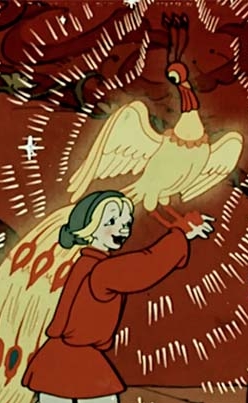
After the Great Patriotic War, animation underwent a significant transformation. Before the war, animators created non-narrative pieces synchronized with rhythmic music to which the characters moved, but after the war, the art changed fundamentally. Animation became smoother, complex narratives and dialogues appeared, and music served only to complement and set the mood. Works based on fairy tales with clear morals and rooted in folklore came to the forefront. Fairy tales featuring the Firebird are some examples of this.
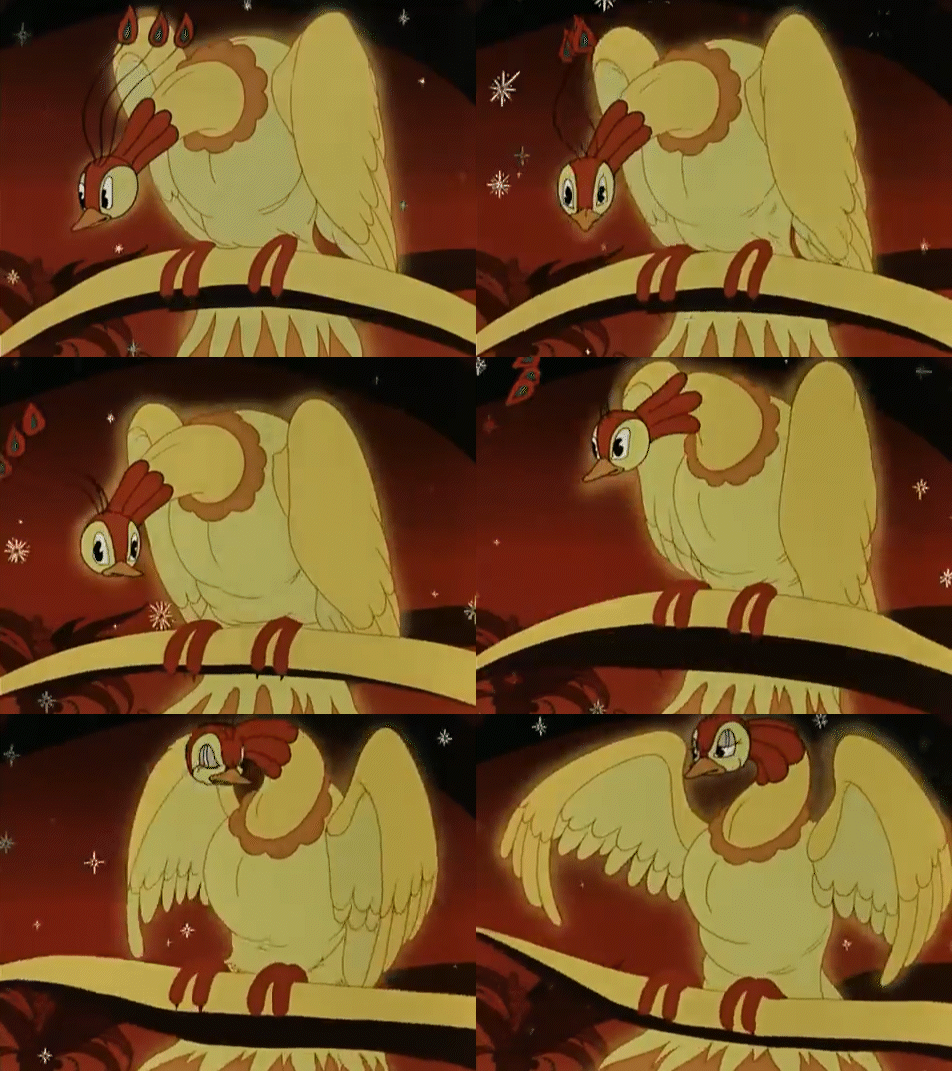
The Firebird is one of the most famous and enduring archetypes in Russian folklore, and it recurs frequently. In fairy tales and Soviet animation, it is not merely decoration; it plays a crucial role in the narrative. It serves as the plot catalyst, prompting the hero to action and driving them toward their goal. Its image is incredibly complex and always stands out against the backdrop of the landscape and other characters. In every piece of animation, it is depicted as brilliant flame; its movements are fluid and varied, with every element of its being operating in its own rhythm. Similarly, in different works, it initiates the plot in various ways, but it never remains in the background. Artists dedicate detailed attention to it, recognizing it as the pivotal character that it is.
The choice of this topic stems from the fact that the Firebird itself is one of the central archetypes of Russian folklore. The goal is to explore what role it plays in various animated tales and how its image is interpreted. Specifically, we will examine the artistic techniques animators employ to convey the character’s fairy-tale quality and vibrant nature—namely, palette, light, movement, and stylization.
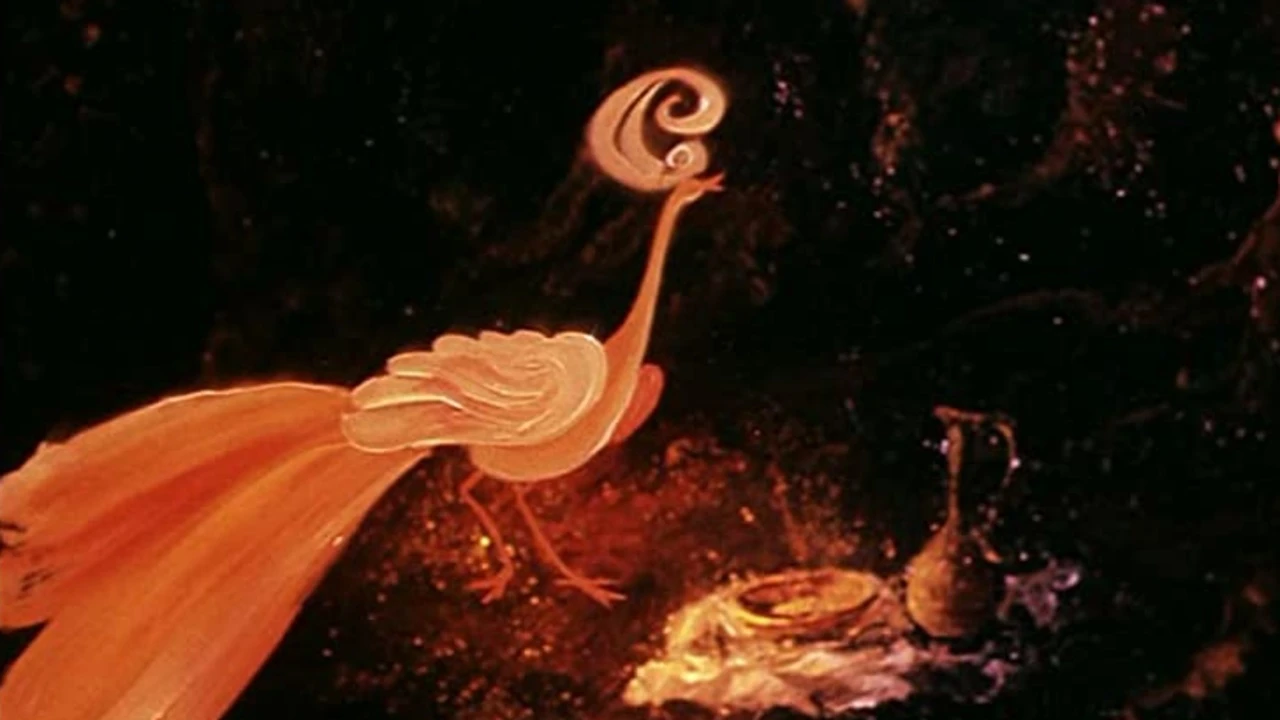
«Firebird» (1984, Vladimir Samsonov)
The source material was selected from cartoons featuring the Firebird. A total of three sources were chosen, in which the character is portrayed not only using different techniques and styles, but also fulfilling various roles in diverse narratives. This selection allows for a comparison of different artists' works, enabling viewers to understand their distinctions beyond technique and plot, and to analyze the role the bird plays in each story.
The research is organized not chronologically or by director, but by the function the Firebird serves in the narrative.— First: the animation «Konek-Gorbunok» by Ivan Ivanov-Vano (1947); the Firebird’s feather as the catalyst for a chain of quests.— Second: the animation «Firebird» by Vladimir Samsonov (1984); the central image and problem-solving mechanism.— Third: «Ivan Tsarevich and the Gray Wolf» by Galina Barinova (1991); also initiates the hero’s trials, but serves as the main quest.
Key question: What techniques do the authors use each time to highlight the Firebird as a central element in the plot and frame of Soviet animation?
Hypothesis: Artists always highlight a character in a narrative. Because of this, the character never ends up relegated to the background. They are always given a distinct character and image, achieved through various means depending on the function they serve in the plot. The Firebird acts as the driving force of the story; the hero encounters her, and his fate changes after this meeting. She is a dualistic character—she helps point the way, yet she also «burns» the characters, but she ultimately guides and assists them. Her brilliant image completely overshadows everything else. This is precisely why she cannot be «background scenery»; her role and image are unique.
Konyok-Gorbunok
Evening Moscow, No. 64, March 17, 1948, p. 4.
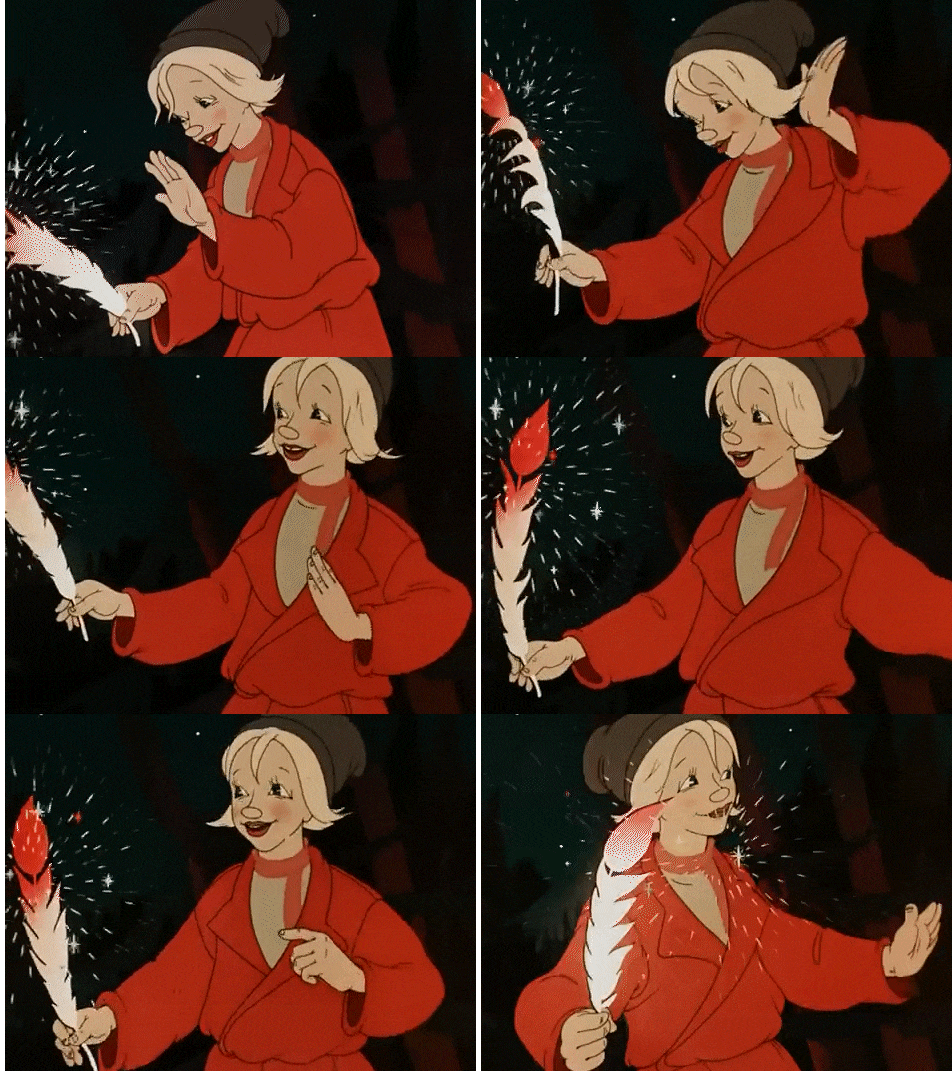
In Ivan Ivanov-Vano’s animation «The Little Horse» (1947), the Firebird is presented not as a character, but as a feather. The feather, found by Ivan, becomes the central narrative element, setting in motion our hero’s journey through the Tsar’s assignments. The visual decision was made to depict the feather not as an object, but as a source of light. This is actually a very important key element—the encounter with the Firebird is not direct, but indirect, thereby already intriguing the viewers toward a meeting with the enigmatic creature.
The key point is that we see not just one bird, but an entire flock. Each bird follows its own migration path. If other animated interpretations of fairy tales show only a single creature in the frame, here the creators decided to go in a different direction. They created an entire «species» that has its own hierarchy and natural laws.
This approach resolves many questions: «Why is the bird alone?», «How did it appear?», «Does it live forever?»
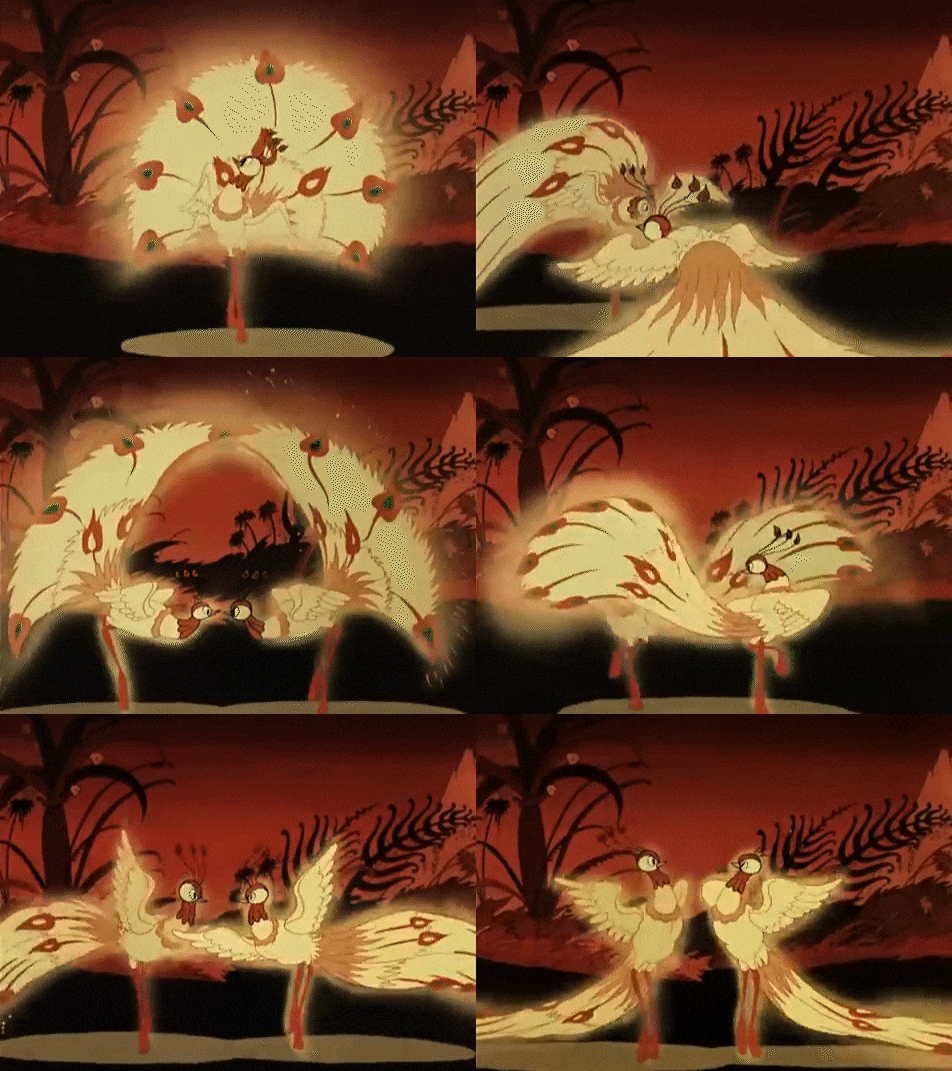
Thanks to this turn, we can observe the mating dance of two Firebirds. The birds' tails have their own plasticity and path of movement, but they do not detach from the body; rather, they are an extension of it.
Catching the Firebird happens in a very beautiful and unusual way. To lure the bird, the hero first creates bait, and after an unsuccessful catch, performs a dance and imitates the bird’s movements, thereby attracting one of the specimens. This is a very interesting and significant moment, because Ivan does not oppose the fairy-tale world—instead, he tries to adapt to it.
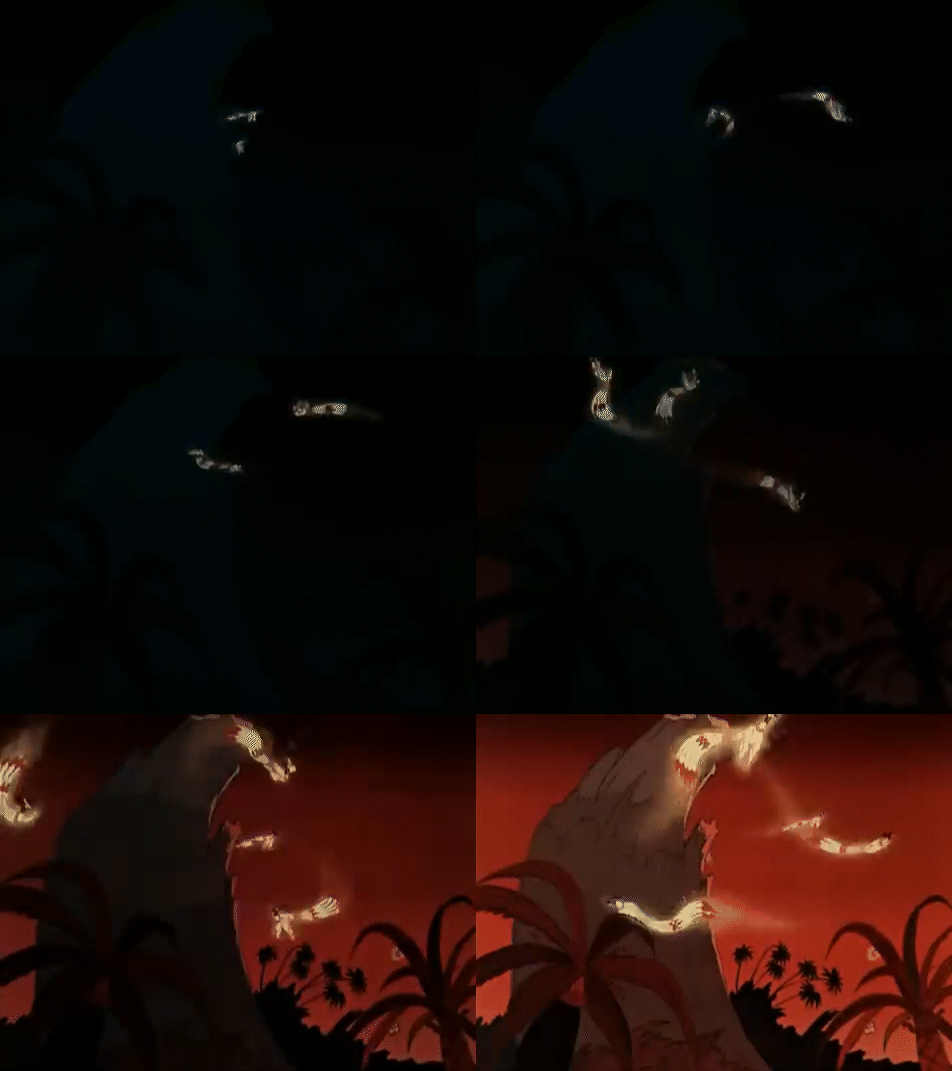
The sculpting focuses on one aspect; the second part is handled by the color transmission. The magic of the Firebird is built upon color combinations that contrast with the painting’s main palette. In the scene of the capture, color transmission is resolved through contrast. The night, which is dark blue, changes to a reddish hue after the Firebirds arrive.
This approach can also be noticed in the scene where Ivan finds the feather in the forest and when he brushes the horses at night in the stables. The birds themselves adhere to a logic of luminescence. They are not merely colored in vibrant shades; they emit a light that alters the surrounding illumination. They also give off a soft glow, which further contributes to their luminous effect. Director Ivan Ivanov-Vano recalled that the principle of color contrast was deliberately echoed in the «Catching the Firebird» episode, following the scene with the feather in the palace, where the flashes of light were also built upon a sharp shift in color palette.
It is important to note that «The Cow-Horse» from 1947 is one of the first full-length animated films in color. To capture the full palette, it was shot on multi-layer Agfacolor film. The artists originally planned to use color to convey the artistic choices embedded in the script.
In the 1975 animation, The Little Horse and the Humpback, the Firebird fulfills the same role as in the 1947 version; the only things that change are the stylization of the bird itself and the execution technique. The feather and the bird are also shown against dark backdrops, but differently. The colors are duller, and the attempt to make the bird stand out is not through contrast, but through depicting a glow surrounding it.
The Little Horse and the Humpback, 1975
By the 1970s, the original 1947 negative had degraded, and the technology for restoring old films did not yet exist. Therefore, Ivanov-Vano reshot the film using the surviving storyboards and sketches from the first version. The technique remained hand-drawn, but the production context made its mark.