Concept
Japanese E-Sugoroku (picture board games) were illustrated tabletop games where participants moved between depicted scenes based on dice rolls. Their themes ranged across journeys, famous landmarks, human activities, and events in life. In Tobisugoroku variations, the number rolled indicated the cell to advance to [5]. Among these works were Sessese-Sugoroku—games about life advancement, where a person’s change in status translated into a sequence of possible gameplay events.
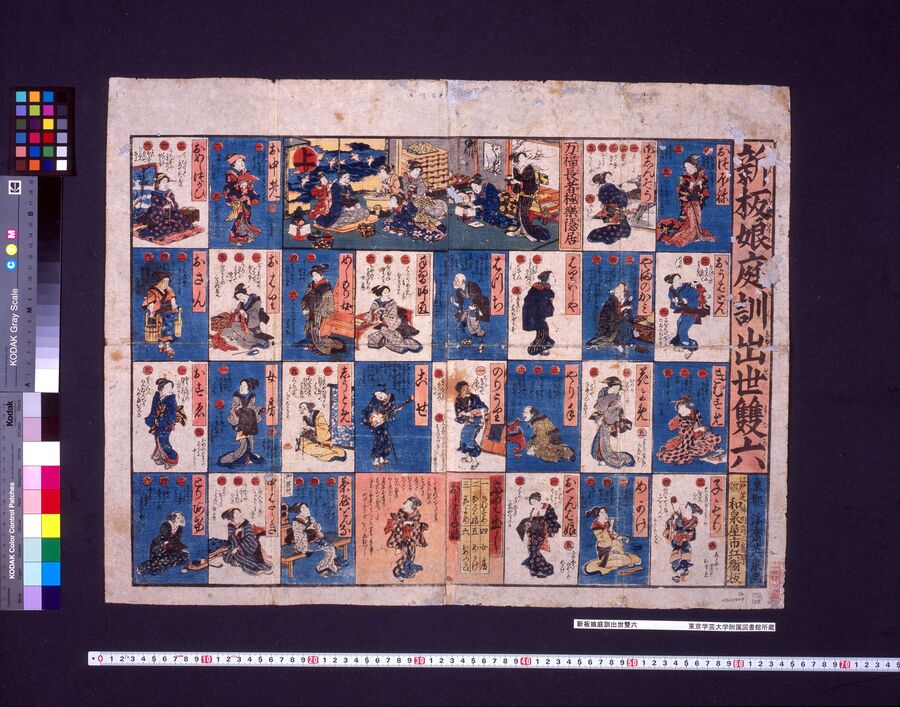
Keisai Eisen. «A New Sugoroku on Guiding Daughters and Advancing in Life.» Vol. 1, 1844–1848.
A comparison of late Edo and Meiji women’s e-sugoroku allows us to examine how these games depicted and assessed various pathways of female life. Their boards represent various activities, social and familial statuses, as well as favorable and unfavorable outcomes. However, it is not only important to know what possibilities were depicted, but also which of those were defined as success and which were framed as failure. Juxtaposing the games from these two eras enables an investigation of these representations within their historical context and the societal ideals of their time—without assuming the game scenarios are direct representations of real women’s biographies.
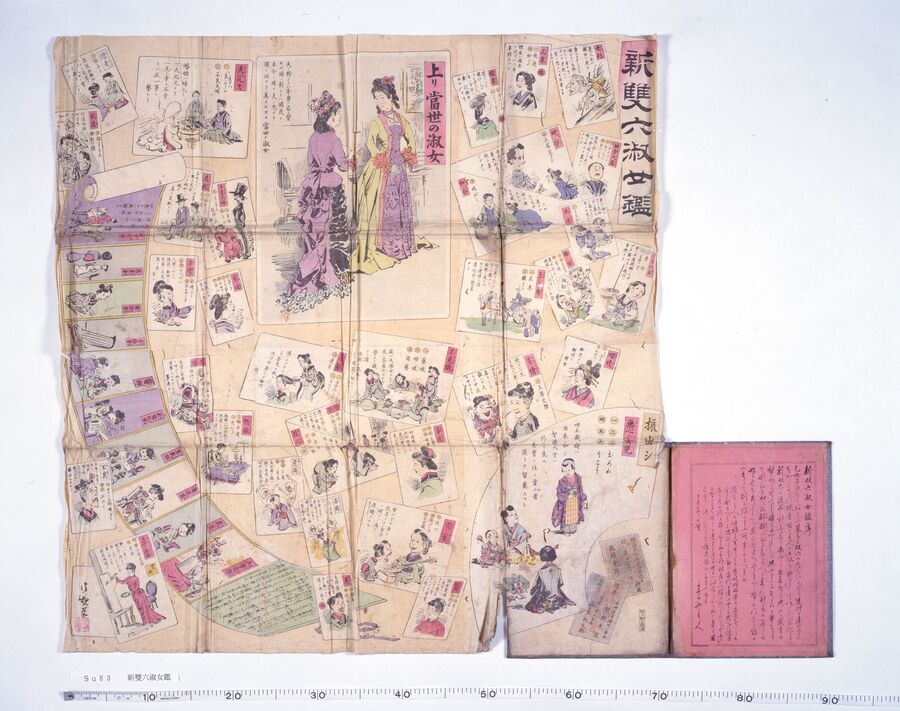
Kiyotaka Kobayashi, «New Sugoroku—A Model of a Cultivated Woman, ” 1886.
The transition from the Edo to the Meiji period was accompanied by profound transformations in Japanese society, including in the field of education. However, this does not mean that women’s life narratives can be prematurely divided into «traditional» and «modern.» To understand how play representations evolved, one must examine specific works and account for the distinctions among games within a single historical period.
1. Keisai Eisen. 1844–1848. 2. Kobayashi Kiyotaka. 1886.
E-shogoroku has long been studied as a source of understanding social mobility and moral norms. Tomohiro Takaku researched the depiction of the vassal’s official career in the Shogunate [2]; Formanek and Linhart examined games with didactic narratives [3], while Osamu Yoshida addressed female pursuits and perceptions of them [4]. This paper focuses on evaluating female life scenarios within the games themselves: it is insufficient merely to list the professions depicted; we must establish which statuses were considered desirable, which were associated with failure, and what outcomes the creators designated as victorious.
Research Question: How were various aspects of female life depicted and evaluated in late Edo and Meiji Japanese e-sugoroku, and how did the representations of success within them differ?
Hypothesis: Between the two eras, not only the depicted occupations and social roles may have changed, but also the perceptions of the desired culmination of a woman’s life path. However, certain family and upbringing ideals may have persisted.
Six board games were selected for this study: three from the late Edo period and three from the Meiji era. The games by Keisai Eisen and Kobayashi Kiyotoki are examined in detail; the others are used for comparison. The analysis is based on three criteria: the depicted female roles, the available game transitions, and the favorable or unfavorable outcomes. The primary sources include museum reproductions, annotations, and published rule decipherments. The concept of alea rogae ciaua is used to explain the role of chance in the game mechanics [1, pp. 44–46].
The E-Sugoroku Analysis Principle: Female Roles, Gameplay Transitions, and Outcomes. An Author’s Scheme.
Research Plan:
Paths to Well-being in Late Edo 1.1. Upbringing and Social Roles. 1.2. Success, Failure, and Final Positions.
Women’s Life Scenarios in Meiji 2.1. Education and Occupation. 2.2. The Ideal Successful Woman.
Changes and Continuity 3.1. Social Roles and Images of Success. 3.2. Upbringing, Play Transitions, and Boundaries of Comparison.
Conclusion.
1. Paths to Well-being in the Late Edo Period
1.1. Education and Social Roles
Caseya Eisen’s game, «A New Sujogo on Guiding Daughters and Advancing in Life» (c. 1844–1848), depicts the roles of women and societal positions, ranging from domestic service to marriage and life within a prosperous family. The game board does not arrange these circumstances into a single sequence; after rolling the die, a player may find herself in various situations, and her status is capable of both improving and declining.
Keisai Eisen. «A New Sugoroku on Guiding Daughters and Advancing in Life.» Vol. 1, 1844–1848.
The initial cell is based on the image of a dancing girl. Next to it is an instruction where the child is compared to a white thread: as she gradually takes on different colors, she changes. This metaphor underscores the importance of upbringing from the earliest years of life. The winning outcome is a comfortable old age surrounded by serving women. Thus, the game encompasses an imagined life path from childhood to old age, and its desired goal is not a specific profession, but a prosperous life in later years.
Two possible life paths in Keisai Eisen’s game, «New Sugoroku on Educating Daughters and Advancing in Life.» An original reconstruction based on the museum’s decipherment of game transitions.
In these interactive narratives, moral judgments intersect with chance. For instance, the path from a disobedient girl to work in an inn is accompanied by commentary on her poor upbringing, and subsequent progression could lead to destitution. The game resembles a cautionary tale, where a person’s behavior is linked to their future social standing. However, the direction of movement is determined by a dice roll, not by the heroine’s choice. This creates a contradiction: the game explains success and failure through human qualities, yet simultaneously cedes fate to chance. The pursuit of landing on a prosperous space becomes part of the player’s experience, through which they are prompted to distinguish between desirable and undesirable life outcomes.
1.2. Success, Failure, and Final Provisions
The end of the game path and the continuation of the heroine’s story in the «Hatti» cage. An original interpretation based on the inscription on the game board.
The unfortunate path ends in the cell of «Hatti, ” from which the player can no longer escape with a regular move. However, the inscription continues the story of the woman: her nurtured daughter later achieves success, and the mother receives help. This does not transform her own destiny into a triumphant outcome, but it shows that a moralistic plot is not limited to punishing misbehavior. Even after social decline, the woman’s future remains tied to the well-being of the next generation.
Keisai Eisen. «A New Sugoroku on Instructing Daughters and Advancement in Life.» Vol. 1, 1844–1848. Hatti Collection. Fragment.
In the game of Eisen, the winning cell is «happy old age in prosperity.» The image depicts an elderly woman in a well-appointed home, surrounded by servants. Unlike the other cells, which represent individual occupations, family, and social statuses, the finish line denotes the outcome of an entire life. Success here is primarily expressed through material well-being and the ability to spend one’s later years in abundance.
Keisai Eisen. «A New Sugoroku on the Upbringing of Daughters and Advancing in Life.» Vol. 1, 1844–1848. Excerpt.
In Eisen’s game, a secure old age is not the result of a single, correct life path. One can attain it from various social standings, including service in a noble household or from an independent family. An unusual example is a nori vendor who reaches the winning square thanks to the success of a child she took in as an orphan.
This case echoes the story of a woman who fell into poverty. Her daughter also achieves success and helps her mother, but the woman herself remains in the «hattie» square, unable to continue the game. In both cases, raising the next generation plays a vital role, yet the outcomes differ: for one woman, the child’s success becomes a victory, while for the other, it is merely assistance after a life setback. This distinction is determined not only by the narrative but also by the game’s rules.
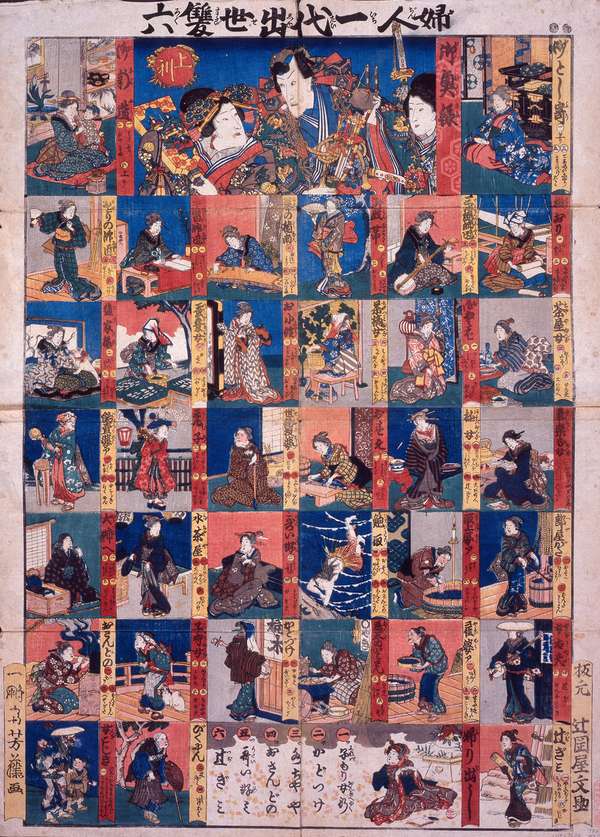
Utagawa Yoshifuji. «Sugoroku on the Life Advancement of Women.» 1847–1852.