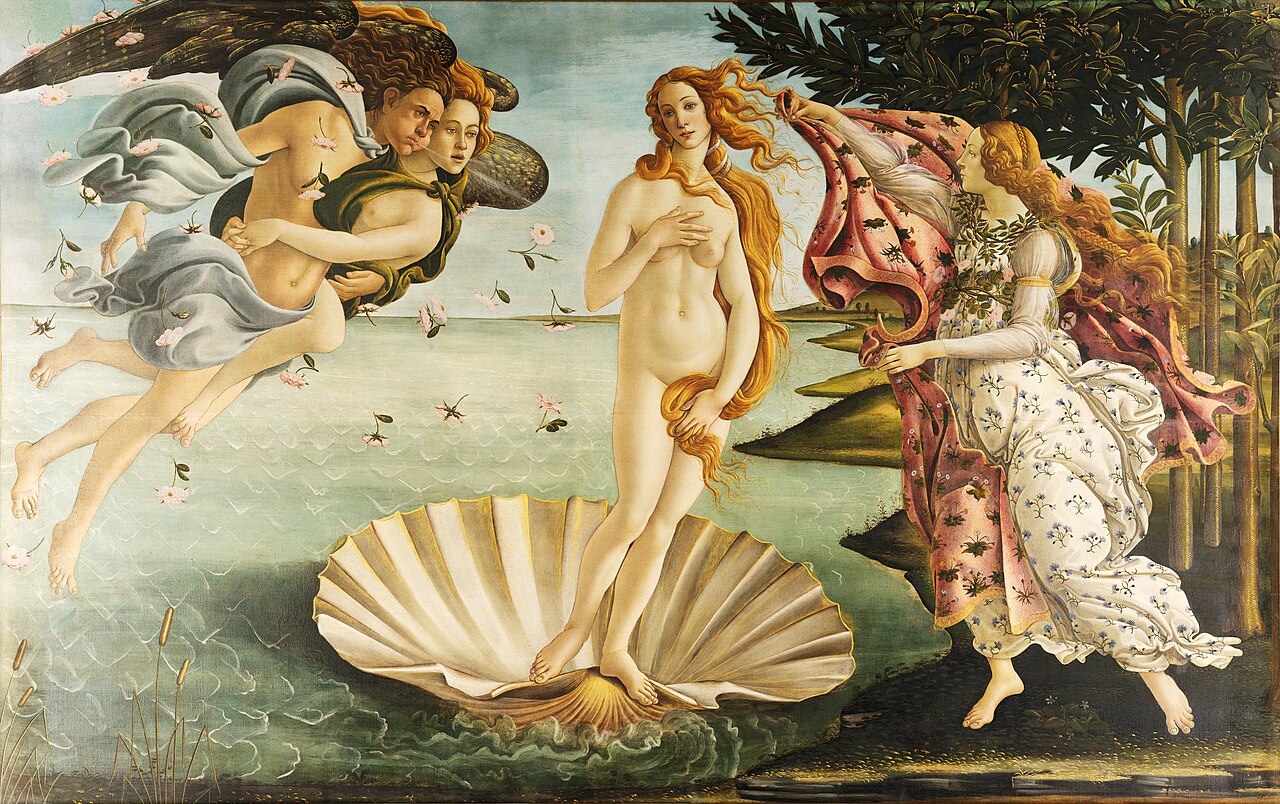
Rationale for Topic Selection
The theme of female nudity during the Renaissance is the intersection of theology, philosophy, anatomy, and social norms. Over several centuries, the nude body has transformed from a symbol of original sin into an independent object of artistic investigation and sensual beauty. This transition is rooted in the traditions of the North, where naturalism often coexisted with moralizing, and Italy, where nudity became the embodiment of the humanistic ideal.
The selection of the theme was driven by the desire to trace how perspectives on the female body have evolved and what cultural prohibitions and permissions underpinned each image.
Concept
The research concept is built upon comparing two trajectories: the northern one, where the nude evolves from religious naturalism to secular mythology while retaining a moralizing subtext, and the Italian one, which moves from idealized antiquity to realistic sensuality.
Both traditions agree that the female body ceases to be solely a symbol of sin, but they diverge on what it becomes instead: an object of moral instruction or an object of humanistic inquiry.
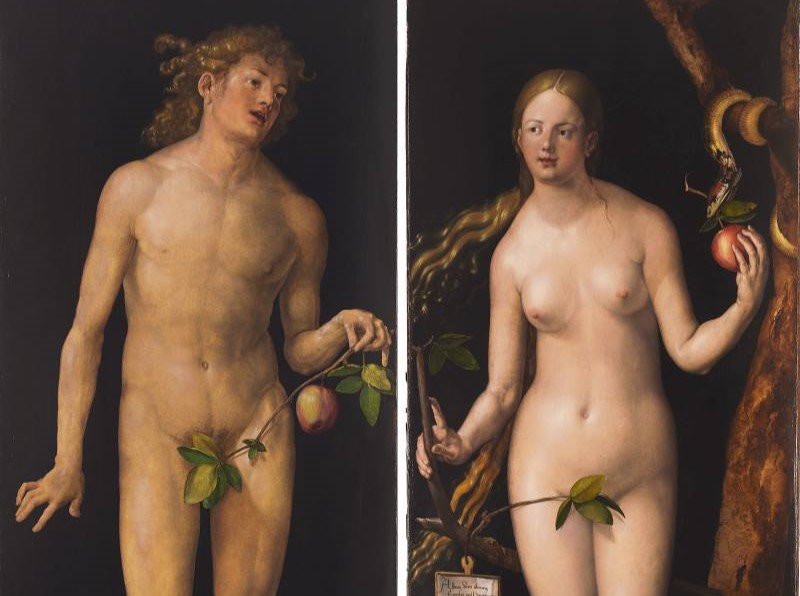
The painting consists of two large-format oil canvases. The diptych was painted in 1507. The work is exhibited at the Prado Museum. In 1504, Albrecht Dürer created the first work on this theme—a copper engraving titled «Adam and Eve.»
Dürer painted this piece upon his return from traveling through Italy, inspired by the art of antiquity. His work is the first depiction in German painting of fully nude figures at life size.
In German Renaissance painting, this was the first depiction of a fully nude human figure at life size. Dürer wrote that since humanity was created in the image and likeness of God, their bodies should represent a model of perfect beauty. Indeed—his Adam and Eve are captivatingly beautiful, but beautiful in different ways: Adam’s youthful masculinity accentuates the soft femininity of his partner.
It seems Eve’s delicate form is blossoming in anticipation of blissful earthly love.
The painting was originally commissioned for an altar, containing all the essential attributes of the Fall of Man scene—the tree, the apples, the serpent (though no longer in the guise of a woman, but as an ordinary snake)—but for unknown reasons, the altar was never painted, and this is likely no coincidence.
The chronological scope of this work covers the period up to the 14th century, serving as the foundation upon which Christian iconography of nudity was formed. The Northern and High Renaissance offered two distinct responses to the question of how the nude female body could be represented. In medieval Europe, nudity was strictly regulated. As noted by the Great Russian Encyclopedia, the depiction of the nude body occupied a marginalized position and was permitted only in a few Old Testament and Christian narratives: primarily, these included the «ancestors of humanity"—Adam and Eve—as well as the righteous and sinners in scenes of the Last Judgment.
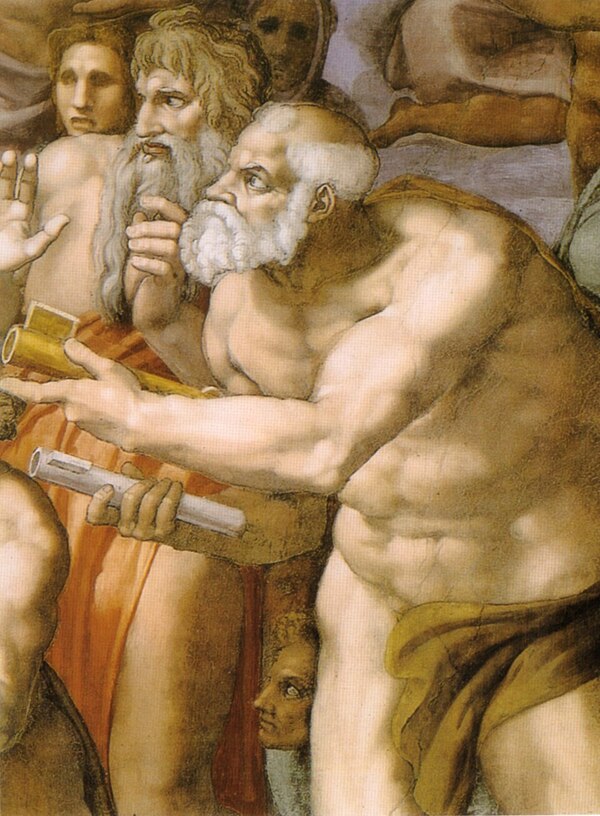
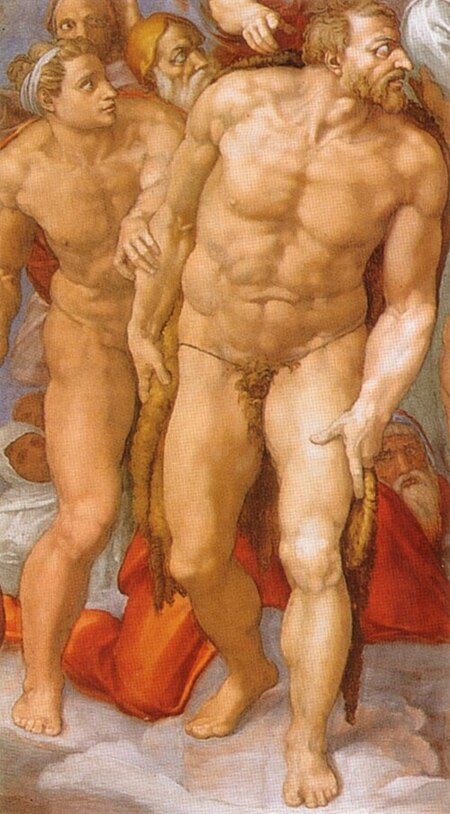
The right group consists of martyrs, confessors, and other blessed figures, with male figures preeminent (approximately eighty characters). On the far right is an athletic man holding a cross. This is presumed to be Simon of Cyrene, who assisted in carrying Jesus’s cross to Golgotha. Another possible identification is Dismas, the repentant robber.
Below him, Saint Sebastian ascends into the clouds, clutching arrows in his left hand—a symbol of his martyrdom. Sebastian’s figure is considered a tribute to the ancient eroticism explored by the artist.
Slightly to the left are depicted Blasius of Sevastapolis and Saint Catherine of Alexandria; this section of the fresco was repainted by Daniele da Volterra. Following them are Saint Philip with a cross, Simon the Zealot with a saw, and Longinus.
On the left side, almost all the figures are women: virgins, sibyls, and Old Testament heroines. Two women stand out among the other figures: one with a bare torso and another kneeling before the first. They are considered personifications of the Church’s mercy and piety. Many of the figures in this row cannot be identified.
Some of the blessed among the risen rush upward, drawn into a massive, collective rotational movement. The gestures and facial expressions of the characters show far more excitement than those standing near Christ.
In 1541, at the commission of Pope Paul III, Michelangelo painted his famous fresco, «The Last Judgment, ” on the altar wall of the Sistine Chapel. At the center of the composition, dedicated to the Apocalypse, amid a crowd of preachers, Old Testament prophets, martyrs, and saints, is the imposing figure of Christ, with the all-knowing Virgin Mary positioned slightly below. Even during the creation process, the fresco provoked bewilderment among representatives of the Church and Roman society.
Contrary to the unshakeable tenets of the Christian world, which dictate that the «Last Judgment» in art must display humility and patience, Michelangelo presented a vortex of diverse emotions—power, terror, helplessness—but never fear or submission. On the fresco, in one relentless torrent of despair, sinners, the righteous, saints, men, and women swirl as they experience the final moments before the universe vanishes.
Their nude figures are imposing, full of power, but helpless before God’s judgment, and therefore their faces are contorted with grimaces of despair. In short, Michelangelo’s «Last Judgment» did not conform to the criteria of religious painting.
The «Last Judgment» was first unveiled in December 1541. People eager to see the monumental fresco gathered from all corners of Italy, France, and Germany, and Flanders. However, Michelangelo’s work—which became a masterpiece of art—elicited admiration from some contemporaries and a desire for its destruction from others.
Previously, Aphrodite’s festival was held annually in Hellas, and the most beautifulhetairai were chosen to participate. They stood nude between the columns in the portico of the local sanctuary (each major city had its own) while processions of various people, including artists and sculptors, passed by. The latter could draw inspiration from these bodies.
However, in the 14th century, the opposite was believed: the naked body was considered a source of sin and temptation, and female nudity almost always marked guilt.