«Transmetropolitan» — a 60-issue comic series chronicling the life of a gonzo journalist in the future United States. It was initially published by DC Comics under the sci-fi imprint Helix, and later by Vertigo, where the boundaries in depicting violence, addiction, and controversial themes were pushed for a more mature audience.Warren Ellis aspired to be a journalist but couldn’t afford additional training courses due to poverty. He was involved in futuristic urbanism but left a conference amidst a scandal after exposing colleagues for cynically manipulating data. «Transmetropolitan,» published over 20 years ago, merges both interests and remains the author’s most renowned work featuring sharp political commentary.The comic began in 1997 and concluded in 2002. Inspired by the legacy of the Watergate scandal and Hunter S. Thompson, it survived the Y2K crisis, the collapse of the Twin Towers, and the presidential election that brought George W. Bush to power. Two years remained until the advent of Facebook, as the world fully transitioned to digital.
«I never understood why people called it [Transmetropoliten] a dystopia. I perceived it as a reality, albeit one with strong exaggerations, filled with sorrows and joys. <…> What matters is that it is a tool, not the truth.» Warren Ellis, from an interview with The Comics Journal in 2018
«Transmetropolitan» began in a peculiar period for the United States. Against the backdrop of the 1970s and 1980s crisis, the nineties were an era of technological ascent, pop-cultural and political zenith, marked by the end of the Cold War. However, the conflict in Iraq soon followed, leading to Jean Baudrillard’s famous essay, «Were the Gulf War Not There?», which focused on the complete severance of reality from the media narrative. People wanted to believe in the future, but they could no longer believe in authority.
«Transmetropolitan» possesses elements of cyberpunk: an overloaded urban environment, the flourishing of trans- and post-humanism, combined with extreme social decay. It also bears signs of transgressive fiction: the constant use of shock value and profanity, the depiction of physiological processes and eroticism in a world where cannibalism and prostitution are normalized. Yet, the setting’s core is rooted in the experience of the 1990s—a time of hopes viewed through the prism of presidential errors and scandals, journalistic investigations, and terrorist attacks. This is post-cyberpunk, where the protagonist is an agent of the system, but not an authoritarian corporate mechanism, but rather of the public and institutional order.
The core hypothesis of the research is that the world of «Transmetropolitian» serves as a link between the past of the United States and its digital future—a future where society experiences crises analogous to those of the 20th century, stemming from the interplay between media representation and democratic models.
The goal of this study is to analyze the narrative and visual language through which this world is depicted and unveiled.
Attributing the comic to post-cyberpunk necessitates contextual framing, so the first section of the study briefly illustrates the characteristics of the cyberpunk style in American comics through the works of other creators.
This is followed by an analysis of the narrative within «Transmetropolis» itself. The structure reflects two inherent features of the work—opposition and the central role of the individual—which is why particular emphasis is placed on the characters and human depiction.
The initial sections are dedicated to the journalism of the future: the personality of Spider of Jerusalem, his gonzo style, and his ethical transformation are then placed within the broader context of media as both an informational space and an institution. The section on technology—intermedia—underscores that even within a cyberpunk context, technology remains a tool with ambivalent potential for Ellis.
The political analysis is divided by the principle of key actors. Both presidents serve as central antagonists. In the crisis they create, law enforcement and, finally, the electorate themselves are at odds—whose political action leads to the resolution of the conflict and the thematic closure of the comic and the study.
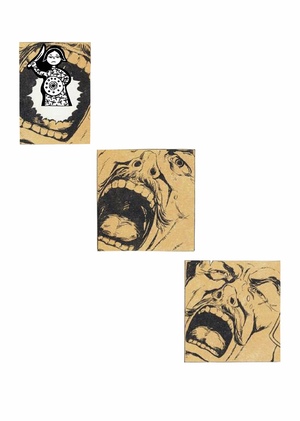
Warren Ellis & Darick Robertson, Rodney Ramos. Transmetropolitan, Issue #32, 2000
For the first section, we selected works depicting a dark, urban future within the American context, published between the 1980s and the early 2000s. Frank Miller’s comics portray the classic cyberpunk outcast hero in antagonism to the entire world, while the «Judge Dredd» series offers a model of a hero within the system, characteristic of post-cyberpunk.The primary visual material consists of issues from «Transmetropolitan.» We are most interested in the pages and panels that illustrate the narrative and thematic aspects of the subject, revealing them through visual techniques: composition, color, rhythm, the space between panels, and character design.Textual sources include author interviews, academic articles, and research dedicated to cyberpunk in comics, and «Transmetropolitan» in particular.
Navigator
Concept: Cyberpunk in American Comics The «Transmetropolitan» Narrative
(1) Gonzo and Ethics (2) Hyperreality and Media (3) Technology (4) Presidents (5) Crisis and Political Action
Conclusion
Cyberpunk in American Comics
Frank Miller & Geof Darrow. Hard Boiled, Issue #3, 1992
Beyond Japanese manga, European comics predate American comics in developing the visual language of cyberpunk. Nikopol depicts a future Paris, while RanXerox places a cyberpunk cyborg in a decaying, futuristic Rome. Moebius’s The Long Tomorrow (1976) establishes a certain canon: a grimy metropolis as the setting, social decline, flying cars, neon, and a marginalized protagonist. The French magazine Métal Hurlant would later find its iconic American counterpart in Heavy Metal.
European cyberpunk is rooted in the surreal vision of ancient continental cities. American comics introduce their own cultural specificity into the genre. Here, the symbolism of recognizable American Dream brands, the image of New York and its suburbs, the perpetual fear, and curiosity regarding Asian influence, along with ultra-violence aesthetics, are mixed together. A defining characteristic of cyberpunk is its brutality. The works often feature mass destruction, whether through explosions or murder, all of which fit within the world’s structure. This is combined with a hyper-detailed, unrealistic depiction of technology—technology far more complex than that of our modern era.
The protagonist is typically a lone outsider—someone either excluded from the social system or whose identity and connection to society are dismantled throughout the narrative. A characteristic example is the work of Frank Miller, executed in an expressive style that recalls hallucinations. Hard Boiled (1990–1992) centers on an insurance agent who turns out to be a killer cyborg. Until the end of the story, despite horrifying collateral damage and loss of identity, he is obsessively focused on the image of a stereotypical American family, into which his consciousness is trapped. Ronin (1983–1984) blends cyberpunk with fantasy, telling the story of a Japanese samurai transported to a future New York along with his ultimate nemesis. Local residents view him as a homeless «Jap,» hurling racist insults. The hastily sketched backgrounds of eclectic ruins evoke a post-apocalypse. The abundance of blood and the final act of harakiri ultimately free the hero. This is generally characteristic of cyberpunk, where destruction takes on a cathartic quality, demonstrating a profound disillusionment with the old world.
2 left: Frank Miller & Geof Darrow. Hard Boiled, Issue #3, 1992; Frank Miller. Ronin, Issue #2, 1983
In 1998, American writer and critic Lawrence Persen penned «Notes to the Post-Cyberpunk Manifesto,» marking a new epoch in the genre. Classical cyberpunk lacks any political or social dimension. Its protagonist cannot have a normal family, a legal, much less respectable job. Instead, he becomes opposed to the existing order, which is portrayed as an absolute dystopia steeped in corporate authoritarianism. Furthermore, the hero does not embody some alternative ideology; rather, the system directly threatens his life and often his purely personal, illusory goals. Space, technology, the body, and the mind—everything exists in a state of acute conflict and paranoia.
Post-cyberpunk attempts a rationalization of the future, allowing for more space for contemplation and adaptation to technology. The hero becomes an agent of the system—a person who occupies a defined place in society and expresses their views from within. Most often, such a protagonist serves as a representative of the law, a detective, or an operative—thus, violence remains at the core of the genre, but it is divided into legitimate and deviant acts. Radicals, modified individuals, and nonhuman entities transform into threats, whose presence echoes the fear of global transformations.
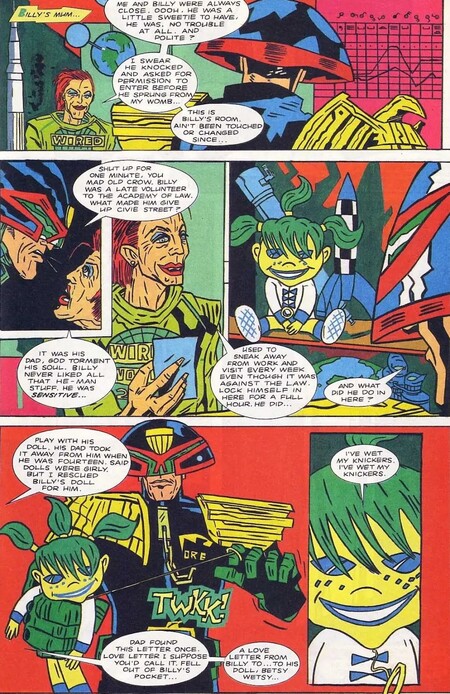
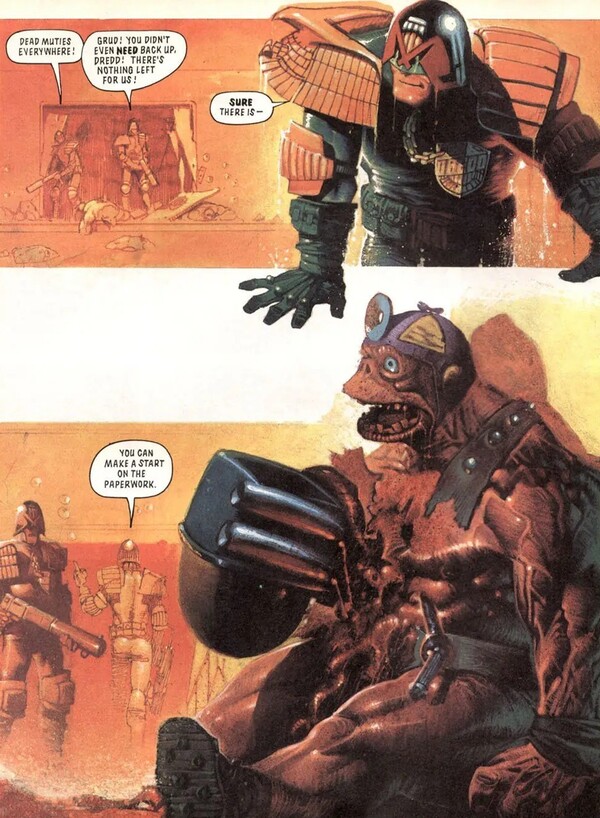
Left: Wagner, John; Mills, Pat. Judge Dredd: The Complete Case Files 02, 2006; Right: Wagner, John; Mills, Pat. Judge Dredd: The Complete Case Files 16, 2010
«Transmetropolis» begins before the manifesto. Many researchers classify it as post-cyberpunk. The central image of the comic is a grimy, futuristic megalopolis where the destruction of traditional morality and grotesque body modifications reign. However, the work is infused with a spirit of optimism, based on the unwavering strength of the protagonist’s character. His profession is also atypical for the genre—he is a journalist. The future challenges him, questioning whether he is ready to work for the characters' audience—characters assembled as if from typical cyberpunk—to prevent his country from turning into a real dystopia.
Warren Ellis & Darick Robertson, Rodney Ramos. Transmetropolitan, Issue #13, 1998
«Transmetro» Narrative
(1) Gonzo and Ethics
Warren Ellis & Darick Robertson, Rodney Ramos. Transmetropolitan, Issue #35, 2000
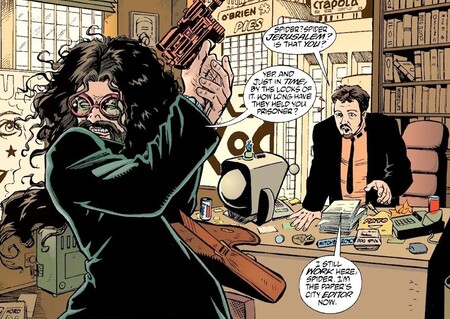
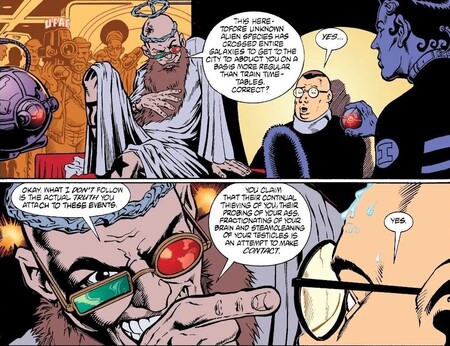
Left: Warren Ellis & Darick Robertson, Rodney Ramos. Transmetropolitan, Issue #1, 1997; Right: Warren Ellis & Darick Robertson, Rodney Ramos. Transmetropolitan, Issue #6, 1998
Gonzo translates to «intoxicated» or «high.» Gonzo reporting is characterized by a rejection of traditional journalistic objectivity. The narrative is told from the author’s perspective, honestly describing their emotions and opinions about the events unfolding.
The main protagonist of «Transmetropolis,» Spider Jerusalem, is directly based on the figure of Hunter S. Thompson, the «father» of gonzo journalism. They resemble each other in appearance and writing style—Spider acts as a narrator—and both abuse adrenaline for their work, ranging from stimulants and narcotics to physical conflict with the subjects of their stories. Spider is a man of words, a figure from an intellectual profession, yet he is fully capable of defending himself in the world of insane cyberpunk, which makes his perspective unique to the genre.
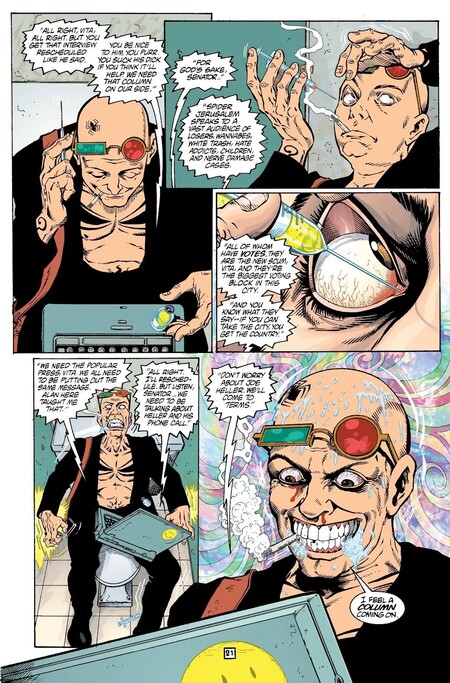
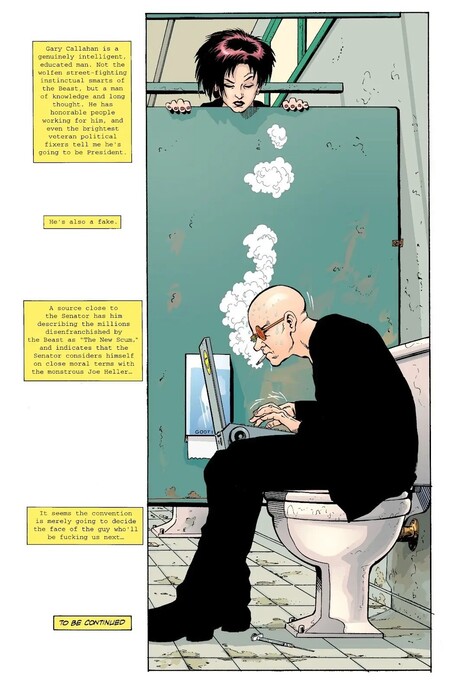
Warren Ellis & Darick Robertson, Rodney Ramos. Transmetropolitan, Issue #14, 1998
Much like Thompson, Spider spends time away from civilization—overwhelmed by the results of past elections and his fame. A contract with the publisher forces him to return and shed the guise of a overgrown paranoid for that of a bald reporter. Having resumed his work, he steadfastly adheres to the Gonzo principle—placing himself at the center of events. The first three issues clearly introduce the reader to Spider’s work and are dedicated to reporting on the suppression of a rebellious neighborhood in the city. The riot is depicted from extreme aerial angles, opening up a panoramic view of the events. Spider, typing text from a rooftop, occupies a central position in the process without participating in it directly. Despite this literal elevation, the story of the riot concludes with police revenge, brutally beating the journalist on the threshold of his home. While Spider writes the text, he shapes the narrative, but then he experiences it in physical reality. The comic immediately sets the rules of the game: here, the hero’s actions will have consequences.
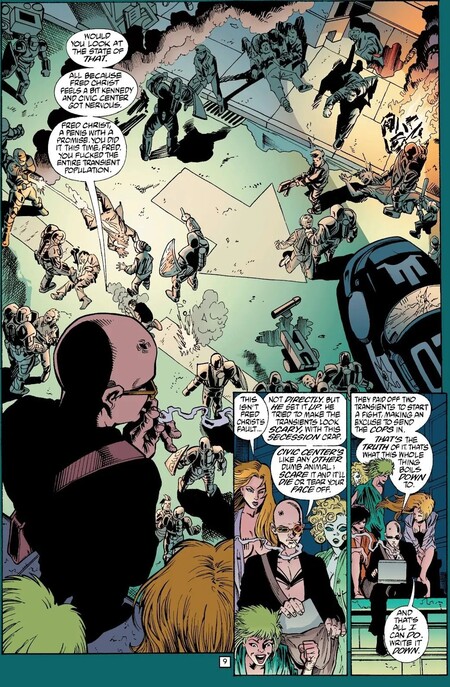
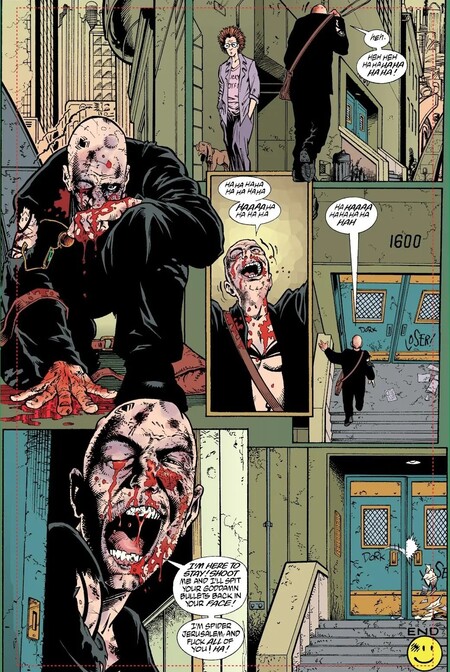
Warren Ellis & Darick Robertson, Rodney Ramos. Transmetropolitan, Issue #3, 1997
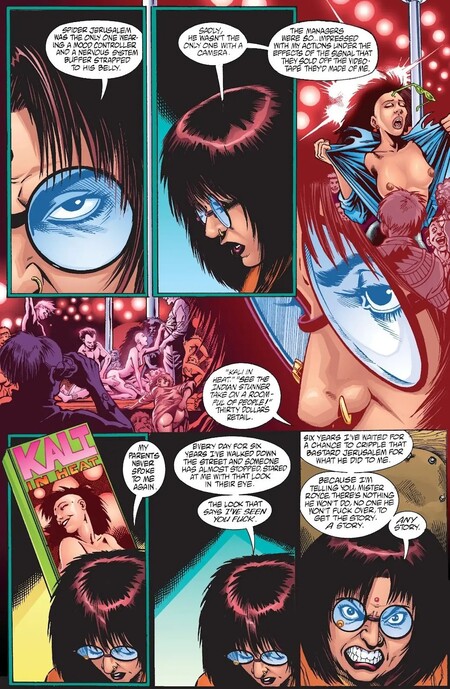
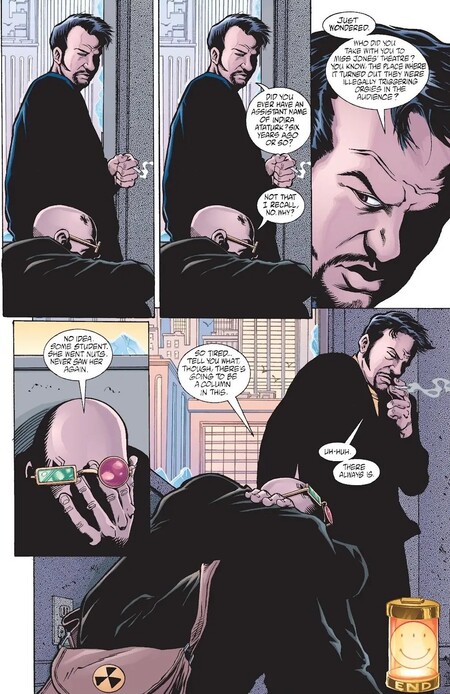
Warren Ellis & Darick Robertson, Rodney Ramos. Transmetropolitan, Issue #12, 1998
For the city, Spider is a fighter for truth, but this does not absolve him of the ethical problem associated with discarding classical journalistic rules. As one of the heroines says, he will do anything for the story. Once, he brought an assistant to a club where patrons were doused in pheromones. The journalist had prepared an antidote for himself, but not for his colleague, leading to the predictable outcome: the publication of pornographic video and a ruined life.
Along with the reader, Spider’s editor, Royce, learns about this. During his interaction with the journalist, he mentions the girl, but we never see Spider’s face, even though he frequently appears on screen. This is a visual association, as concealing one’s face is linked to shame or the refusal of shame and guilt. Spider has either forgotten this incident or failed to consider the consequences, much like in the case of the rebellion—only this time, it wasn’t him who was harmed. This is how the hero is before the election arc, which will force him to re-evaluate his work.
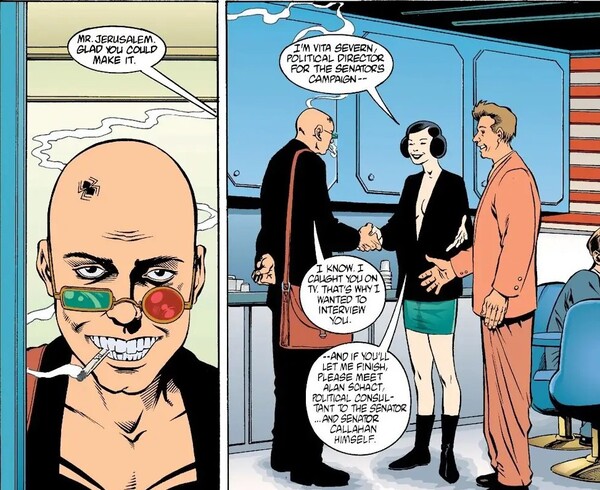
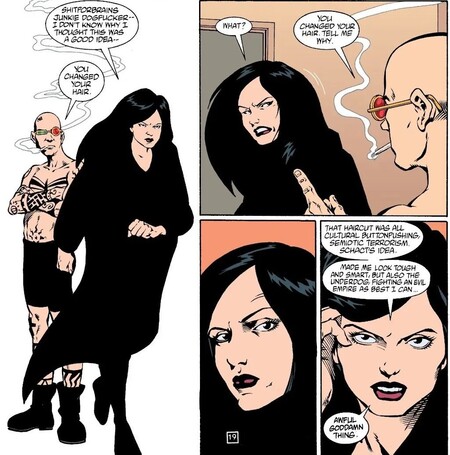
left: Warren Ellis & Darick Robertson, Rodney Ramos. Transmetropolitan, Issue #14, 1998; right: Warren Ellis & Darick Robertson, Rodney Ramos. Transmetropolitan, Issue #15, 1998
During the election race, Spider meets Vita Severn, the political director for a young and ambitious candidate. Initially, Vita sports a hairstyle that ironically references Princess Leia—a tactic designed to present her to voters as an intelligent woman deeply engaged in the fight for democracy. After the first meeting with Spider, Vita lets her hair down, a change he notices immediately.
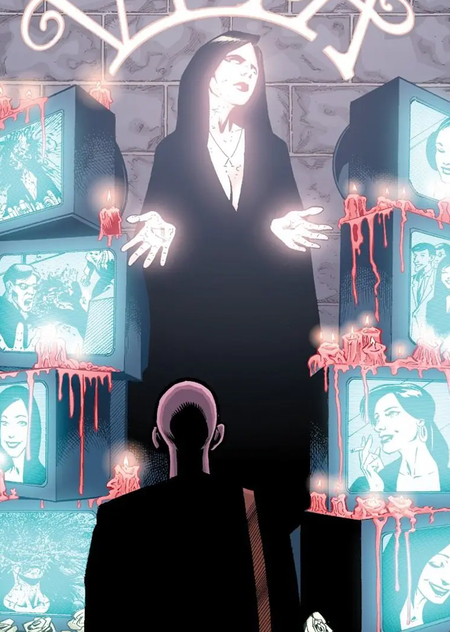
Spider easily connects with Vita despite her political convictions, largely because he is a gonzo journalist—he relies on instinct and does whatever he pleases. Through Vita, Spider gains access to the campaign headquarters of candidate Harry Callahan. His actions simultaneously undermine his rating while boosting Vita’s public reputation. This leads to horrific consequences—Vita is killed on live television, and for the first time, Spider feels the full moral weight of his involvement. The pages following Vita’s bloody death adopt an almost noir aesthetic, contrasting sharply with the vibrant colors of the previous installments. The frames sometimes mirror the shape of a tombstone, and at other times cascade down the page, as if the space itself is falling behind Spider’s spirit. We see him cry for the first time, and beside him, a cat hunts a lizard—an unmistakable metaphor for a journalist who has gotten entangled in high-stakes politics.
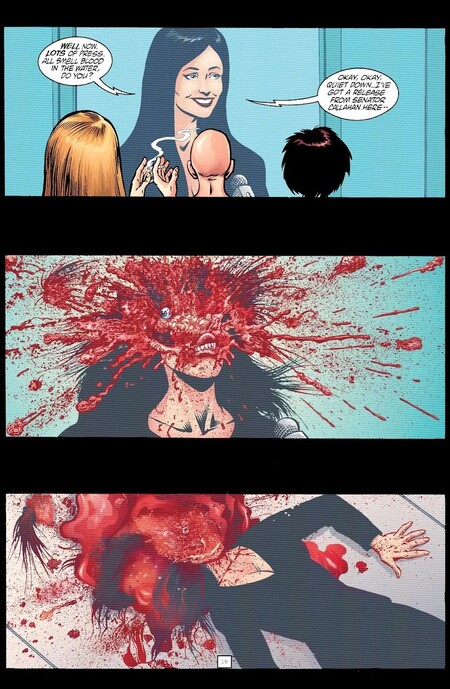
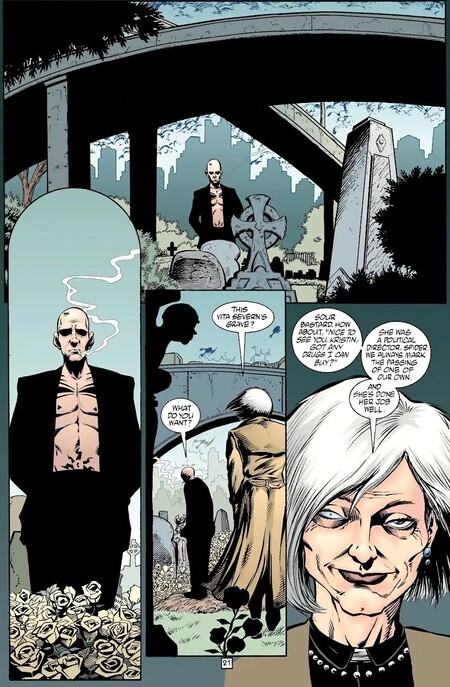
Warren Ellis & Darick Robertson, Rodney Ramos. Transmetropolitan, Issue #18, 1998