Navigation Menu
— Concept
— Sculpture: The Image of the Goddess Bastet
— Paintings: Role in the Afterlife
— Papyrus and Ostraca: Satire and Humor
— Conclusion
— Bibliography
? ¿? ¿? ¿? ¿? ¿? ¿? ¿? ¿? ¿? ¿? ¿? ¿? ¿? ¿? ¿? ¿? ¿? ¿?
Concept
Today, cats share a home with us, bringing joy and endearing charm simply by existing near us. But it wasn’t always like this. Decades ago, our ancestors depicted these animals not for sentimental remembrance, but by embedding sacred, social, and even mystical meanings within their image. What hidden significance did the ancient Egyptians place in the depiction of cats? And what cultural codes, understandable to people of the past, have we gradually lost amidst modern affection?
? ¿? ¿? ¿? ¿? ¿? ¿? ¿? ¿? ¿? ¿? ¿? ¿? ¿? ¿? ¿? ¿? ¿? ¿?
Sculptures: The Image of the Goddess Bastet
It is no secret that Ancient Egypt was the primary birthplace of all domesticated cats worldwide, as well as a center for their special reverence. However, to gain a truly complete understanding of the place these animals held in the Egyptian worldview, one must look to their art and culture.
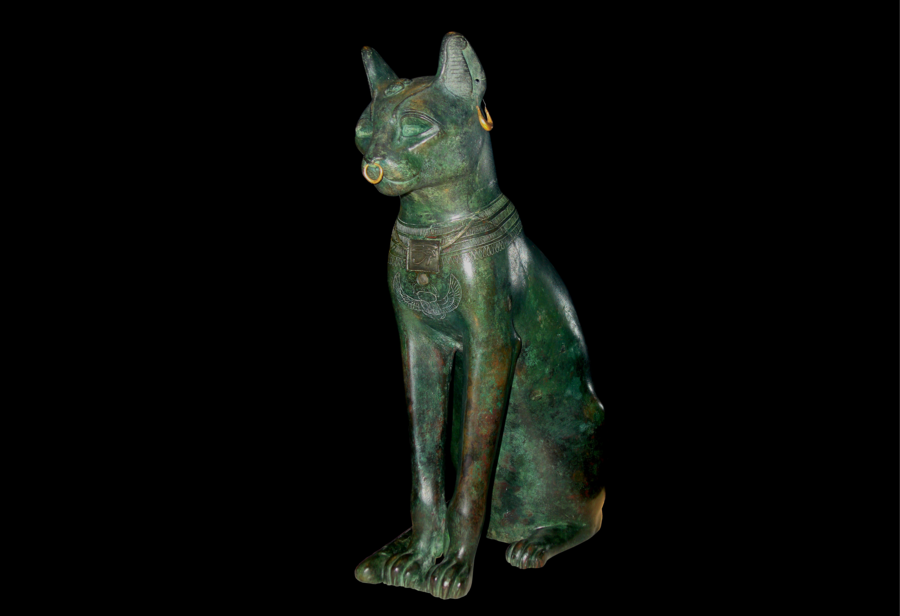
The first key exhibit is the figure of the «Gayer-Anderson Cat» (Late Ancient Egypt, 600 BCE), named after Major Robert Grenville Gayer-Anderson, who discovered it and later donated it to the British Museum in 1939. This statue embodies one form of the goddess Bastet—the patroness of joy, merriment, love, and feminine beauty, as well as fertility and the hearth—who was often depicted as a woman with a cat’s head, though entirely in animal form in votive sculpture.
Gazing at the elegance of this statue, one cannot help but notice the severity of the figure, captured in perfect symmetry and radiating regal grandeur. The status of the figurine and its patron can be discerned from the jewelery details—gold earrings in its ears, a nose ring, and a engraved breastplate featuring the protective eye of Wadjet. There are theories that this cat was discovered in a temple, as hundreds of divine figures were displayed in temples with the hope of communing with them.
<><><><><><><><><><><><><><><><><><>
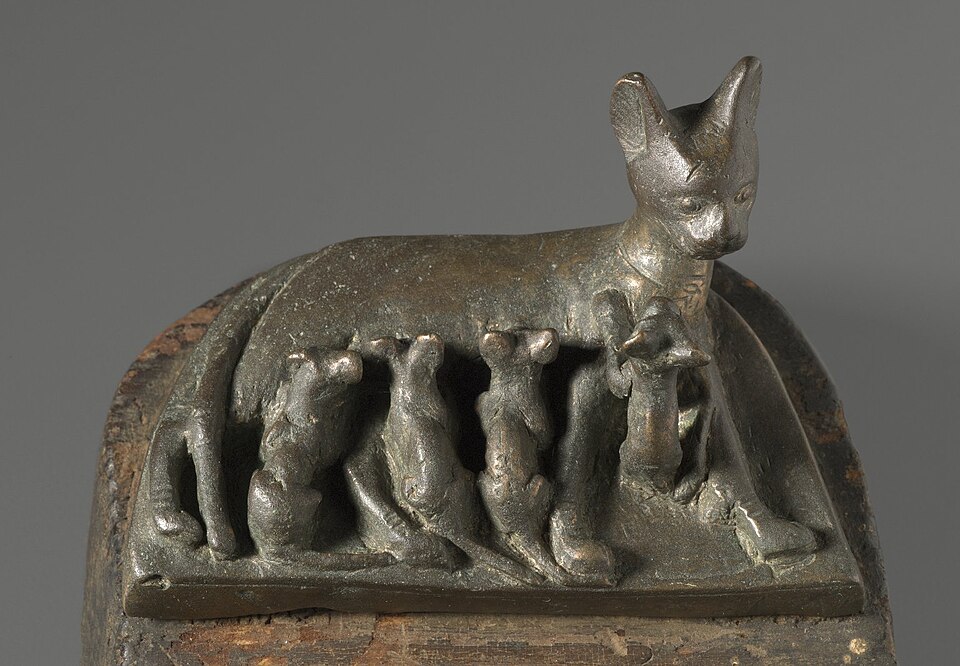
Continuing the theme of sculptures and depictions of the goddess Bastet, one cannot ignore the figure of the «Cat with Kittens.» Its creation period ranges from 664 to 30 BCE. Like the previous statuette, it is made of bronze, but it fundamentally differs in its artistic conception and intended meaning. While the «Gayer-Anderson Cat» impresses with its strict symmetry and regal appearance, this miniature composition captivates with an asymmetry rare in ancient Egyptian art and a vibrant, almost quotidian naturalism.
The mother cat, personifying Bastet, lies calmly on her side, surrounded by four kittens. Three of them are intently drinking milk, while the fourth climbs toward her neck, prompting the goddess to slightly lift her head. The only hints of her divine status here are a scratched necklace with a protective amulet on her chest and an inscribed prayer on the pedestal. The kittens symbolize Bastet’s fertility, and the act of nursing emphasizes her maternal and protective qualities, which extend not only to her offspring but to all the people of Egypt.
? ¿? ¿? ¿? ¿? ¿? ¿? ¿? ¿? ¿? ¿? ¿? ¿? ¿? ¿? ¿? ¿? ¿? ¿?
Murals: A Role in the Afterlife
In addition to sculptures, cats can also be found in ancient wall paintings, where they battle alongside inhabitants of Ancient Egypt.
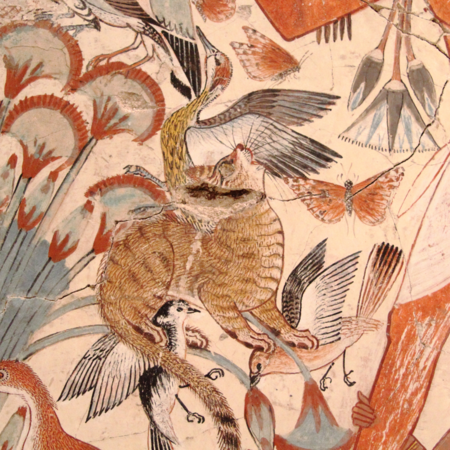
The most famous example is the painting, «Nebamon’s Hunt for Birds in the Swamps.» It is estimated to have been created around 1350 BCE. It depicts the hunting process: Nebamon stands in a small boat, holding a throwing weapon in one hand and clutching three birds with the other. Nearby, a ginger cat can be seen, also deeply engaged in the hunt. The cat seems frozen in mid-air: with its back paws, it strikes a bird trying to take flight; with its front paws, it pins down a second bird, and its mouth grips the wing of a departing comrade.
Paintings of this format were often found adorning small chapels and mausoleums, depicting the deceased owner leading a sweet and colorful life in the afterlife. Furthermore, some believe that the cats in these sketches symbolize the sun god Ra, hunting the enemies of light and order. The gilt eye of the cat clearly hints at its sacred meaning within this composition.
<><><><><><><><><><><><><><><><><><>
Another depiction of «The Cat Killing the Serpent Apophis» also deserves close attention. It has numerous variations, but the most high-quality and popular rendition comes from the «Book of the Dead.» It is estimated to have been written around 1300–1224 BCE.
This composition illustrates Perseus, a proud, emotionless ginger cat seated by a tree, holding a blade in one paw that slices a snake in half. Perseus serves as a symbol of the sun’s rebirth and the boundary between worlds; the cat sitting near him embodies the sun god Ra, while the dying serpent represents Apophis, symbolizing the forces of darkness and cosmic chaos.
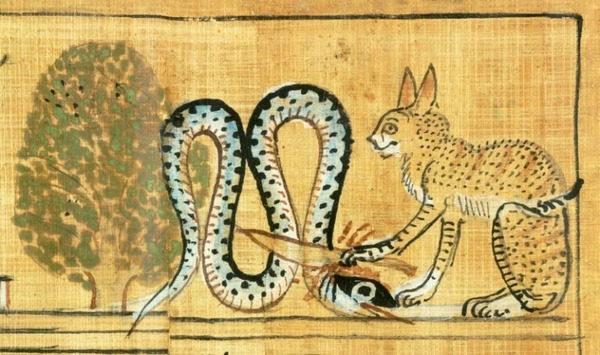
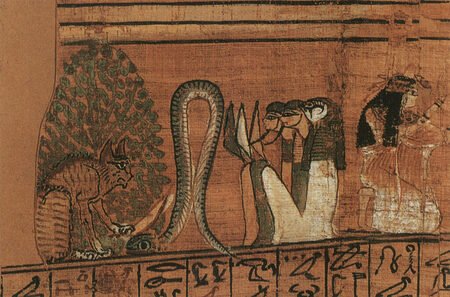
Comparing this painting to «Neumon’s Hunt for Birds in the Swamps, ” one can notice a clear transition from keen observation of everyday life to pure myth. In the former case, the cat participating in the hunt alludes to a deity merely through its coloration and material, executing wholly natural, vivid, and auxiliary actions. Here, however, the feline figure distinctly exhibits a human attribute and a calm composure amid the inevitable triumph over cosmic chaos.