Navigation
- Concept
- Hypothesis
- Attack and Outline Modification
- Repetition and Pause
- Rhythm of Multiple Layers
Concept
Rhythm as the audible cause of change
The same frame can appear as a random alteration of a drawing or as the result of a musical beat. This distinction is especially noticeable in abstract animation: a point, a line, or a three-dimensional object has no inherent voice or customary connection to an instrument sound. Sound can be perceived as the cause of a visible event when the boundary of a shape suddenly contracts, expands, or disappears at the moment of a distinct attack. Within the scope of this research, I am interested in how the capacity to give rhythm to a specific visual action has changed—from a drawn waveform on film to the mixing and frame-by-frame manipulation of a digital track.
Research Question
What properties of musical rhythm does animation convey through changes in form, and in what cases is mere temporal synchronization sufficient for the viewer?
[2] Hypothesis
Short accents are perceived through rapid contour shifts, while repetition and pauses become visible through the intervals between shape changes. When sound and image evolve according to a common principle, the connection can be maintained at the level of an entire phrase, even if individual events diverge.
The material was selected based on three criteria: the availability of a version with sound, the ability to isolate a segment for examination, and a source detailing the phonogram’s origin or its method of interaction with the image. Five works were included in the corpus. In Dots, the sound and image are projected onto film. In Begone Dull Care, a plastic drawing follows a jazz phonogram. In Synchromy, the optical phonogram becomes the image material. In Gantz Graf, an abstract digital object unfolds to an electronic track, while in Order from Chaos, rhythm emerges from a recording of rain. The last two works allow for a comparison between the specific alignment of sonic and visual accents and the similarity of more extended processes.
First, in each segment, I isolate what can be heard: a sharp onset of sound, a repeating pattern, rarefaction, the pause of a single layer, or the appearance of multiple sound parts. Then, I correlate these events with the series of frames and note the type of reaction: the appearance or disappearance of a contour, a change in proportion, division into parts, or reconfiguration of a group. Simple object movement and changes in scale due to the camera are accounted for separately. This allows me to distinguish actual deformation from other methods of drawing attention to something. The time stamps refer to a specific published copy.
[3] Attack and Contour Modification
A short sound provides the starting point. In adjacent frames, one can distinguish the appearance of an object, the deformation of its contour, and changes in scale.
Dots
Norman McLaren. Dots. 1940. Frame from the NFB version · 01:42,1
McLaren applied the image and sound directly to the film. Brief synthetic sounds allow us to test which visual events begin to be perceived as a strike: the appearance of a point, a change in size, or the sequential appearance of several markers. The mere presence of a common medium does not explain why each sound corresponds to a specific point.
Solo Attack
WHAT CAN BE HEARD
A short, synthetic click is audible. In this series, individual pulses occur approximately once per second.
HOW FORM EVOLVES
A small icon rapidly expands into a blue disc, then contracts. The change in scale is visible silently. The waveform highlights the brief moment of expansion as a transient.
Composite Impulse
WHAT CAN BE HEARD
Instead of a single, isolated click, a series of close pulses is heard.
HOW THE FORM EVOLVES
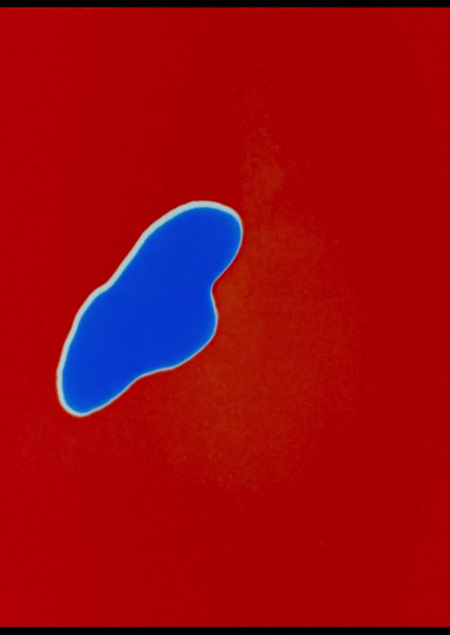
A multi-lobed form emerges on the red field, which then contracts. The appearance of a discrete point nearby adds a second visual event within the short group.
Increased Sonic Events