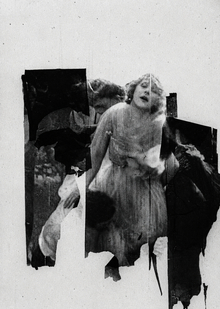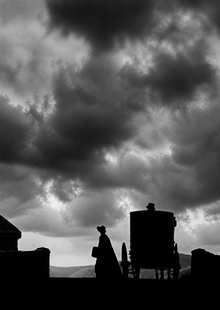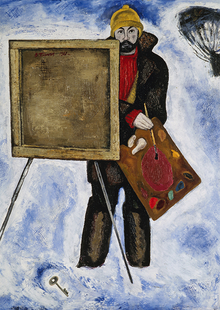
In The Republic, Plato describes art as imitation, a copy of the visible world rather than reality itself. At the same time, Plato’s philosophy grants a privileged status to ideal forms — perfect, timeless entities that exist beyond the material world. For centuries, Western art developed within this framework, treating artworks either as representations of reality or as attempts to approach ideal forms through representation.
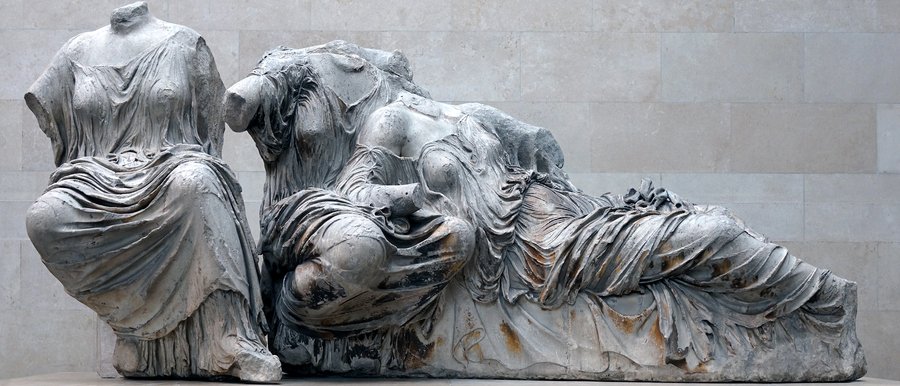
Pediments of the Parthenon, Phidias, 5th century BCE
The twentieth century witnessed a growing dissatisfaction with both assumptions. Artists increasingly questioned whether an artwork had to represent anything at all. One of the earliest and most influential challenges came from Marcel Duchamp’s ‘Fountain' (1917), which shifted attention away from representation and toward the status of the object itself. In his essay Minimal Art, Richard Wollheim later identified such developments as important precedents for the emergence of a new artistic sensibility concerned less with images than with objects [2, 4].
This tendency became particularly visible in postwar American art. While Abstract Expressionism rejected figurative representation in favor of gesture and emotion, artists such as Robert Rauschenberg began to challenge the distinction between image and object altogether. Works such as ‘Monogram' (1955–59) combined painting, sculpture, and found materials, making it increasingly difficult to classify them within traditional artistic categories [1, p. 809].
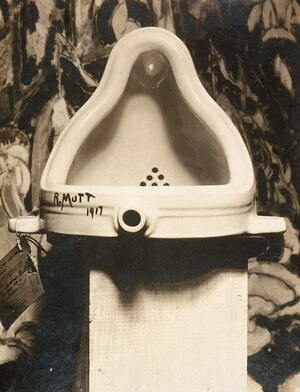
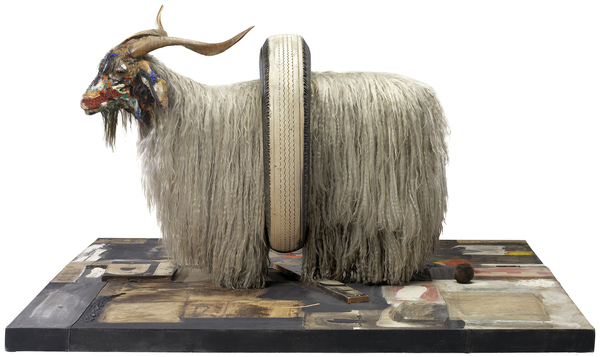
Fountain, Marcel Duchamp, 1917 | Monogram, Robert Rauschenberg, 1955-1959
These developments culminated in the emergence of a new artistic tendency during the 1960s. Critics and artists referred to it by several names, including 'Minimal Art, ' 'ABC Art, ' and 'Literalist Art.' Despite stylistic differences, minimalist works shared several characteristics: they employed simple geometric forms, avoided symbolism and narrative content, utilized industrial materials, and emphasized serial repetition, proportion, and spatial relationships [2].
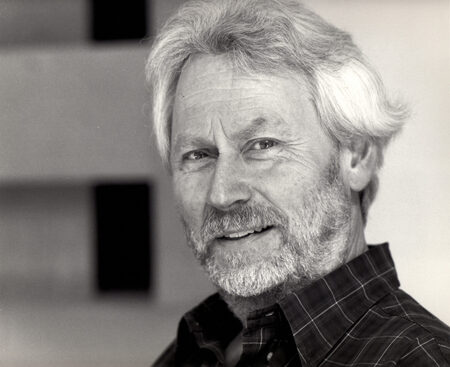
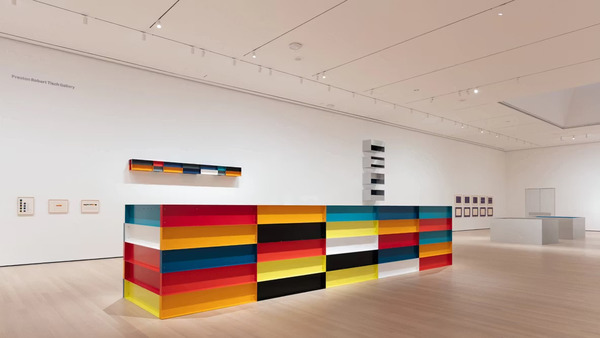
Donald Judd and exhibition of his works in MoMA, NYC
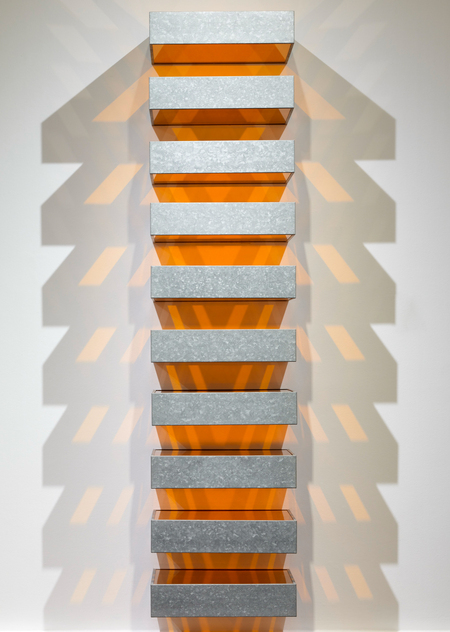
The most influential theorist of the movement was Donald Judd. In his 1965 essay Specific Objects, he argued that many significant contemporary works could no longer be classified as either painting or sculpture. As Judd famously wrote, 'Half or more of the best work in the last few years has been neither painting nor sculpture' [1, p. 809]. For Judd, the new art rejected the illusionism and pictorial space that had dominated European artistic traditions. Instead, it occupied real space and confronted the viewer as a physical presence. Judd’s own works, particularly his series of untitled wall-mounted stacks, exemplify these ideas. Consisting of repeated industrial units arranged at regular intervals, they emphasize materiality, proportion, and spatial perception rather than symbolism or expression. Similar concerns can be found in the work of Frank Stella, whose shaped canvases challenged the traditional separation between image and object. Judd frequently cited Stella as an important example of the new artistic direction [1, p. 809–813].

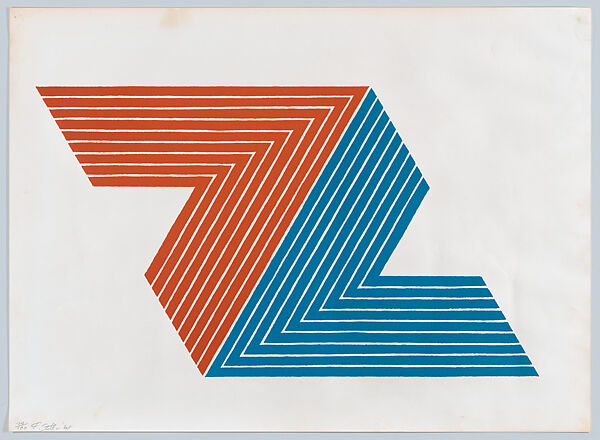
Frank Stella | Itata, 1968
Another major figure was Robert Morris, whose essays Notes on Sculpture (1966–67) expanded minimalist theory. While Judd focused primarily on the object itself, Morris emphasized the role of the viewer. According to Morris, the meaning of a work emerges through the viewer’s physical experience of scale, distance, and spatial relationships. Minimalist objects therefore cannot be understood independently of the bodies that encounter them. This attention to perception and embodied experience would become one of the movement’s most influential contributions [1, p. 813–822]. Other important artists included Dan Flavin, who created installations using commercially available fluorescent lights, and Carl Andre, whose floor-based sculptures transformed ordinary industrial materials into carefully structured spatial arrangements. Although their works differed significantly, all shared a commitment to reducing artistic form to its essential physical conditions. As a result, attention shifted away from craftsmanship and personal expression toward the structure of the object and its relationship to space [2].
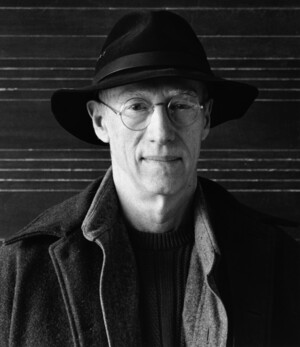
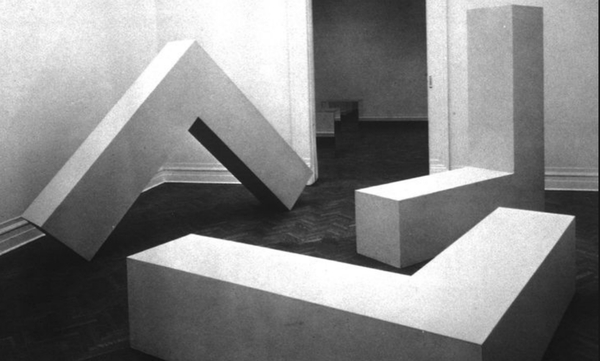
Robert Morris | Untitled (3 Ls), 1965
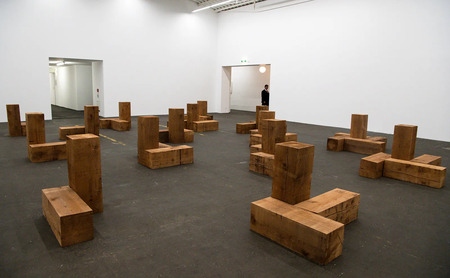
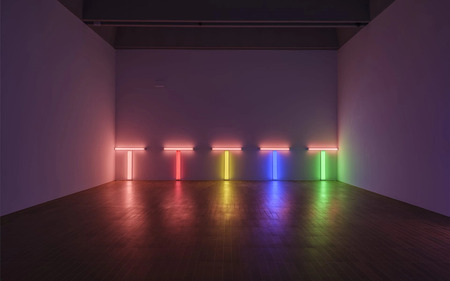
Uncarved Blocks, Carl Andre, 1975 | Untitled (to Don Judd, colorist), Dan Flavin, 1987
The movement was not without critics. The most famous critique came from art critic Michael Fried in his essay Art and Objecthood (1967). Fried argued that Minimalism was excessively ‘theatrica' because it depended upon the presence of a viewer and unfolded through time rather than offering an immediate aesthetic experience. Ironically, the qualities Fried criticized would later become central to installation art and other postmodern artistic practices [1, p. 822].
By the 1970s, Minimalism had ceased to exist as a unified movement, yet its influence continued to expand. Its emphasis on space, materiality, and direct experience shaped Conceptual Art, Installation Art, and Land Art. Robert Smithson’s Spiral Jetty (1970), for example, extended minimalist concerns into the landscape itself, transforming an entire environment into an artistic medium [2].
Spiral Jetty, Robert Smithson, 1970
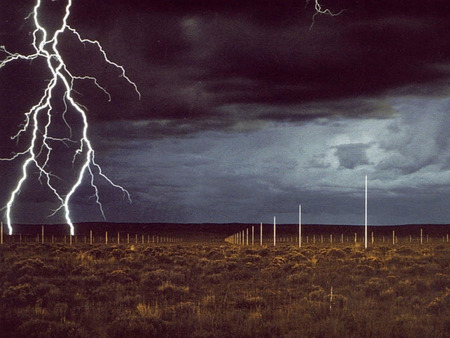
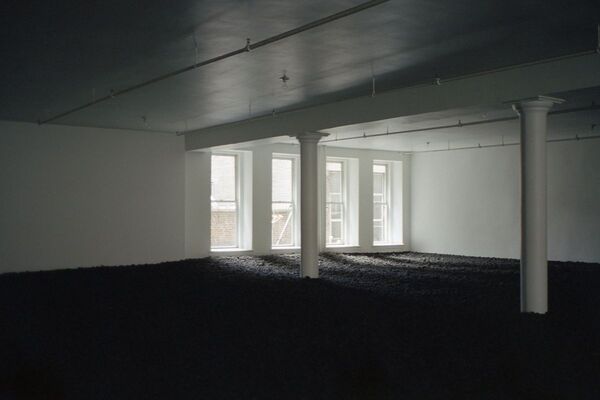
Lightning Field (1977) and New York’s Earth Room (1980) by Walter De Maria
Minimalism can be understood as one of the most radical attempts to abandon the representational logic that had shaped Western art for centuries. Rather than functioning as images, symbols, or metaphors, minimalist works presented themselves as physical objects occupying real space. Their significance emerged through the viewer’s direct experience of material, scale, proportion, and spatial relationships.
Well, I am extremely uninterested in Plato’s idea of form, pure form. I don’t think geometric art is…I don’t like to call it that. I don’t think it’s any more pure than pop art or anything else. It doesn’t have anything to do with purity. There’s a certain type of quality involved that can’t be gotten any other way.
Art in Theory 1900–1990: an anthology of changing ideas / ed. by C. Harrison, P. Wood. — Oxford; Cambridge: Blackwell Publishers, 1999. — 1239 p. — ISBN 0-631-16575-4.
Marzona D. Minimal Art / D. Marzona. — Köln: Taschen, 2006. — 96 p.
Oral history interview with Donald Judd, 1965 February 3 [Электронный ресурс] / Interviewed by B. Rose. — Режим доступа: https://www.aaa.si.edu/collections/interviews/oral-history-interview-donald-judd-11621 (дата обращения: 07.06.2026).
Wollheim R. Minimal Art / R. Wollheim // Arts Magazine. — 1965. — Vol. 39, Iss. 4. — Jan.
Untitled / Donald Judd // Buffalo AKG Art Museum. URL: https://buffaloakg.org/artworks/19724-untitled (дата обращения: 08.06.2026).
Pediments of the Parthenon // Smarthistory. URL: https://smarthistory.org/artist/phidias/ (дата обращения: 08.06.2026).
Fountain / Marcel Duchamp // Wikipedia. URL: https://en.wikipedia.org/wiki/Fountain_(Duchamp) (дата обращения: 08.06.2026).
Monogram / Robert Rauschenberg // Moderna Museet. URL: https://www.modernamuseet.se/en/stockholm/the-collection/research/previous-research-projects/robert-rauschenberg/ (дата обращения: 08.06.2026).
Фотография Donald Judd // Judd Foundation. URL: https://juddfoundation.org/donald-judd/biography/ (дата обращения: 08.06.2026).
Donald Judd’s exhibition in MoMA // Museum of Modern Art. URL: https://www.moma.org/artists/2948-donald-judd (дата обращения: 08.06.2026).
Фотография Frank Stella // The New York Times. URL: https://www.nytimes.com/2024/05/04/arts/frank-stella-dead.html (дата обращения: 08.06.2026).
Itata // The Metropolitan Museum of Art. URL: https://www.metmuseum.org/art/collection/search/736636 (дата обращения: 08.06.2026).
Фотография Robert Morris // Sotheby’s. URL: https://www.sothebys.com/en/articles/the-dexterity-and-complexity-of-robert-morris (дата обращения: 08.06.2026).
Untitled (3 L-Beams) / Robert Morris // Smarthistory. URL: https://smarthistory.org/robert-morris-untitled-l-beams/ (дата обращения: 08.06.2026).
Untitled (to Don Judd, Colorist) / Dan Flavin // Galerie Magazine. URL: https://galeriemagazine.com/dan-flavin-pivotal-works/ (дата обращения: 08.06.2026).
Uncarved Blocks / Carl Andre // Encyclopaedia Britannica. URL: https://www.britannica.com/biography/Carl-Andre (дата обращения: 08.06.2026).
Spiral Jetty / Robert Smithson // Smarthistory. URL: https://smarthistory.org/spiral-jetty-robert-smithson/ (дата обращения: 08.06.2026).
Lightning Field / Walter De Maria // The Independent. URL: https://www.independent.co.uk/news/obituaries/walter-de-maria-artist-who-forsook-a-career-with-the-velvet-underground-to-create-electric-enigmatic-installations-8764340.html (дата обращения: 08.06.2026).
New York Earth Room / Walter De Maria // Artsper Magazine. URL: https://blog.artsper.com/en/get-inspired/art-exhibitions/walter-de-maria-new-york-earth-room/ (дата обращения: 08.06.2026).