12.12 | Tuesday
Military-Revolutionary Tribunal
Day, No. 219 The Bulatov Case The Bulatov case has been scheduled for a session of the Military-Revolutionary Tribunal on December 12th. Lieutenant Bulatov had been serving as the Bolshevik commissar for the former Petrograd City Administration. He carried out raids on mansions, specifically the Balashova mansion, where he plundered all property and appropriated all cash. This same Bulatov also raided clubs, extorting specific fees. Yesterday, Lieutenant Bulatov fled the Peter and Paul Fortress, leaving a note that read: «To my judges. I am leaving the fortress. I am running to the front. I kiss everyone and wish you all the best.» Emergency measures have been taken to locate Bulatov. However, he has not yet been found. Nevertheless, the Bulatov case will be heard today…
Dismissal of the Sumenson Case Incidentally, the investigative commission recently dismissed the Sumenson case, which had previously been arrested along with Kozlovsky on charges of high treason. Ms. Sumenson is currently an active staff member of the Special Investigative Commission working with Kozlovsky.
The Junkers Case In the Purishkevich conspiracy case, in addition to three hundred junkers, the Duke of Leuchtenberg is also implicated. He is allegedly involved with Purishkevich in organizing the junker uprising in Petrograd.
Other Cases The last case to be heard in the upcoming session is the case of the Ministry of Public Education’s curriculum committee. Thirty-six inspectors and directors, led by the district trustee, are being held accountable for sabotage. A series of cases has been brought forward to combat speculation, as well as against clubs and blackmailers.
The Tragedy of Officer Corps As of December 1st, the Russian army has no officer corps. All positions, starting with regimental commander, are elected. Currently, re-elections of the command staff are taking place in most regiments. Most officers have been left out by the soldiers—meaning they have not received any rank and, according to the decree of the People’s Commissars, are forced to remain in the same unit as enlisted men, receiving five rubles a month’s pay and eating from the communal pot. …What will become of the officer corps, which, thanks to the commissars' decree, has been stripped of the meager salaries that existed in the forces? The decree has annihilated the word «officer» and all ranks, from private to general…
New Life, No. 199 Daily News • The leftists will receive seven portfolios in the Council of People’s Commissars. • Bolshevik troops are concentrating in Moscow to fight against the Rada and Kaledin… • The newly opened Mejlis in Orenburg recognized that a state should be formed within the federal Russian republic’s states: «Volga Region — Southern Urals,» comprising the Ufa, Kazan, Orenburg, and other provinces.
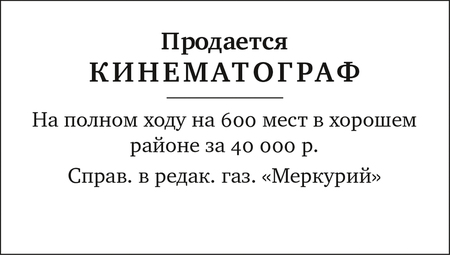
Theatre Gazette, No. 50 Screen We receive letters from Oryol: Every day we see incredible tails. For example, recently near one of the electric theaters, you could see a crowd eager to get into that electric theater to see the American film: «The Mask That Laughs.» However, not everyone managed to get in. Then, the unsuccessful people vented their frustration on the glass doors and display windows with photos of «Miniatures”—both were smashed by the surging crowd. Something from ancient Rome: „Bread!“ in the morning, and „spectacles!“ in the evening.
12/14 | Thursday
Civil War
Kornilov in Novocherkassk According to reports from Voronezh, General Kornilov is in Novocherkassk and is actively participating in the work of the military government.
New Life, No. 201
…In Novocherkassk, there is intense preparation for the meeting of Bolshevik troops advancing from the Caucasus… Reports from Voronezh: Fighting has resumed between Red Guards and Cossacks in the Taganrog District…
Day, No. 221 N. Evening Report (From our special correspondent). A delegation from the circle of united Cossacks and peasants visited the headquarters of the punitive detachment at the «Zorinovka» station; at a joint meeting, it was resolved to establish a prolonged truce, set up a neutral zone prohibiting the passage of armed forces from both sides, and send soldiers and Cossacks to Lenin with an inquiry regarding the motives for dispatching the punitive expedition. …The regiment’s delegates arrived at the circle; a shocking scene unfolded. The delegates stated: we don’t know why we were traveling; we were told that Kornilov was plundering and devastating the Don, and we arrived—we see Cossacks standing there, we ask why, and they reply: we are defending our native land from Bolshevik bandits! The circle explained the entire situation in the Don to the delegates and pointed to the defense of the Cossacks' right to self-determination and the convocation of the Constituent Assembly. The delegates renounced bloodshed and took seats in the front rows of the circle; this provoked enthusiastic applause—the delegation is departing for Lenin in a few days…Shkapskaya
New Petrograd Gazette, No. 10 A Free Dispatch from Riga An officer who arrived from the northern front reports that German goods are abundantly available in the Baltic provinces. The German imports currently in circulation include dishes, textiles, and footwear. Trade with the Germans is conducted through Riga, which allows entry not only to inhabitants from areas of the Baltics not yet occupied by Germans but also to our soldiers. «We maintain an automobile connection with Riga…» the officer explains. «Of course, it is difficult to buy anything with Russian money, but commodity exchange is thriving.» Currently, nothing is being shipped from the Baltic estates to Petrograd—no milk, no butter, no cheese. This is because all these products are flowing to Riga, from where they go to Germany. For 3–4 pounds of butter, which amounts to 25–30 rubles in our money, you can obtain better boots. To our regret, there are individuals on the front who are transporting flour to Riga for sale. Flour is especially prized by the Germans. One must wonder how soldiers carry flour to the Germans while the Russians are starving and lack flour themselves… …Some bankers, who received permission from Smolny to travel to the city occupied by the Germans to settle financial matters, have also decided to maintain contact with Riga. For instance, two representatives of the Petrograd-Riga Commercial Bank are traveling to Riga in the coming days… The bankers will travel by train to the Valk station, from where, after verification of their travel documents by our military authorities for passage into enemy territory, they will be driven to Riga by car. The representatives of the Riga bank plan to return in about a week.B-ov
Day, No. 221 In the State Bank Work at the State Bank cannot get organized, and the further things go, the greater the chaos becomes. To work in the departments, officials are brought in under escort… Each department has a special commissar appointed, so there are very many «superiors.» The appointed commissars have no understanding of banking work. The current account, transfers, exchange, and savings windows «function»… Entry into the bank is allowed from 10:30 AM to 11:30 AM. Every morning at the start of the admission, a massive queue forms at the bank fence gate, stretching along the Ekaterininsky Canal, turning onto the Gostiny Dvor Bank Line, and reaching the Perinna Line. Inside the bank, there is a crush and a press. After enduring the long wait, the client receives an entry pass only for the next day. But due to the abundance of applicants, it is not always possible to get in with this pass even the next day. Private individuals are only issued 500 rubles once a week for checks and transfers.
The «Freedom Loan» is being completely boycotted by the officials of the State Bank… One woman, who held capital worth several tens of thousands of rubles in the bank—part of which was invested in «Freedom Loan» securities—wished to pay income tax, which required her to sell some of these securities. The Commissioner stated: «We have continuously preached at rallies not to buy the 'Freedom Loan.' We cannot buy them.» Then the woman asked what she should do with the securities. «You can cover your walls with them, ” the Commissioner replied.
On December 13, a meeting was held again with the newly recruited State Bank employees… New rates were established: 850 rubles per month for the department commissioner, 350–400 rubles for the clerks, and 300 rubles for the lower-ranking employees.
12/15 | Friday
Day, No. 222 «Nationalization» of Banks Yesterday, a decree was adopted at the meeting of the Central Executive Committee, with the regional, city, and district departments. Banking business is declared a state monopoly. All private joint-stock banks and banking houses are merged with the State Bank. The second decree states that all money stored in the steel vaults of the banks must be deposited into the client’s current account at the State Bank. Gold in coins and ingots is confiscated. Vault owners must appear at the bank with the keys to be present during the vault inspection… If they fail to appear, the steel vaults will be opened by order of the investigative commission, and all found property will be confiscated. However, the investigative commission may postpone the liquidation of the vaults in justifiable cases. Incidentally, the first decree stipulates that the temporary management of private banks will be entrusted to the board of the State Bank. The interests of small depositors—as stated in the decree—will be upheld.
News of the Day A German delegation, consisting of Rear Admiral Gr. Kaiserling and two officers, arrived in Petrograd. The head of the delegation stated that he had come to personally survey the state of affairs in Petrograd.
Germans in Petrograd
Distinguished Foreigners …A representative from Germany, who came for a personal viewing, does not lose his brazen self-confidence. Warmly and ceremoniously received by the Bolsheviks, he blackmails Russian society with assurances that Germany is ready to fight indefinitely. With a candor worthy of imitation by the Bolsheviks, he lays out Germany’s hopes concerning a separate peace with Russia—a Russia that, he states frankly, Germany is no longer «afraid» of. Was Trotsky’s motivation for having the German delegation here something other than these declarations, something to lend weight to the necessity of a German peace?
Mr. Kaiserling on the Bolsheviks …When your emperor was deposed, we Germans remained indifferent. We decided not to interfere in Russia’s internal affairs, especially since my government believed the Russian Revolution would accelerate the approach of peace. Now, with the Bolsheviks in power, we can count on achieving peace through joint efforts… We knew that Russia found itself in a difficult situation. …Only one circumstance is unclear to us: what the Bolsheviks desire, what their actual program is, and how they plan to end the civil war…
German Goods Those who arrived from Minsk report that German goods have appeared in abundance in the city recently at prices that existed before the war. Pencils, ink pens, envelopes, patented German medicines, and so on, can be bought in any quantity. Especially abundant are the Primus-style kerosene stoves, which are being sold for 6 rubles each, while just a few days ago their price was 40 rubles.
12/16 | Saturday
New Life, No. 203 Dual Authority in Turkestan Peace has not settled over Turkestan following the bloody October days… The authority in Turkestan, having transferred to the Bolshevik Council after the defeat of Gen. Korovichenko and the surrender of the cadets and Cossacks, did not achieve widespread recognition; its formation proceeded slowly… This regional government, named the Council of People’s Commissars of the Turkestan Krai, consisted of 15 individuals and was modeled after the People’s Commissars in Petrograd… …The native Muslim population, above all, did not recognize the Commissars… Then, on November 26–28, a regional Muslim congress was held in Kokand, which decreed the autonomy of Turkestan. According to the resolutions of this congress, the Turkestan Constituent Assembly was to be convened in the near future… Until the Constituent Assembly is convened, a Council is established, consisting of 54 members, of which 36 seats belong to Muslims and 18 seats are allocated to be elected from the European population… And undoubtedly, a conflict must arise between the two authorities, which will harm both the local population and the interests of the entire country… And currently, Turkestan is not calm. The food issue has become extremely acute; the population is starving… Chinese troops are advancing toward Turkestan from the east, while within, there is a dual power structure and terror. Recently, Gen. Korovichenko, who was arrested after the November uprising, was killed in prison…
Day, No. 223 Daily News At a meeting of Russian and German delegates in Petrograd, the issue of lifting the blockade in the White Sea was fundamentally resolved. Bessarabia has been declared the Moldovan Republic, which is a part of the Russian Federative Republic… The council of teacher delegates announced a general teachers' strike until the day of the opening of the Constituent Assembly.
The Delegation in the Capital …The Germans, residing in the Russian capital, consider themselves the masters of the situation. One of the German officers boldly told members of the press that if they were «bourgeois, ” they dared not bother the German delegation… Russian domestic staff at the „Bristol“ hotel are literally terrorized by German orders. The entire hotel is furnished in a German style, according to the directives of the delegates themselves. Shouts are constantly directed at the Russian staff for the slightest disorder or discourtesy.
The Second Delegation At night, the second German delegation arrived by an express train, headed by Count Mirbach, a former advisor to the Austrian embassy in Petrograd. This delegation includes representatives from Austria, Bulgaria, Turkey, and Germany… Part of this delegation will be housed in the „Bristol“ hotel, and part in the „European“ hotel… …The delegation will meet at the Ministry of Foreign Affairs. Discussions, based on the Treaty of Brest-Litovsk, will cover issues such as the exchange of prisoners of war, the resumption of trade relations between Russia and the Central Powers, and so forth. Trotsky himself will preside over this session…
Two Styles
Each subject has its own performer among the Bolsheviks. When the role requires handling the pen of Leopold Bauer, this is performed masterfully by Comrade Ioffe. Without hesitation, the People’s Commissar states, «Your Highness, ” „be so kind as to complete, ” and so on. There is no trace of grandiosity in the delegates' address to the high representatives of the German-Turkish governments. The clients from Smolny behave modestly…
But look at the proud language of the commissars when they speak to the allies! What lionhearted courage, what uncompromising nobility, what purity of national dignity! For example, look at the words People’s Commissar Zhugashvili-Stalin addresses to the French imperialists: «Soon the allies will have to realize that Russia is not Central Africa»… Zhugashvili-Stalin will show the allies!.. He will not allow any harm to state independence; he will not permit the dishonor of Russia to be mocked; he will stop foreign missions in time, who have forgotten that the Russian people are not savage natives to be trifled with. And what, precisely, can Zhugashvili-Stalin «show» the allies?..V. K.
12/17 | Sunday
New Petrograd Gazette, No. 13 Why Are the Austro-Germans Coming to Petrograd? …According to informed sources, the Austro-German delegation hopes to press the Council of People’s Commissars to immediately arrange the export of foodstuffs from Russia. In exchange, the Austro-Germans promise to deliver their manufactured goods to Petrograd and Moscow in the very near future… However, there is reason to believe that, besides these reasons, the Austro-German delegation has other objectives. If the matter were solely about restoring trade relations with Germany, a delegation of 10–15 people would have been sufficient. So far, about 200 Germans, Austrians, Bulgarians, and Turks have arrived in Petrograd, most of whom are staff and line officers. In addition to those who have arrived… the coming days are expected to see the arrival of several more German and Austrian officers.
Decrease in Commodity Prices Due to rumors of the impending resumption of trade relations with Germany, a sharp drop in prices for many goods has been observed. A large quantity of manufactured, haberdashery, and footwear items, priced significantly lower than previous rates, has appeared in stores…
Bolsheviks in Banks
The rumors that circulated this morning regarding the payout of savings to small and medium depositors, of course, proved unfounded. However, the majority of banks were packed with crowds this morning, people awaiting the resumption of operations at the credit institutions and the disbursement of either the entire deposit amount or, at the very least, a significant portion of it.