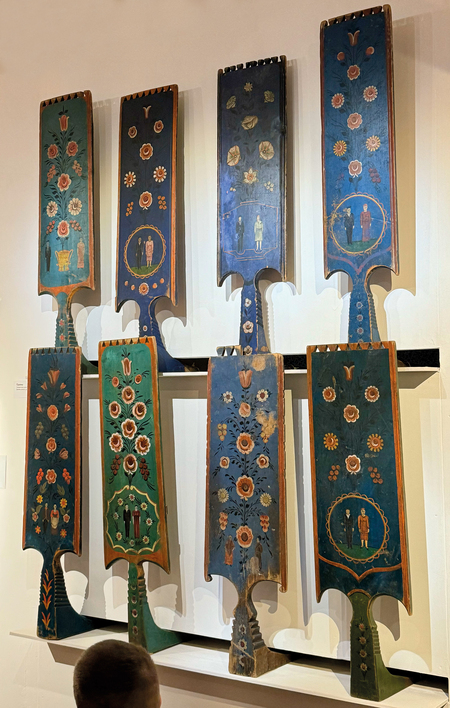
Visual research on the use of traditional Kargopol painting to decorate 18th-century homes and its application in contemporary interior and urban design.
The project’s goal is to preserve the cultural tradition of adorning the spaces surrounding people’s lives using free-hand Kargopol painting.
- Kargopol Painting Kargopol painting emerged in the 18th century in northwestern Russia. Its technical foundation is the free brushstroke, accented with white «vines» (lines). Its subjects primarily include everyday objects: spinning wheels, chests, partitions, icons, church interior items and utensils, among others. The main motif is floral painting. Artisans create compositions of varying complexity featuring multi-petaled flowers painted in a polychromatic palette with numerous light highlights, detailed with dot outlines, often set against a favored green background. Occasionally, the floral designs are supplemented with images of animals, birds, or people. Frequently, the paintings are accompanied by inscriptions indicating the date and the owner’s name.
Imagine this: What might an Empress have seen while visiting Kargopol in the 18th century? Breathtaking wooden churches and temples in the northern style, dense coniferous forests, the Onega River, peasants and gentry in formal attire—we can vividly picture all of this. Our gaze would also fall upon the interior decoration of the churches and even the peasant homes. The churches feature rich wooden iconostases painted with oil by skilled artists, while the wooden furniture in the peasant homes—cupboards, chests, spinning wheels—is also painted with oil, but by the homeowner themselves. It is these simple paintings that we will be studying in our visual research.
Project Concept
Kargopol free-hand painting is one of the significant elements of the city of Kargopol. It is important to study and preserve this art form in new artistic works. To do this, it is necessary to conduct historical research on Kargopol painting and study the materials most commonly used for artistic execution. Create concepts for new small-scale architectural forms where the beauty of Kargopol painting can be showcased. Demonstrate your ability to apply this painting style to contemporary art objects.
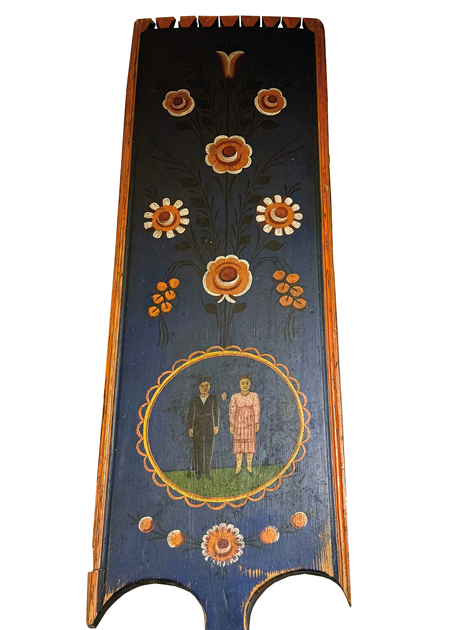
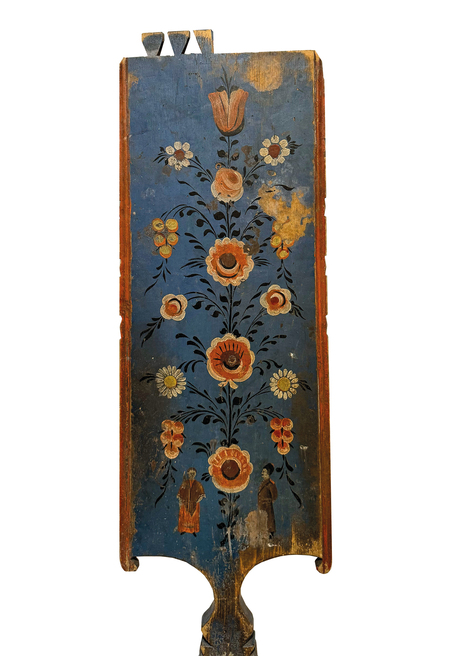
Spinning wheels with Kargopol freehand brush painting
During my trip to Kargopol, I had the opportunity to observe many of the cultural characteristics of the North. The cultural code of Kargopol is found in its materials: wood, oil paint, and clay. I was particularly struck by the use of the traditional Kargopol folk painting technique. The primary colors used in the painting are red, blue, black, white, and green.
The historically formed cultural-geographic concepts of Ponezhye and Kargopolye refer to the lands along the Onega River and around Lake Onega—territories that once fell within the sphere of trade, industry, and cultural influence of the town of Kargopol. This area borders Karelia. The city itself, mentioned in chronicles as early as the 12th century, was for a long time an important economic, political, and trading center in northwestern Russia. In the settlements, interesting techniques for constructing religious and residential architecture, along with their customs and rituals, are still preserved, which attests to the existence of a distinct local culture. The residential houses in this part of the region are architecturally diverse, which can be attributed to the presence of various ethnic groups (Karelians, Finns, Veps, Russians), each possessing its own traditions and building culture. In these regions, facade and interior house painting became widely practiced, techniques that have survived to the present day.
Trunk Painting
In the 18th century, a distinct stylistic direction emerged in the folk paintings of northwestern Russia. Their technical foundation is the free brushstroke, supplemented by white «highlights» (lines). The highly relaxed execution, the unique compositional freedom, and the vibrancy of the color palette—all combined with virtuosic technique—constitute important stylistic features of this art form. Artistic workshops exerted a significant influence on its development, where they produced illuminated manuscripts, icons, painted furniture, household items, and decorative pictures.
Spinning Dyeing
The surviving monuments allow us to establish a stylistic continuity between this picturesque school of the 18th and early 19th centuries and the folk house paintings found in many regions of the Russian North from a later period. This influence is particularly evident in the floral ornaments featuring the rose motif, which became very widespread in the North. The bright, multi-colored palette of Novgorod painters, their adherence to pure local tones, and the techniques of free brushwork developed in Novgorod’s vegetal ornamentation formed the foundation of a later artistic tradition.
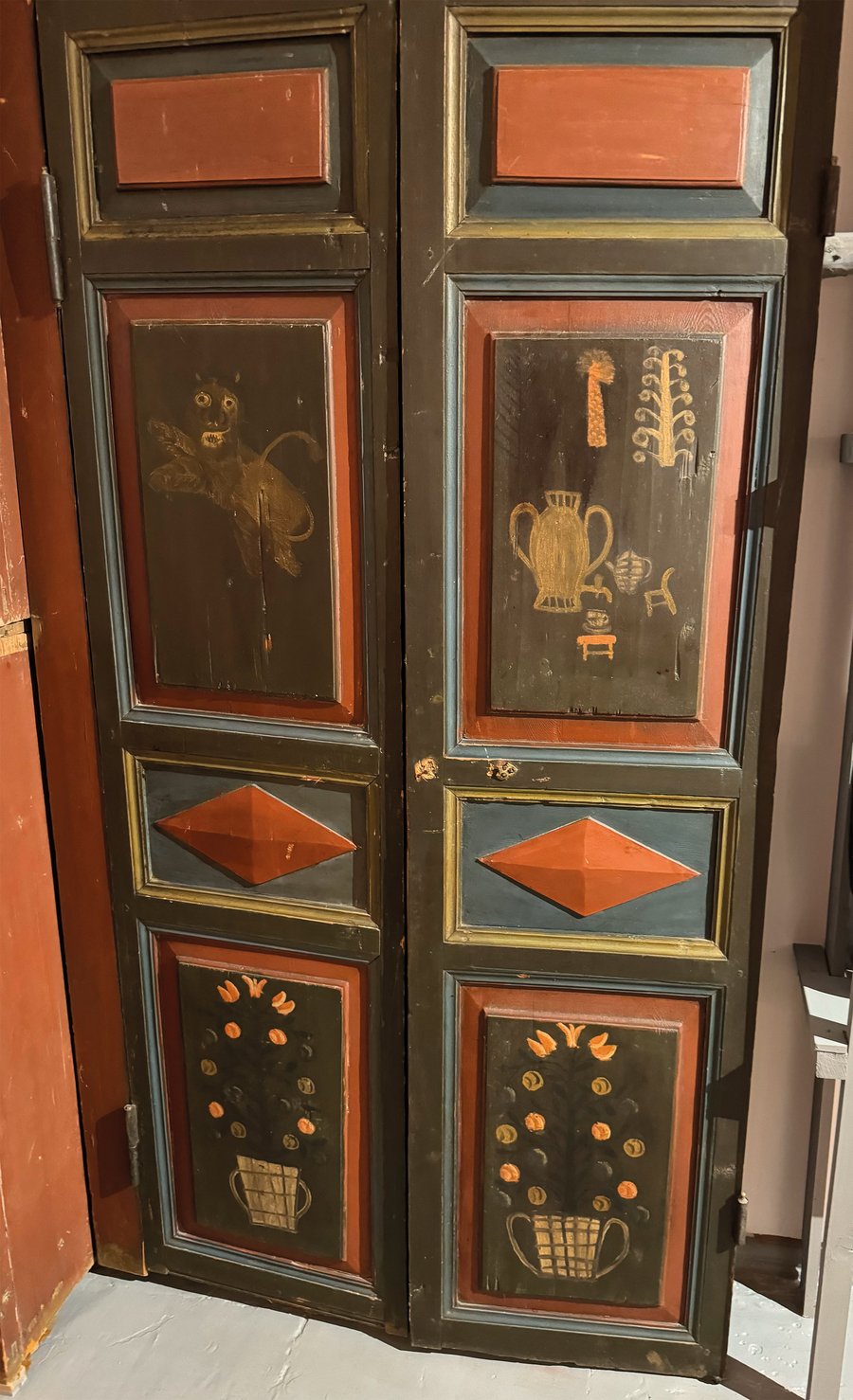
Door Painting
Often, this influence was the most direct. It has been documented that Mikhey Abramov, a resident of the Zaozerye region, studied painting under the «Danilov Elder» and later passed on his skill to his son, Ivan Abramov, who began working with his father at age 12. In addition to household items and tools of labor, the Abramov father and son painted churches and chapels, and created icons.
Sleigh Painting
Other peasant artisans also decorated spinning wheels and tubs, bows, and sleighs with paintings, and painted houses. Peasant artists worked not only at home but also traveled through villages to find commissions. For instance, the Tarakanov brothers and the Semyanin artists from Maly Konev decorated houses and spinning wheels in Kenozerye and other locations. A favorite ornamental motif in the paintings is the bouquet in the form of a shrub, an elongated or curved branch, or a complex floral composition, often growing from a «vase» (the symbol of the «tree of life»). The bouquets were composed of lily-tulips, frontally unfurled rosette flowers, apple spheres, and flowers resembling roses. Among the flowers and long, curved leaves, birds were often depicted—white, red, black, and blue. Apple-like roses, rosettes resembling rosehip flowers, might be intertwined with delicate interlacing of twigs, tendrils, and scrolls. Images of lions were frequently incorporated into the compositions. Motifs of the lion and the grape vine, situated next to the lush floral painting of a balcony, can be found on the pediments of a number of preserved houses. The depiction of grapes symbolized the prosperity and wealth of the home, while the image of the lion performed protective functions.
Lion Painting

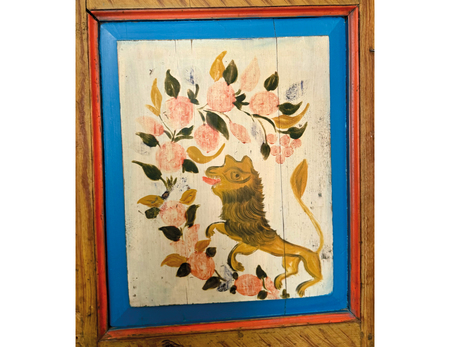
Lions, Kargopol Painting
However, it should be emphasized that peasant paintings sometimes displayed the national characteristics of different local populations. This once again suggests that the stylistic similarity—and in some cases, the commonality—between Russian, Karelian, and Finnish peasant wood paintings is explained by the interaction of cultures and artistic traditions.
Spinning Wheel Painting
Spinning decoration
Kargopol Painting in a Contemporary Interpretation
Inspired by preserved examples of Kargopol freehand painting, I managed to create several sketches for future works. To ensure the greatest correspondence with the historical painting samples, a wooden base and oil paints of primary colors were used as materials.
Sketch, freehand brush painting
In the past, people used freehand brush painting to decorate and protect dwellings, as well as to convey information about the owners of objects or homes. Portraits of the owners and their initials might have been painted on items. What might the logos of the Kargopol Museum and HSE look like rendered in the style of wood painting?
To create the painting based on the Kargopol Museum logo, a wooden base and oil paints were used. Dark green is employed as the background, while red and light green are used to depict the flowers, and white is used for the highlights characteristic of Kargopol painting.