
1. Media Concept
«AI for Everyday Life» is a Telegram channel dedicated to exploring which routine tasks can be delegated to artificial intelligence and how to learn how to use it quickly. The media’s goal is to help people understand exactly what they can delegate to AI in their daily lives, and to teach them how to use it not just for the sake of technology, but to gain more time, convenience, and opportunity for themselves.
2. Half-Yearmatic Curriculum Plan
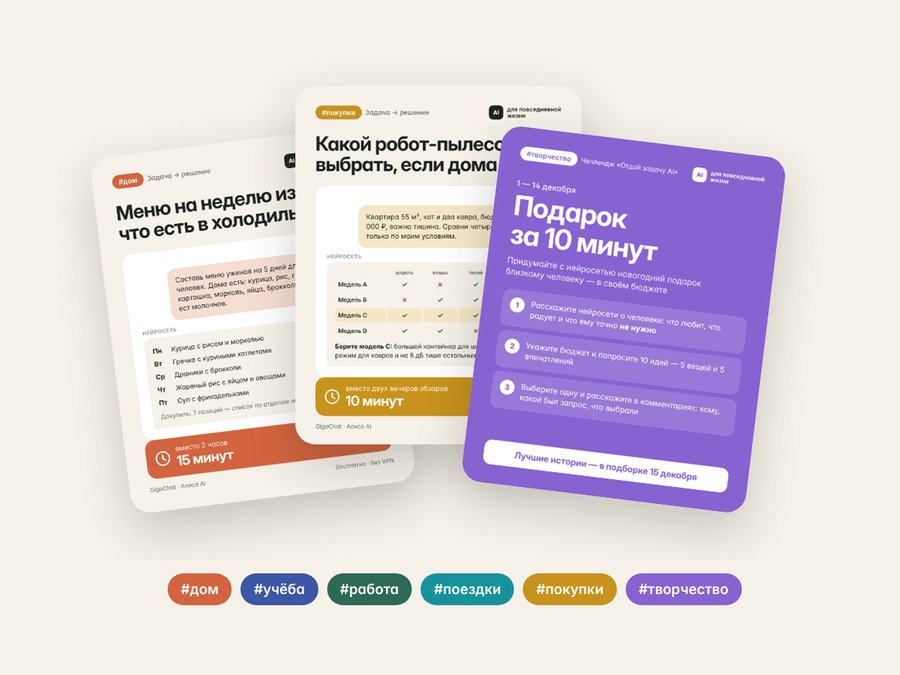
The plan is set for November 2026 — April 2027. Each month is built around seasonal challenges that the audience is currently facing: exams, holidays, gifts, country house trips, and travel. This way, the scenarios align with real-world needs, and participants immediately put them into practice.We publish about six pieces of content each week: three «Problem → Solution» posts, one «First Step» carousel, one «Before / After» video, and one «You Asked» breakdown. Every two weeks, there is an «Give the Task to AI» challenge. Over six months, this amounts to about 150 posts and 12 challenges. All posts are duplicated on VKontakte.The channel is divided into thematic sections using tags, which help readers navigate the published media more easily and quickly find the task they need. Each tag is assigned a specific color that corresponds to the post’s design aesthetic.
November — «Introduction: What Can We Even Give to AI»
December — «Stress-Free New Year»
Since the channel is new, in the first month of its launch, we will aim to warm up and engage the audience. The goal for this month is to demystify neural networks and demonstrate their utility in the most frequent daily tasks.
— Week 1: Navigation Guide, «First Step: How to Ask Your First Question to an AI, ” a selection of free AI assistants that do not require a VPN. — Week 2: #Home — weekly meal planning based on what’s in the fridge, grocery lists, and cleaning schedules. — Week 3: #Work — drafting emails you dread writing, summarizing long documents, and structuring presentations; launching the bot. — Week 4: #Shopping — selecting appliances for the late November sales and comparing models based on specific criteria. — Challenges: „First Prompt“ (send a screenshot of your first dialogue with an AI), and „Dinner from What You Have.“
December is the month of the busiest domestic tasks: gifts, holiday meals, corporate events, deadlines, and preparing for winter sessions. This is the prime month for audience growth—useful scenarios are most actively shared with friends.
— Week 1: #Creativity — gifts based on interests and budget, card messages you feel comfortable signing — Week 2: #Studying — session preparation plans, flashcards for memorization, «explain a topic like you’re in fifth grade» — Week 3: #Home — a New Year’s dinner for six people, including budget and cooking timing, a children’s celebration, a family evening script — Week 4: #Trips — a winter break itinerary, packing list, what to do with kids during long weekends — Challenges: «Gift in 10 Minutes, ” „New Year’s Menu Within Budget“
January — «Semester and Yearly Plans»
After the holidays, the focus shifts to organization: setting new goals, reviewing holiday spending, and for all students outside of HSE, tackling their first semester of the year.
— Week 1 (Break): Light-hearted formats—weekend activity ideas, and the best December scenarios chosen by subscribers. — Week 2: #Studying—a practice exam with AI, lecture notes/cheat sheet, and foreign language practice. — Week 3: #Shopping—analyzing December expenditures and creating a simple monthly budget. — Week 4: #Career—setting year-long goals without self-deception, weekly planning, resumes, and cover letters. — Challenges: «Pass your semester with AI» (preparation plan report) and «One Goal for the Year.»
February — «Motivations and Habits»
New semester: February 14th and 23rd—let’s establish a routine. A month of scenarios for relationships and regular tasks.
- Week 1: #academics—Semester schedule and deadlines in one plan, course assignment theme
- Week 2: #creativity—February 14th evening scenario, a handmade gift, a poem to celebrate
- Week 3: #shopping—Budget-friendly gifts for colleagues and loved ones for February 23rd
- Week 4: #home—Daily routine and home workouts tailored to your schedule (with a note that AI does not replace a physician)
Challenges: «The Compliment That Touched, ” „21 Days with an AI Plan“
March — «Spring Refresh»
March 8th, Maslenitsa (March 8–14, 2027), spring cleaning, and paperwork. A month dedicated to «getting organized"—in the home, the closet, and with documents.— 1st Week: #Creativity — Gifts and greetings for March 8th for mothers, colleagues, and teachers — 2nd Week: #Home — Pancakes from what you have, family Maslenitsa with the kids — 3rd Week: #Home — Spring cleaning plan by room, decluttering, what to sell, and how to write an advertisement — 4th Week: #Work — How to handle tax deductions, understanding utility bills, writing a formal letter — Challenges: «One Room Over the Weekend,» «Pancakes with a Secret»
April — «Dacha, May Holidays, and Wrap-Up»
The start of the gardening season and planning for the May holidays. At the end of the month, the channel summarizes the first half of the year and asks the audience which areas they want to develop further.— Week 1: #garden — a calendar planting plan for the dacha, seedlings on the windowsill, shopping list for the season — Week 2: #trips — a route for the May holidays across Russia with a budget, comparison of accommodation options — Week 3: #shopping — interior renovation and updates: cost estimate, mood board, materials list — Week 4: half-year review — top 10 saving scenarios, subscriber stories, survey on new features — Challenges: «My Garden Plan», «May Evening Getaway»
3. 10 Content Samples
The examples showcase all the channel’s topics and the six spheres of life. Formats: a post with a card, a seven-slide carousel, and a vertical video with a script and storyboard. Each post is targeted at one of four audience segments. The tools used in the examples—Alice AI, GigaChat, and DeepSeek—all have free versions and operate in Russia without a VPN.
Example 1. Sticky Post-Navigator
Format: text + image. For all segments.Hello! This is «AI for Everyday Life.»Here, we show you what everyday tasks you can assign to a neural network—and how to do it in 5–15 minutes. Each post features one real-life task and a complete solution: which service to use, what to write, and what the result will be. You can copy the prompt with a single click. All services work in Russia without a VPN, and every task has a free option.To find what you need, click on a hashtag: — #home — food, cleaning, household chores, family — #studies — exams, notes, languages — #work — emails, documents, presentations — #trips — routes, budget, packing — #shopping — product selection and comparison — #creativity — gifts, holidays, DIYIs this your first time using an AI? Start with the #first_step section. Can’t find a task that fits? Write it in our bot using your own words (link in the channel description), and it will send you relevant scenarios. And if there are no scenarios yet—we will break down your task in the «You Asked» section.
Example 2. «Problem → Solution»: a weekly menu based on what’s in the refrigerator
Format: text + card. Segment: parents.The task: every Sunday is spent spending two hours planning the weekly menu and creating a shopping list. Yet, half the groceries in the fridge still go to waste.Tool: GigaChat or Alice AI — free, no VPN needed.Prompt (copy and customize): «Create a 5-day dinner menu for a family of four: two adults and children aged 6 and 10. We have at home: 1 kg of chicken, rice, buckwheat, potatoes, carrots, onions, eggs, frozen broccoli. The younger child does not eat dairy. Cooking time should not exceed 40 minutes. At the end, provide a list of items to buy, categorized by store section.»What happened: the neural network put together five dinners using what was already at home. Monday was chicken with rice and carrots, Tuesday was buckwheat with chicken cutlets, Wednesday was potato pancakes with broccoli, Thursday was fried rice with egg and vegetables, and Friday was dumpling soup. We only needed to buy seven items, and the list was immediately broken down by store sections: vegetables, bread, dry goods.Time: instead of 2 hours—it took 15 minutes, including clarifications.Where the AI errs: the neural network might «forget» the constraint and add cheese or milk to one of the recipes. Check each recipe, and if necessary, write: «Replace dairy on Wednesday.» The quantities provided by the AI are approximate.Tip: Save this prompt to «Favorites» and only change the list of groceries every Sunday.
#home
task_solutionExample 3. «Problem → Solution»: A 10-Minute Exam Prep Plan
Format: text + card. Segment: students.Task: I have 12 days until the microeconomics exam, there are 30 questions on the list, and I work on the weekends. I don’t know where to start, and every evening I spend deciding what to study that day.Tool: DeepSeek — free, no VPN required, and I can attach a file with the list of questions.Prompt: «I am a student, and my microeconomics exam is in 12 days. The file contains 30 questions. During the week, I have 2 hours per day; on Saturday and Sunday, I have 1 hour each. Create a daily plan: which questions to study and when to review them. Start with the difficult topics, then move to the easier ones. The last two days should be for final review.»Result: A 12-day plan, with 3–4 questions assigned to each day. Difficult topics—such as elasticity, market structures, and costs—are scheduled for weekdays when there is more time. The weekends are reserved for reviewing previously covered material. Days 11 and 12 are left for a practice exam.Bonus prompt for a difficult topic: «Explain the topic ‘demand elasticity’ as if I were 12 years old, using a real-life example. Then, ask me 3 quiz questions and wait for my answers.»Time: Instead of spending an entire evening planning, it now takes only 10 minutes.Where the AI makes mistakes: The neural network doesn’t know which topics are difficult specifically for you—so rearrange the days yourself. Verify definitions and formulas with your lectures; the exam will be based on the professor’s version.
#studying
task_solutionExample 4. «Problem $\rightarrow$ Solution»: A weekend getaway to Nizhny Novgorod planned in half an hour