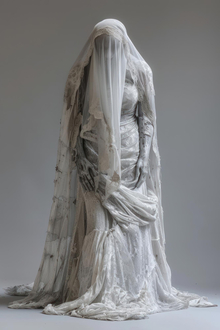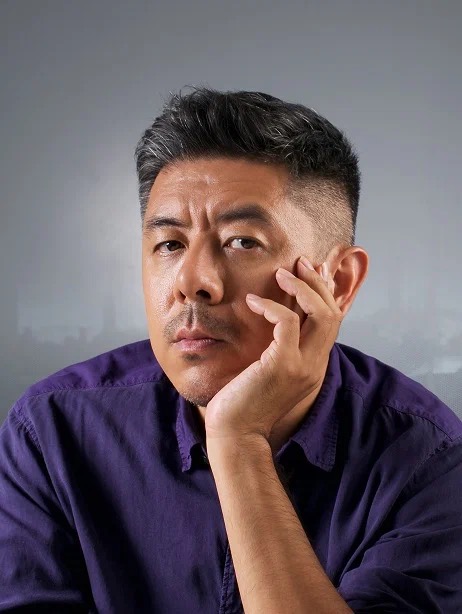
When Ma Yansun was less than thirty, he proposed building the «Floating Island”—a horizontal city suspended in the air—atop the ruins of the World Trade Center. The project, like dozens of others conceived after September 11, remained only on paper.
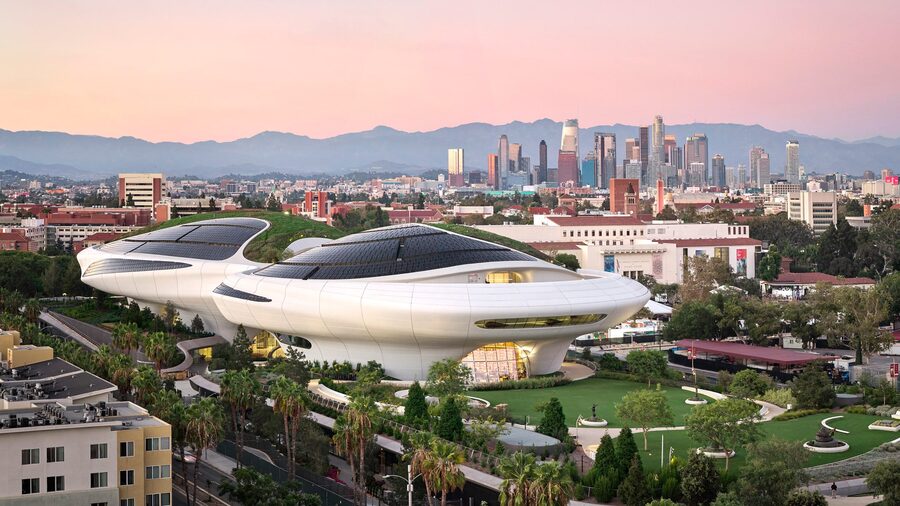
Twenty-four years later, he finally lifted the building off the ground, and in America: on Tuesday, September 22nd, the George Lucas Narrative Art Museum opens in Los Angeles, which Ma positioned on consoles so that it appears to float.
The Empire Strikes Back
The road to this Tuesday spanned almost twenty years and three cities. First, they wanted to place the museum in San Francisco, in Presidio Park—but the location was denied. Then came Chicago: Ma designed a mountain-like building for the shores of Lake Michigan, but the waterfront defenders sued, and in 2016, Lucas threw in the towel. The third attempt was the Exposition Park in Los Angeles. Lucas changed the cities, but he did not change the architect.
Who is Ma Yan Sun
Ma was born in Beijing in 1975. He studied architecture in Beijing and at Yale University, worked for Zaha Hadid, and founded MAD Architects in 2004. He gained significant recognition following the «Floating Island» project—long before any of his completed works. His first major project was the Absolute Towers, two residential skyscrapers in Toronto. They are twisted so that each floor is rotated relative to the one before it, and locals immediately nicknamed them «Marilyn Monroe» because of the distinctive curve. Later, he designed the white opera house in Harbin, which looks as if it were sculpted by the wind from a snowdrift, and residential complexes in Beijing.
Ma has his own theory, beautifully titled «Shanshui City.» Shanshui, meaning «mountains and waters, ” is the name in China for the genre of landscape painting. The idea is simple: the metropolis must evoke in people the same feeling as nature—mountains, water, shadow. This explains the main characteristic of his buildings: a right angle is a rare visitor.
What’s Inside?
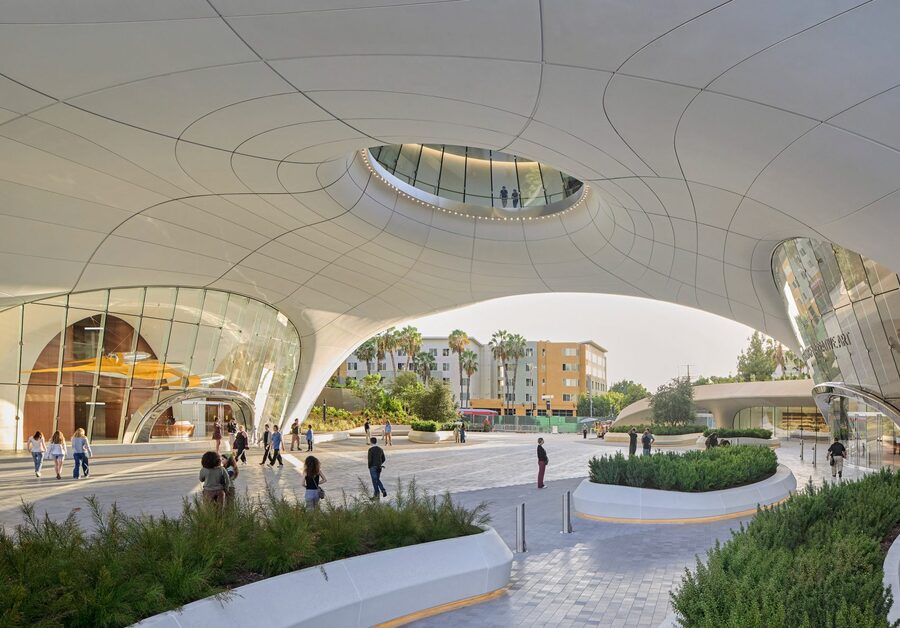
The museum occupies a site spanning about 4.5 hectares. It consists of five stories and covers approximately 28,000 square meters, featuring a facade made up of fifteen hundred individually curved fiberglass panels. The cantilevers—sections of the building supported at only one end—jut out so far that the museum appears to float in the air. The roof is planted with trees and topped with solar panels, while a fountain on the edge helps to cool the building. Visitors enter through a covered courtyard with an oval skylight. The surrounding landscape was designed by Mia Lerer from Studio-MLA: meadows, valleys, foothills, and canyons—California in miniature.
Ma wanted the building to serve as a canopy, a sprawling tree under which people could gather, without drawing undue attention to itself. The collection is the main focus here. Lucas and his wife, financier Melody Hobson, gathered narrative art—the kind that tells stories. The ceiling of the Sistine Chapel? A precise replica. Trajan’s Column and the Aztec Sun Stone are also here. Next to these are drawings by Robert Crumb, the king of American underground comics, paintings by Norman Rockwell, who spent nearly fifty years illustrating scenes from small American towns for magazine covers, and the model of the «Thousand Year Falcon,» Han Solo’s ship. Lucas is convinced that storytelling in art began with cave paintings, so Michelangelo and the smuggler Han Solo reside under the same roof.
At the opening reception on September 19th, Max said that over the years of knowing him, he had understood one thing about Lucas: he loves taking on the impossible and bringing it into reality.