Concept
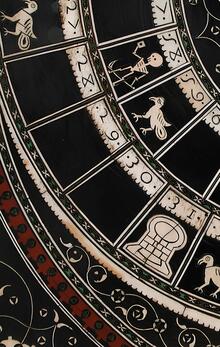
Ornament is one of the most ancient examples of artistic culture. It fundamentally reveals the spirituality and traditions of people from different historical periods, much like icons or folk art do. Ornament is a complex pattern found on everyday objects, architecture, clothing, and the human body. Its distinguishing features include rhythmicity, alternation, and repetition of motifs—often symmetry and geometrization.
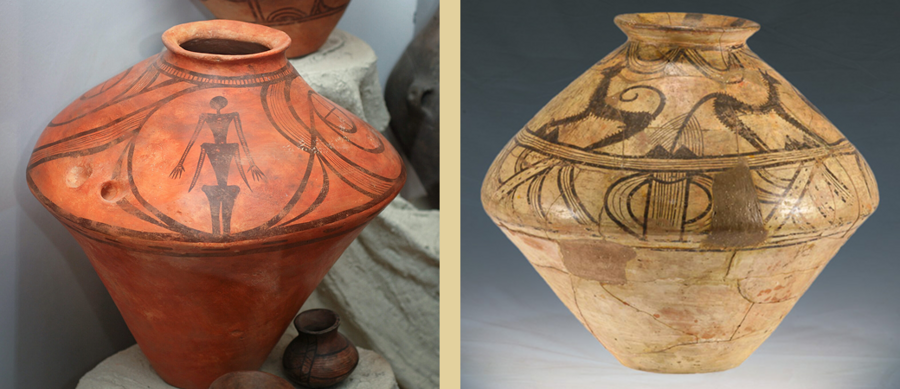

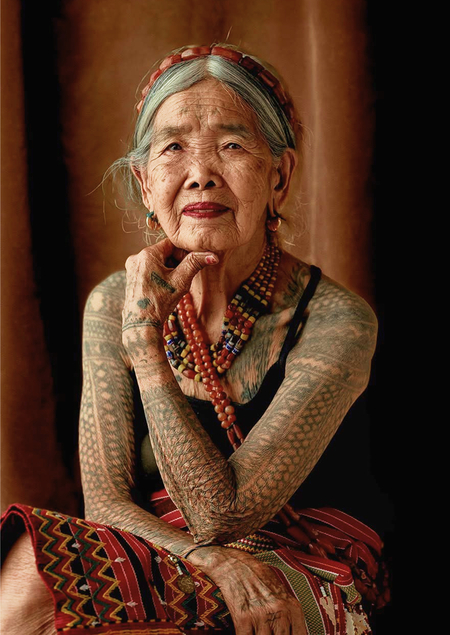
The research will examine the relationship between the human body and ornamentation, using tattooing as a case study. The process of cultural self-identification can be manifested through the use of ornaments featuring anthropomorphic symbols and images of fantastical creatures that combine
The Genesis of Tattooing
The history of tattooing dates back to ancient times. Historical and archaeological evidence suggests that tattoos existed across the globe. However, studying the most ancient examples is difficult because they are preserved on skin only under specific climatic conditions, and their meanings cannot always be fully restored.
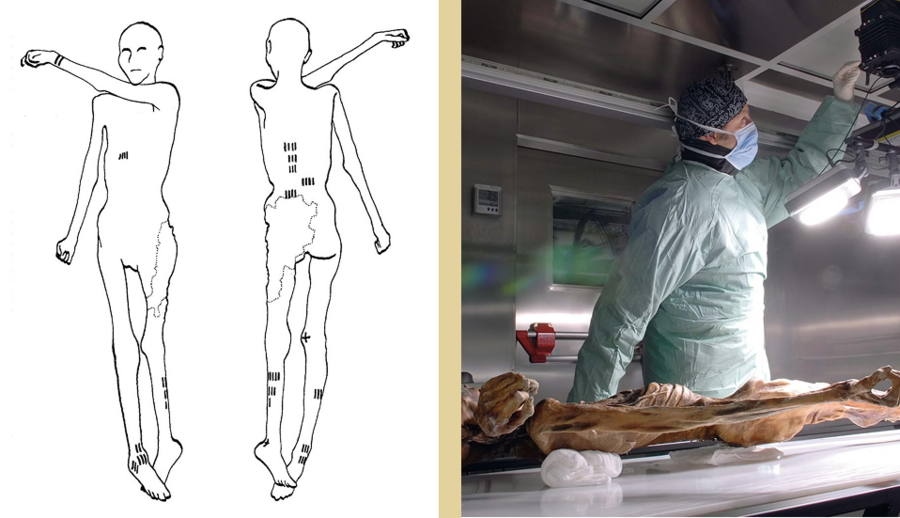
Nevertheless, in 1981, the Atapu mummy, also known as the Yeti, was discovered in the Alps. This individual lived during the Chalcolithic period, 5,300 years ago. Sixty-one tattoos were preserved on his skin. Through analysis, researchers determined that Atapu’s tattoos are the oldest known surviving tattoos in the world. The designs were placed on areas of the body that were predominantly covered by clothing, leading to the hypothesis that their purpose was not ornamental. One theory suggests the tattoos were made for medical purposes. This is supported by the fact that Atapu was approximately 46 years old at the time of his death. He showed degenerative changes in his joints and spine. The placement of some of the tattoos corresponds to areas that could have caused pain.
Tattoos were created using the «handpoke» technique—piercing the skin with a sharp object and rubbing charcoal into it. Analyzing the patterns, one can observe that most of them consist of groups of parallel lines. As an ornament, they possess rhythm within each group and repetition. The number of lines varies: only 2 are present on the left wrist, while 7 appear on one section of the left calf. Cross-shaped symbols are also encountered. If one adheres to the hypothesis of medical purposes, it can be suggested that the number of lines depended on the area of the affected zone.
Two Gebel el-Hair mummies—a woman and a man who lived around the same time as Etci, but in the hot climate of Egypt—serve as another example of ancient tattooing. In 2018, infrared imaging allowed researchers to document the ornaments on the mummies' bodies. It was discovered that the man’s patterns are the oldest recorded figurative tattoos. They were likely created using soot from fire, most likely with a needle made of copper or bone.
It is interesting to note the varied nature of the tattoos. The male tattoos are figurative, depicting, presumably, a Berber sheep and a wild bull with horns. It can be inferred that such figures may have symbolized courage and masculinity.
The female tattoos, however, have a different character: they are ornamental. On the mummy’s right arm is a motif made of S-shaped symbols. Slightly below this is an angular symbol, often found on ceramics from Predynastic Egypt. This sign could represent a curved staff and symbolize status or power, or it might be a stick used in ritual dances. This detail suggests that the tattoo was part of the culture’s visual language—similar symbols have been observed on both everyday objects and the human body.
Intricate patterns can be seen on a 3,000-year-old mummy of a woman from Deir el-Medina, Egypt. Thirty tattoos were discovered on her torso. During the analysis of the tattoos, researchers determined that the woman was connected to religion and possibly performed rituals.
Upon close examination of the nature of the tattoos, one can identify a repetition of motifs and the symmetrical placement of certain symbols. The markings on the neck are symmetrical and arranged in two rows. The ornamental quality is evident here through the recurrence of motifs and their symmetrical arrangement. On the neck, the symbols form two rows. Additionally, lotus flowers, connected by dots, are symmetrically positioned around the waist.
Thus, the body becomes a canvas for numerous patterns. Researcher Ann Austin, who discovered the tattoos, suggests they may have served a protective function and been connected to the cult of the goddess Hathor. The repeating images of the Udjat eyes on the neck, shoulders, and back, appearing as if they are turned in different directions toward adversaries, symbolically guard the woman.
Body Ornamentation as Tradition
Body ornamentation can be an element of cultural tradition. Passed down from one generation to the next, these motifs and application methods preserve notions of beauty, beliefs, and an individual’s belonging to a community.
Amazigh Tattoos
Photographs of tattooed women from North Africa, by Yumna Al-Araishi
In North Africa, female tattooing was a tradition among the Berbers (Amazigh). It was so deeply woven into people’s lives that a woman without tattoos could be considered less feminine by society. Tattoos were applied at different stages of life—marking transitions into adulthood, marriage, and motherhood. The tattooing process was part of female socialization, and the patterns themselves formed a sacred system of signs, expressing the woman’s connection to the universe, experience, and the wisdom of generations. Today, tattoos are most commonly seen on elderly Berber women who work in agriculture. And the tradition of tattooing is fading.
Berber tattoo by Elena Pchela
Symbols are typically geometric, simple, and placed in specific body zones. They carry various meanings related to protection, fertility, identity, and homeland. In some instances, tattoos may also be used for medical purposes. Similar symbols to those found in patterns on everyday objects—dots, lines, crosses, circles, chevrons, and stars—are used in the ornamentation. Among the most common Berber motifs are the Sun, the Moon, flies, and the grouse eye.
Tattoo Motifs of the Chaouia. Illustration from the article by T. Rivière and J. Foble, «Les tatouages des Chaouia de l’Aurès, ” 1942.
Using the examples of tattoos from the Chaouia people of Oran, Algeria, one can observe how natural imagery is conveyed through geometric forms and symmetry. For instance, diamond motifs symbolize the grouse’s eye. The sun symbol is represented by a circle with lines radiating from it. Simple elements are combined into complex motifs: the «Hand of Fatima» composition consists of several connected diamonds of varying sizes from which lines with fine etchings emerge symmetrically.
Sichuan