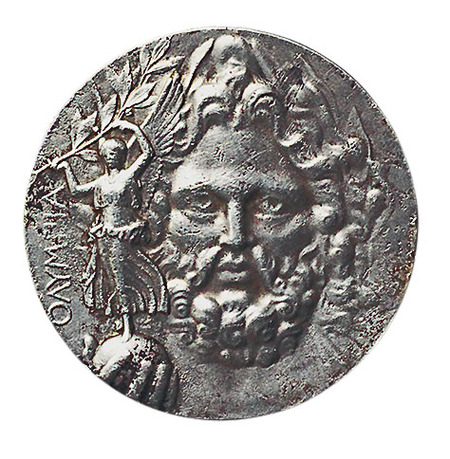
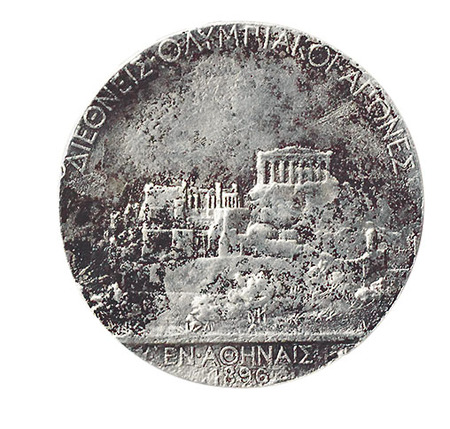
Award Medal For 1st Place Silver Diameter: 48 mm Thickness: 3.8 mm Weight: 60 g
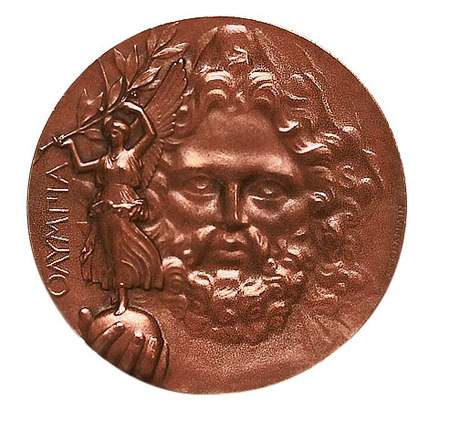
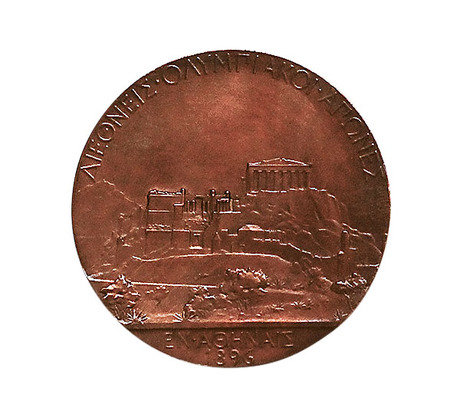
Award Medal Second Place Bronze Diameter: 50 mm Thickness: 3.8 mm Mass: 69 g
Design: Jules-Clément Chapelain (France)
Obverse: A copy of the head of Zeus by Phidias, crowned with an olive branch. To the left on the sphere stands the goddess of victory Nike, holding an olive branch in her raised hand. The name of the city of Olympia, where the first Panhellenic athletic games—which have since been called the Olympic Games—were held, is inscribed along the rim of the medal.
Reverse: A panorama of the Athenian Acropolis, with the inscription written in Greek circling above at the top: ΔΙΕΘΝΕΙΣ · ΟΛΥΜΠΙΑΚΟΙ · ΑΓΩΝΕΣ (International Olympic Games). Below the medal are indicated the location and date of the games: ΕΝ · ΑΘΗΝΑΙΣ · 1896 (In Athens 1896).
THE VERY FIRST CHAMPION
Track and Field: Triple Jump
James Connolly
James Connolly (October 28, 1868– January 20, 1957). American track and field athlete. Olympic Champion (1896), silver medalist (1896, 1900), and bronze medalist (1896) in the Olympic Games.
The American track and field athletes who arrived in Greece for the first Games overlooked one vital detail: Greece was still operating on the Julian calendar. The athletes expected to have another 12 days to prepare for the competition, but they had to compete the day after their arrival. Furthermore, Connolly discovered that the Olympic rules for the triple jump differed significantly from those he was accustomed to in the United States. However, the organizers turned a blind eye to the American’s unique jumping style, especially when he «soared» to 13.71 meters. His main competitor, the French athlete Alexandre Tüfferi, jumped a meter short. In Athens, Connolly also managed to participate in two other track and field events: long jump and high jump. Fortune smiled upon him here as well—he received bronze and silver medals in the competitions.
A Difficult Ascent to Olympus
To become the first Olympic champion, the American had to exert titanic efforts. Because Harvard, where he was studying, refused to grant Connolly the eight-week leave necessary for the trip to Athens, he filed for withdrawal. The Boston Athletic Association covered the travel costs for the 11 top American track and field athletes, but it lacked the funds to send the U.S. triple jumper to Greece. Connolly managed to scrape together part of the necessary sum through donations, invested all his savings in purchasing a ticket on a German cargo steamer, but two days before departure, he injured his back during training. During the 17-day voyage, the American recovered, but the bad luck continued: upon landing in Naples, he discovered his wallet had been stolen.
After winning the Olympics, Connolly attempted to run for the U.S. Congress twice, but both attempts were unsuccessful.
Fruitful Marinist
Returning to America from Athens, Connolly sharply altered his life trajectory—becoming a journalist and writer. His frontline correspondence from the Spanish-American War of 1898 was warmly received by readers of the Boston Globe, but his impressions of the 1908 London Olympics proved so unfavorable to the arrogant hosts that Connolly hesitated to publish them. Over the years, James dedicated more and more time to literary work—he printed about 200 short stories and over 25 sea novels. Yet, today, no one recalls the author of works such as Seiners, Trawler, and Submarine Hunters, published by Charles Scribner’s Sons. On the contrary, the first champion of the Games is remembered.
James Connolly was primarily known as a writer in his later years.
Enmity until the very end
Until his dying day, James Connolly could not forgive the Harvard University administration for denying him permission to compete in the Olympic Games in Greece. Upon his arrival from Athens, the champion decided not to return to classes. In 1949, Harvard finally tried to make peace and offered him the title of Doctor of Humane Letters, but Connolly firmly refused.
GERMAN MULTI-TASKER
Gymnastics: team exercises on parallel bars and high bar, vault.
Greco-Roman Wrestling
Carl Schumann
Carl Schumann (May 12, 1869– March 24, 1946). A German track and field athlete, wrestler, gymnast, and weightlifter. Four-time Olympic champion (1896–1936).
The Spiridon Lewis Greco-Roman wrestling tournament, held in the «sandbox» of the Panathenaic Stadium, unfolded most dramatically for the 26-year-old athlete. In the first match, Schuman defeated the Scot, Lonceston Elliot, with relative ease—Elliot was notably larger than his opponent (weight classes did not exist in the first Games). However, the loser was dissatisfied with the judges' decision, believing they signaled the end of the bout too early. Elliot contended that he made contact with his shoulder, not his back. The dispute became protracted and required the intervention of one of the Greek princesses, who escorted the irate Briton off the mat.
Unforeseen delays meant that the final bout between Schuman and the Athenian baker Georgios Titas began closer to evening. Since there was no time limit for the match, it only concluded after one of the wrestlers laid the other on their back. Neither Schuman nor Titas could accomplish this in 40 minutes, and meanwhile, it was beginning to darken. The judges decided to postpone the meeting until the next day. In the morning, Schuman required 15 minutes to secure a clean victory: he unsettled his opponent and then pinned him from the «bridge» position.
His victory brought Shuman a fourth gold medal in the Games. King George I of Greece, presenting him with the award, said, «You are now the most popular person in our country—more popular than I am.»
Fourth or fifth
In Athens, the German all-arounder entered multiple events. In addition to the artistic gymnastics—his supposed specialty—he competed in track and field events: triple jump, long jump, and shot put. However, he did not place higher than fifth. On one day, Schumann challenged the weightlifters competing in the two-hand clean and jerk. There, he placed fourth, sharing the position with the Greek athlete Papasideris.
Internationalists—out!
Upon returning from Athens, all members of the German delegation, including Schumann, were expelled from the German Gymnastics Association, which held conservative views, for «participating in athletic competitions promoting internationalism.»