Deconstructing the «Fourth Wall»: Visual Techniques of the Model’s Direct Gaze at the Viewer in 15th–18th Century Portraiture
I. Concept and Topic Selection
Rationale and Relevance of the Topic
In classical art history, portraits are most often analyzed through the subject’s social status, attributes, or biography. In this study, I shift the focus to the very mechanics of contact between the painting and the viewer—how artists deconstruct the «fourth wall.» By tracking how the model’s direct gaze has evolved over four centuries (15th–18th centuries), one can observe hidden compositional techniques by which the artists manage our attention.
Key Question
How exactly—through head turn, pupil direction, compositional axes, and the play of light and shadow—did artists transform the gaze of a painted figure into a tool for direct interaction with the viewer?
Hypothesis
The direct gaze in portraiture evolved from the calm, almost documentary fixity of the Renaissance to the intense spatial «challenge» of Baroque art, and subsequently to the light, theatrical play of the Rococo and Enlightenment eras. By altering the angle of the eyes relative to the turn of the shoulders and introducing pinpoint highlights of light, masters gradually shifted the role of the viewer itself: from an external observer (15th century), the viewer transformed into an unwitting participant in the drama (17th century), and later—into a conversational partner in a societal dialogue (18th century).
Materials and Chronological Frameworks
For this analysis, I selected key portraits from Western European painting spanning the 15th to the 18th centuries—ranging from the Northern and Italian Renaissance through Baroque, Caravaggism, Rococo, and the Enlightenment. The primary selection criterion was the model’s gaze, directed strictly toward the viewer.
Navigation
I. Concept and Topic Selection
II. Observational Study: Stasis and Sacral Centricism in XV–XVI Century Portraits
III. Provocational Study: The Baroque Breakthrough of Spatial Boundaries in the XVII Century
IV. Playful Study: Courtly Dialogue and Coquetry in XVIII Century Art
V. Conclusion and Bibliography, Image Sources
II. Document View: Statics and Sacral Centricity in 15th–16th Century Portraits
In the era of the Early and Northern Renaissance, the emergence of a direct gaze toward the viewer held the weight of a legal and existential testament. The model asserts its presence in the world, conveying monumentality and inner tranquility. The optical axes are precisely calibrated, and the eyes become the compositional center of the canvas.
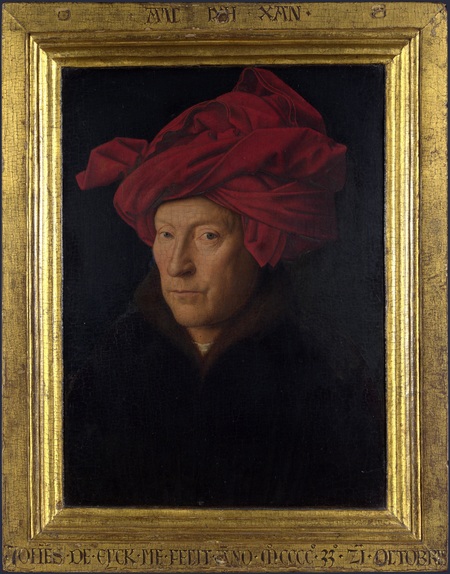
Jan van Eyck. Portrait of a Man in a Red Turban (Presumably a Self-Portrait). 1433. National Gallery, London.This painting is considered the earliest portrait in European Renaissance art where the model’s gaze is directed straight at the viewer. Van Eyck solves an incredibly complex spatial problem: the character’s head is turned three-quarters, yet the optical axis of the eyes is slanted directly toward us. This creates the famous «haunting gaze» effect. The eyes are rigidly fixed; they seem to document the mere fact of the person’s existence.
«For the first time, we are confronted by a living gaze from depths of ages directed right at us, breaking down the barrier of time» [1].
A detail from Jan van Eyck’s painting, «Portrait of a Man in a Red Turban.»
Upon close examination of the painted surface, it becomes clear exactly how Van Eyck ignites this gaze. He applies the thinnest dots of white—points of light—onto the moist surface of the pupil. These microscopic points of light capture the viewer’s gaze, regardless of where in the room they are looking at the painting. The gaze here is not an emotion, but a tool for optical fixation.
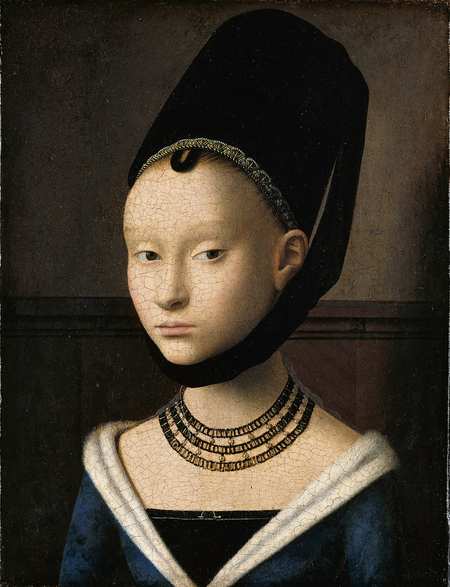
Petrus Christus. Portrait of a Young Woman. Circa 1470. Berlin Picture Gallery, Berlin.This masterpiece of early Netherlandish painting exhibits a meticulously constructed geometry in the gaze. The woman’s face is offset from the canvas’s central axis, yet her gaze is directed squarely at the viewer. The artist uses a subtle tilt of the model’s head to offset the static quality of the frontal pose. The eyes are rendered with thin, almond-shaped lines, and the eyelids are half-closed. This creates an effect of cool, detached observation of the beholder, which underscores the model’s high aristocratic status.
Detail from Petrus Christus’ painting, «Portrait of a Young Woman.»
Macro analysis reveals that Christus virtually strips the model’s pupils of bright specular highlights, rendering them matte and deep. This radically distinguishes his approach from Van Eyck’s method. The absence of highlight removes the illusion of a «living» shimmer, transforming the gaze into a frozen, idealized mask that documents the heroine’s unattainable social status.
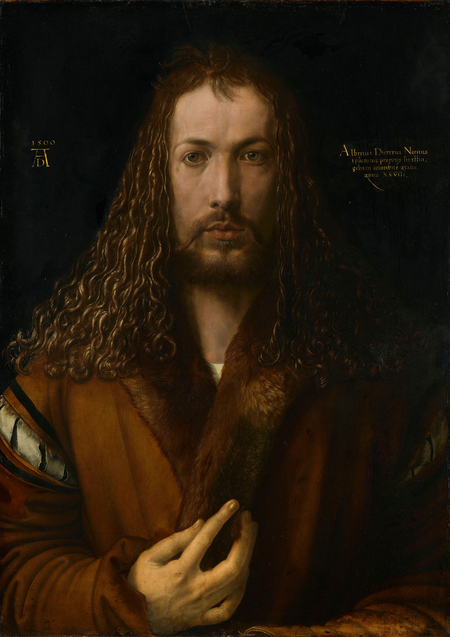
Albrecht Dürer. Self-Portrait at Twenty-Eight. 1500. Alte Pinakothek, Munich.Dürer pushes the concept of the «documentary gaze» to its absolute, sacred peak. He employs a strictly frontal composition, which until the 15th century was permissible only when depicting icons of Jesus Christ. The optical axis of the gaze aligns with the painting’s central axis of symmetry. Dürer’s gaze is directed not simply at the viewer, but «through» them—into eternity. This technique elevates the artist’s personality to the status of a demigod, a Creator.
Antonello da Messina. Portrait of an Unknown Man. c. 1475. Borghese Gallery, Rome.
The Italian master Messina uses a dark, deep background to isolate the model’s face. Light falls from the left, sharply defining the contours of the eye sockets. The model’s direct gaze is accompanied by a subtle half-smile. However, note the geometry: the lower eyelids are rendered with a strict horizontal line, lending severity to the gaze despite the slight benevolence of the lips. The fourth wall isn’t broken; it merely thins out.
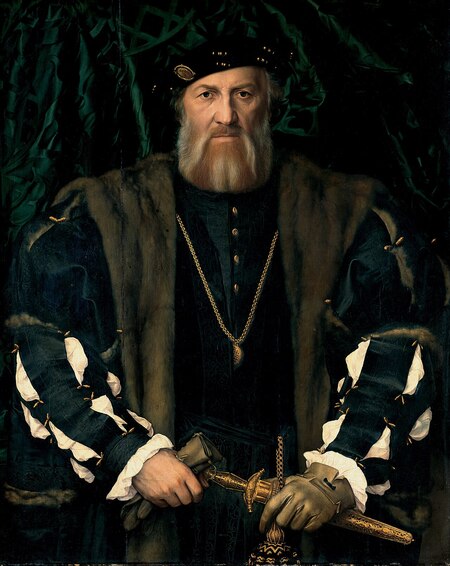
Hans Holbein the Younger. Portrait of Charles de Sole, Signore de Moret. 1534. Old Masters Gallery, Dresden.Holbein was a master of representation during the Northern Renaissance. In this portrait, the direct optical axis of the gaze is rigidly linked to the monumental silhouette of the body. The model is inscribed within a stable rectangle, and the eyes are placed strictly in the upper third of the canvas, intersecting the vertical axis of symmetry. De Sole’s gaze lacks psychological reflection; it is absolutely monumental, calm, and monumentally fixes the presence of the French diplomat in space and time.
Compositional grid of a portrait by Charles de Sologne
The analytical diagram proves that Holbein intentionally aligns the model’s optical focus of the eyes with the intersection points of the canvas’s compositional guidelines. The gaze becomes the keystone of the entire visual structure: if the viewer mentally removes this direct visual confrontation, the painting dissolves into disparate decorative planes of costume and background.
III. A Challenging Gaze: The Baroque Breakthrough in Spacial Boundaries in the 17th Century
In the 17th century, Baroque art and Caravaggism radically changed the rules of the game. The gaze ceased to be static; it became a dynamic vector that pierced the picture plane and drew the viewer into the tumultuous narrative. Characters catch our eye randomly, making ironic comments, issuing threats, or demanding assistance.