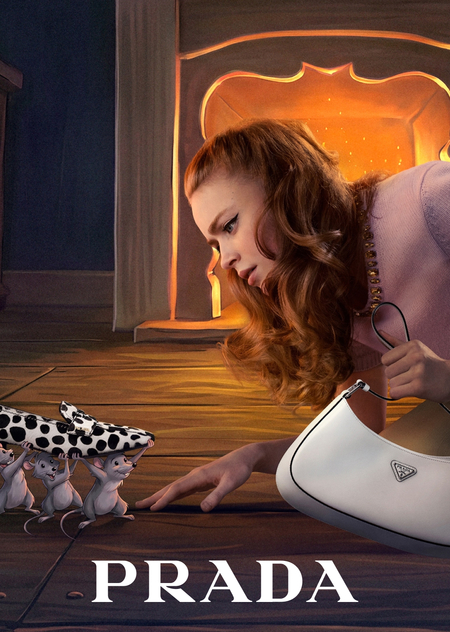
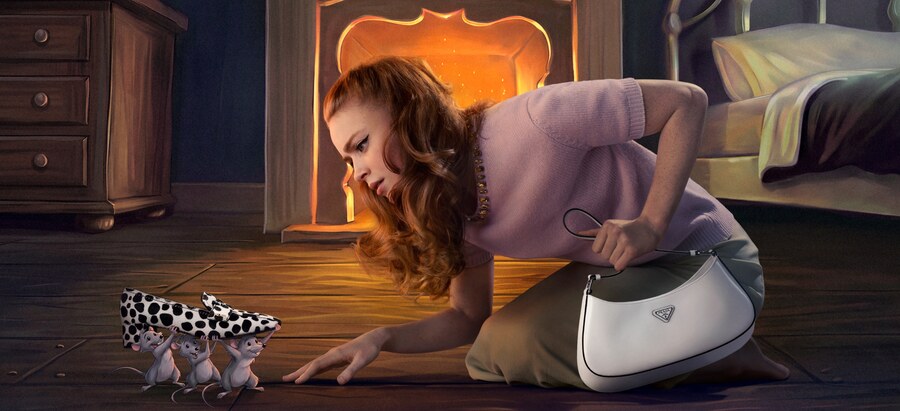
«Drawing Prada: Animated by Hand, ” Prada, 2026.
Why are leading fashion houses returning to the pencil in 2026? And why are some praised for this while others are accused of deception?

In the past two years, AI-generated imagery has noticeably transformed holiday advertising. Coca-Cola re-edited its Christmas commercial twice using AI, McDonald’s in the Netherlands released an AI-generated film just three days after filming, and the term «neuralop» has become derogatory. Concurrently, viewer behavior has shifted: beautiful visuals are now scrutinized for flaws—detecting extra fingers, «swimming» backgrounds, or overly smooth skin. The image no longer inherently proves that a human was behind its creation. For a designer, this is a significant shift because value is gradually moving from the final product to the process of its making.
In the fall of 2026, Prada released its holiday campaign, «Drawing Prada: Animated by Hand.» It was hand-drawn by animators under the direction of John Pomroy, who has worked at Disney for many years. The brand presented not only the finished videos but also sketches, rough animation, and a documentary about the production. A week later, Dior released a animated short by Sylvain Chome, only to face immediate accusations that parts of the footage were touched up by an AI. Both brands gave the audience the same promise, but the reaction proved to be opposite. This contradiction became the starting point for my research.
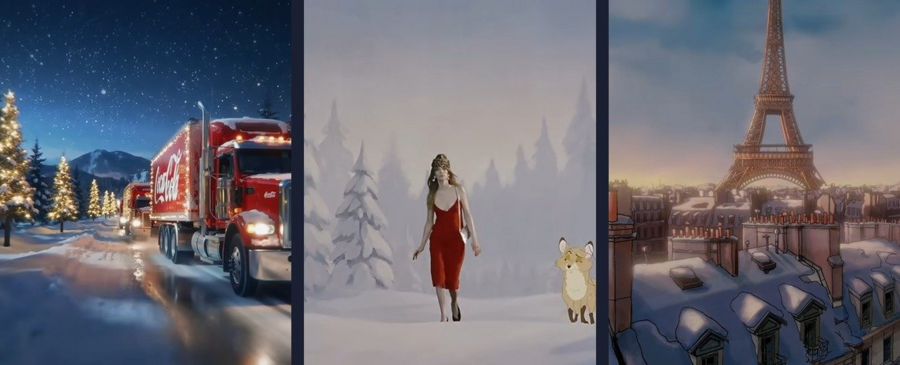
Stills from the videos: «Holidays Are Coming, ” Coca-Cola, 2025 / „Drawing Prada: Animated by Hand, ” Prada, 2026 / „Christian Dior’s Night in Color, ” Dior, Dir. C. Schome, 2026.
The subject of this research is the «Drawing Prada» campaign. For comparison, I am referencing the Dior film «Night in Color, ” AI videos from Coca-Cola and McDonald’s, as well as a 1995 Coca-Cola holiday commercial that an AI reassembled thirty years later. From these commercials, I select frames that allow for an assessment of the image creation method: line, hands, faces, and fine details. I am not examining the plot, music, or acting because my interest lies in what the viewer trusts visually. I compare Prada and Dior frames in pairs to illustrate where a hand-drawn line is visible and where viewers detect signs of an AI.
The research progresses from the general to the specific. First, I describe the context in which the campaign emerged, followed by the brand and the visual language of the commercials. After that, I analyze the techniques used to influence the viewer and explain why it is so crucial for Prada to showcase the creation process. The Dior case is considered a counterexample, while Coca-Cola serves as an exception to the rule. In conclusion, I propose alternative approaches each brand could have taken. The theoretical framework is built upon the works of Walter Benjamin, Thorsten Weber, and studies in perception psychology. Factual information is drawn from brand materials, author interviews, and viewer reactions found in articles and video analyses. The allegations against Dior are not proven, so I describe them as observations made by viewers rather than as established fact.
In the age of neural networks, true luxury is no longer the manual labor itself, but the opportunity to witness and verify it.
To understand why the Prada image has become so sought after, we must describe the context in which it emerged. In November 2024, Coca-Cola released an AI-generated version of the «Holidays Are Coming» film, and another one a year later. In December 2025, McDonald’s in the Netherlands published a Christmas film entirely created by a neural network, only to retract it three days after a wave of criticism.
«Holidays Are Coming, ” Coca-Cola, 2025. Video excerpt
Upon frame-by-frame review, characteristic glitches become evident in these videos. The truck wheels do not roll through the snow; instead, they appear to slide as if overlaid on the road. The lighting remains uniformly soft across all frames and lacks any incidental shadows. The animals display human-like smiles, yet their facial expressions remain static. Formally, the imagery is correct, but it lacks a sense of life.
Japanese robotics expert Masahiro Mori described the «uncanny valley» effect back in 1970: the more an artificial face resembles a human one, the more painfully noticeable any slight inaccuracy becomes (Mori, 1970). A drawn mouse does not evoke unease, but a nearly realistic bear with a human smile does. The viewer may not always be able to articulate what is wrong, but they sense the deception and lose trust in the entire video after finding the first error.
Even in the most perfect reproduction, one moment is missing: the here and now of the artwork.
Benjamin wrote this in 1936 about photography and cinema: the copy loses its «aura”—that is, the unique presence of the work. A neural network creates not a copy, but an image devoid of an original. Such an image has no „here and now, ” no author, and no traces of labor. This is precisely why, against this backdrop, any human trace becomes valuable: an uneven line, a brushstroke, a draft.
A beautiful image proves nothing. The proof lies in the hand behind it.
Prada, the Milanese fashion house, is currently led by Miuccia Prada and Raf Simons. The brand has long cultivated an image of intellectual luxury, where irony and artistic references take precedence over the direct display of wealth. The festive campaign for 2026 continues this trajectory. Ferdinando Verderi served as the art director, with Glen Lockwood as photographer and director, and John Pomroy—known for his work on «Pocahontas» and «Fantasy 2000”—directed the animation. The videos feature Sadie Sink, Maya Hawke, Kelvin Harrison Jr., Luther Ford, and Chen Haoyu.
Hand illustration is the true star of the campaign
Notably, the brand names the central protagonist not the actress nor the bag, but the drawing technique itself. The campaign includes five short films, a series of photographs, and a separate film about the creative process. Each clip runs for about thirteen
seconds and follows a consistent pattern: an animal appears next to the protagonist, something unexpected happens to the Prada item, and then the world freezes again.
«Drawing Prada: Animated by Hand, ” Prada, 2026. Still life photography on a painted background.
The product photography is structured differently. Typically, the bag is photographed against a neutral background so that nothing distracts from the product. At Prada, the shoes and bags are set in painted snow, and on some shots, pencil markings are visible behind them. The item seems pasted into an illustration, and the brand doesn’t hide that seam.
The plot of the Prada videos is extremely simple. What captures attention is something else: the line drawn by the hand.
«Drawing Prada: Animated by Hand, ” Prada, 2026. Video excerpt
The fox’s outline in this frame barely jitters; the line weight changes along the curves, and the tail lags behind the body’s movement by a fraction of a second. The pace accelerates and then almost halts—this is how the animator conveys the character’s weight and personality. The neural network operates differently; its lines are uniformly smooth, and the motion is even, like a puppet’s. The imperfection in hand-drawn animation is not a flaw, but an authorial signature.
To test this impression, I isolated the primary colors from two campaign shots. Prada features warm brown and ochre tones juxtaposed with a cool grey-blue snow, reminiscent of classic Disney backgrounds painted with gouache. In the Coca-Cola AI video, nearly the entire palette is reduced to shades of a single dark blue. The image is saturated but emotionally flat—it lacks the contrast between warm and cool tones that conveys a sense of coziness.
The animals in the campaign are drawn according to the rules of classic animation: large eyes, a large head, and short legs. The mice haul the shoe like a treasure, the lynx reaches for the bag, and the fox accompanies the heroine through the woods. The Prada items are not displayed in a window; they are hunted. This is how the brand conveys desire—not with words, but through characters to whom the viewer already feels affection.
«Drawing Prada: Animated by Hand, ” Prada, 2026. Stills from the videos