Concept
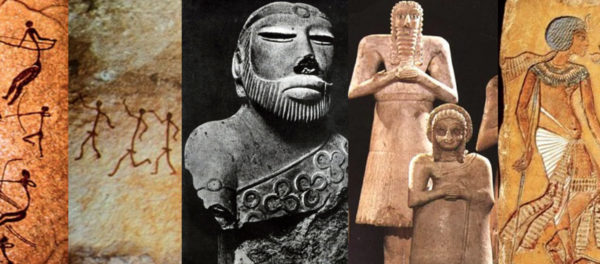
Humans learned to depict motion long before the invention of devices to reproduce moving images. People have always sought to capture the world around them not just as it looks, but as it feels in motion. The run of an animal, the flap of a bird’s wing, a dance, a battle, the transition from day to night—these are phenomena that cannot be fully conveyed by a single static image. However, long before the advent of photography, cinema, and digital animation, people were already searching for ways to overcome the limitations of a fixed picture.
What is meant by the term «animation»?
When discussing the creation of moving images before the advent of modern technologies necessary for their reproduction, it is important to precisely define which phenomena and for what reasons will be considered animations or related phenomena, or their precursors, in the ensuing narrative. When discussing the creation of moving images before the advent of modern technologies necessary for their reproduction, it is important to precisely define which phenomena and for what reasons will be considered animations or related phenomena, or their precursors, in the ensuing narrative.
Defining Animation
Animation (from Latin animatio—animation, revitalization, from anima—soul; German) is an audiovisual art form centered on the illusion of animation within three-dimensional or two-dimensional images or objects created by the artist, or objects from the real world captured frame-by-frame on film or digital media. In Collier’s encyclopedia, animation is defined as a technology that allows the illusion of movement to be created using inanimate, stationary objects. The most popular form is animation (or 'cartoons'), which consists of a series of drawn images. In both definitions, key characteristics of animation are the «illusion of movement» and the use of a sequence of static images—a framework I will rely on when examining artworks going forward.
Therefore, in this study, animation will be examined primarily as an illusion of motion, generated by the sequence of images capturing individual phases of an action or event.
From this definition, two concepts deserve particular emphasis: 1. Sequence — while viewing, the audience can perceive individual images as continuous motion. 2. Temporal Proximity — successive images capture phases of motion, action, or an event that are relatively close in time to one another.
The study also includes a range of historical works that are not technically animation, as they do not involve the direct transition of frames or create the optical illusion of continuous motion. Nevertheless, they share significant structural and semantic similarities with animation and are crucial for understanding the history of this phenomenon.